Gardenia cornuta
Hemsl.
Natal Gardenia
iNaturalist· cc-by
(c) Jesús Cabrera, some rights reserved (CC BY)
iNaturalist· cc-by-nc
(c) magdastlucia, some rights reserved (CC BY-NC)
iNaturalist· cc-by-nc
(c) magdastlucia, some rights reserved (CC BY-NC)
Summary
Source: WikipediaGardenia cornuta, commonly known as Tonga gardenia, Natal gardenia or horned gardenia, is a species of flowering plant in the family Rubiaceae. It is native to southern Africa. Though specimens were collected in 1870, the species was not described until 1906.
Description
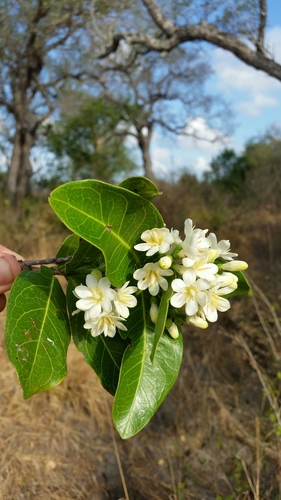
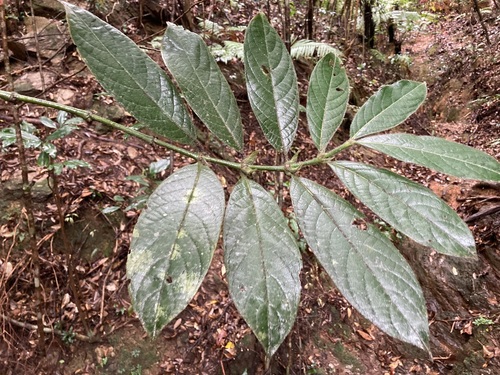
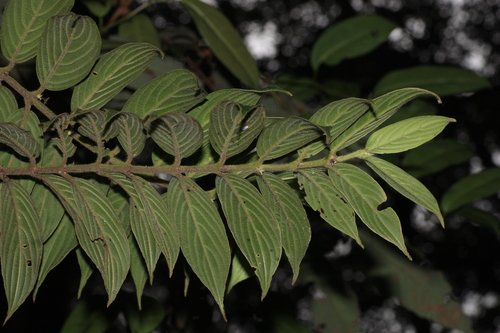
A dense rounded shrub. It grows 5 m tall. The leaves are glossy and light green. The flowers are large and white and showy. The fruit are large and oval and shiny. They turn yellow as they ripen.
Edible Uses
The fruit is eaten as a snack and is used as a famine food.
Traditional Uses
The fruit is eaten as a snack.
This uses section is brief — help expand it
Distribution
It is a subtropical plant. It grows in grassland and in open woodland. In Brisbane Botanical Gardens.
Where It Grows
Africa, Australia, East Africa, Eswatini, Mozambique, South Africa, Southern Africa, Swaziland, Zambia,
Cultivation
Plants are grown from seeds.
Other Information
It is a famine food.
References (6)
- Fox, F. W. & Young, M. E. N., 1982, Food from the Veld. Delta Books. p 320
- https://growwild.co.za Edible Indigenous plants
- Joffe, P., 2007, Creative Gardening with Indigenous Plants. A South African Guide. Briza. p 227
- Long, C., 2005, Swaziland's Flora - siSwati names and Uses http://www.sntc.org.sz/flora/
- Ruiters-Welcome, A. K., 2019, Food plants of southern Africa. Ph.D. thesis. Univ. of Johannesburg p 96
Show all 6 references Hide references
- Welcome, A. K. & Van Wyk, B.-E., 2019, An inventory and analysis of the food plants of southern Africa. South African Journal of Botany 122 (2019) 136–179