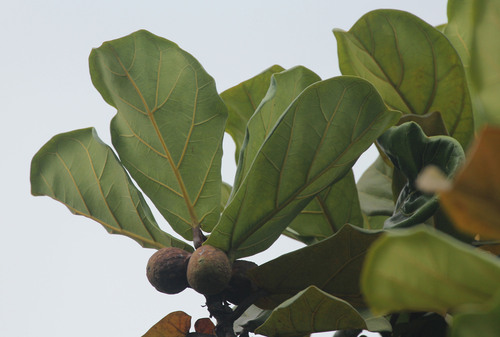
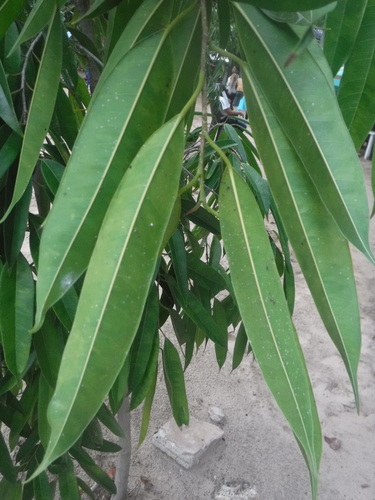
Ficus vogeliana
(Miq.) Miq.
iNaturalist· cc-by-nc
(c) Carel Jongkind, some rights reserved (CC BY-NC), uploaded by Carel Jongkind
iNaturalist· cc-by-nc
(c) Carel Jongkind, some rights reserved (CC BY-NC)
Summary
Source: WikipediaFicus vogeliana is a fig species within the family Moraceae which bears flagelliform infructescences (also called stolon-panicles), found at or just beneath the surface of the soil. When the figs (syconia) are subsurface it is unclear how pollination is accomplished. Its outer bark tends to be greyish, while the slash (cut bark) is reddish.
Description
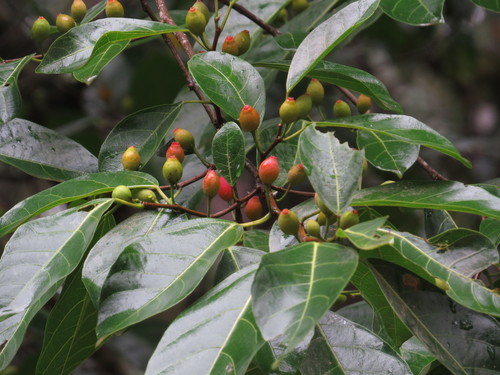
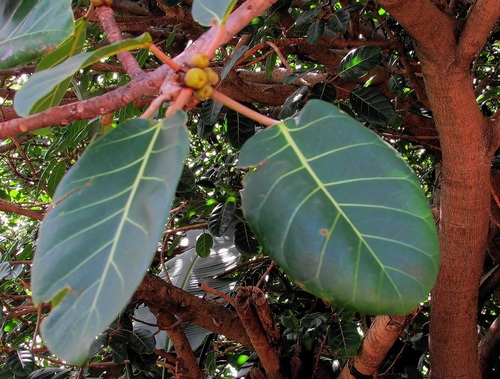
A fig. It is a tree. It grows 5-20 m high. The trunk can be 90 cm across. It can have low buttresses. The fruit develop on the trunk. They can also be on branches along or under the ground.
Edible Uses
The figs are eaten. The red to orange-red, globose fruit can be 20 - 30mm in diameter. The fruits are poduced on massive leafless branches that can be up to 10 metres long, arising from the base of the bole (with the figs on the ground in the leaf litter) or on usually short branchlets on the trunk up to the main branches.
Medicinal Uses
The trunk of the tree is used as raw materials for canoe making in Sierra Leone while its woods is useful for carpentry work. A decoction of bark extracts is used in traditional medecine among the Fang of Gabon who drank it as an emetic, another decoction is also used in the treatment of stomach cancer, while a leaf decoction is used in Gabon to induce vomiting.
Distribution
A tropical plant. It grows in evergreen forests in moist swampy areas in West Africa.
Where It Grows
Africa, Angola, Benin, Burkina Faso, Congo DR, Congo R, Côte d'Ivoire, Ghana, Guinea, Guinée, Ivory Coast, Liberia, Nigeria, Sierra Leone, Togo, Uganda, West Africa,
Cultivation
The pollinating wasp is Ceratosolen acutatus Grandi.
Other Uses
Wood ash is used for soap-making. The bark is made into cloth. In Sierra Leone the bark is recorded to be used for dyeing cloth. The reddish wood has a beautiful figure, the texture is coarse. The wood is light in weight and soft. It is suitable for carpentry. Traditionally, the bole is made into canoes. The tree is sometimes retained as a shade tree when land is cleared for cocoa production.
Notes
There are about 800-1000 Ficus species. They are mostly in the tropics. There are 120 Ficus species in tropical America.
Also Known As
Blorh, Bo hu, Domini, Mporo, Opanto
References (8)
- Abbiw, D.K., 1990, Useful Plants of Ghana. West African uses of wild and cultivated plants. Intermediate Technology Publications and the Royal Botanic Gardens, Kew. p 47
- Burkill, H. M., 1985, The useful plants of west tropical Africa, Vol. 4. Kew.
- Dalziel, J. M., 1937, The Useful plants of west tropical Africa. Crown Agents for the Colonies London.
- Jardin, C., 1970, List of Foods Used In Africa, FAO Nutrition Information Document Series No 2.p 138
- Le Houerou, H. N., (Ed.), 1980, Browse in Africa. The current state of knowledge. International Livestock Centre for Africa, Ethiopia. p 163
Show all 8 references Hide references
- Peters, C. R., O'Brien, E. M., and Drummond, R.B., 1992, Edible Wild plants of Sub-saharan Africa. Kew. p 152
- World Checklist of Useful Plant Species 2020. Royal Botanic Gardens, Kew
- www.figweb.org