Artocarpus hirsutus
Lam.
Wild jack fruit
iNaturalist· cc-by
(c) Siddarth Machado, some rights reserved (CC BY), uploaded by Siddarth Machado
iNaturalist· cc-by
(c) Siddarth Machado, some rights reserved (CC BY), uploaded by Siddarth Machado
iNaturalist· cc-by
(c) Siddarth Machado, some rights reserved (CC BY), uploaded by Siddarth Machado
Summary
Source: WikipediaArtocarpus hirsutus, commonly known as wild jack, is a tropical evergreen tree species that is native to India, primarily in Kerala, but also in Karnataka, Maharashtra and Tamil Nadu, where it grows in moist, deciduous to partially evergreen woodlands.
Description
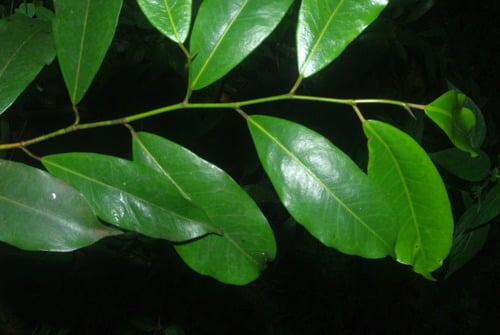
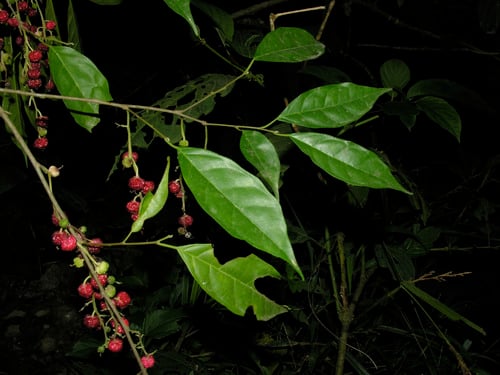
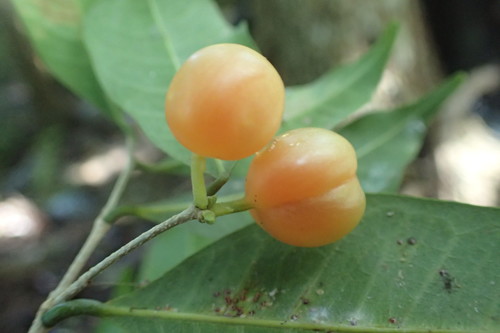
A tall evergreen tree. The young shoots have sharp hairs. The leaves are broadly oval. They are 25 cm long by 14 cm wide. The fruit is oval and has sharp hairs. It is 15 cm long by 10 cm wide. They are orange colour when ripe.
Edible Uses
Unripe fruits are used to make curry. Ripe fruits are eaten raw. Seeds are fried or roasted.
Traditional Uses
The unripe fruits are used for making curry. The ripe fruit are eaten raw. The seeds are eaten. They are fried or roasted.
This uses section is brief — help expand it
Medicinal Uses
The seed is used medicinally.
Distribution
A tropical plant. In grows in evergreen and moist deciduous forest.
Where It Grows
Asia, India, Indochina, Laos, Northeastern India, SE Asia,
Cultivation
A plant of the tropics, where it is found at elevations up to 1,300 metres. It grows best in areas where annual daytime temperatures are within the range 22 - 32°c, but can tolerate 16 - 38°c. It prefers a mean annual rainfall in the range 2,500 - 3,500mm, but tolerates 1,700 - 4,500mm. Older plants succeed in full sun or moderate shade, but younger trees require reasonable levels of shade. Succeeds in most soils, preferably well-drained. Prefers a pH in the range 5 - 6.5, tolerating 4.5 - 7.5. A fast growing tree. Trees do not coppice well, but produce abundant root suckers. The tree has a deep taproot.
Propagation
Seed - best sown as soon as it is ripe. Seedlings do not transplant well and so the seed should either be sown in situ or in deep individual containers.
Other Uses
The concreted juice forms a waxy, tough, light brown substance, which, when melted, is used as a cement to join broken earthen-ware and stoned ware. The heartwood is yellowish-brown; the sapwood white. The wood is moderately hard, durable, it lasts well in water and is not attacked by white ants. A valuable timber, it is used for house and boat building, furniture, etc. The tree is grown to provide shade in coffee plantations and also as an undergrowth in teak plantations.
Production
In southern India plants fruit in January and February.
Notes
There are about 50 Artocarpus species. They are in the tropics and subtropics of Asia and the Pacific.
Also Known As
Aini, Anjili, Ayani, Ayani plavu, Cheenipala, Curipillavu, Habbhalasu, Hebbelsh, Jat malang, Pat-phanas, Pejata
References (22)
- Ajesh, T. P., et al, 2012, Ethnobotanical Documentation of Wild Edible Fruits used by Muthuvan Tribes of Idukki, Kerala-India. International Journal of Pharma and Bio Sciences 3(3): 479-487
- Altschul, S.V.R., 1973, Drugs and Foods from Little-known Plants. Notes in Harvard University Herbaria. Harvard Univ. Press. Massachusetts. no. 691
- Ambasta S.P. (Ed.), 2000, The Useful Plants of India. CSIR India. p 57
- Binu, S., 2010, Wild edible plants by the tribals in Pathanamthitta district, Kerala. Indian Journal of Traditional Knowledge. 9(2): 309-312
- Bircher, A. G. & Bircher, W. H., 2000, Encyclopedia of Fruit Trees and Edible Flowering Plants in Egypt and the Subtropics. AUC Press. p 43
Show all 22 references Hide references
- Chandrashekara, U. M., 2009, Tree species yielding edible fruit in the coffee-based homegardens of Kerala, India: their diversity, uses and management. Food Sec. 1:361-370
- Dobriyal, M. J. R. & Dobriyal, R., 2014, Non Wood Forest Produce an Option for Ethnic Food and Nutritional Security in India. Int. J. of Usuf. Mngt. 15(1):17-37
- Hedrick, U.P., 1919, (Ed.), Sturtevant's edible plants of the world. p 75 (As Artocarpus hirsuta)
- J. B. A. P. M. de Lamarck & L. A. J. Desrousseaux, Encycl. 3:210. 1789 "hirsuta"
- Jose, D. T. & Sasidharan, N., 2016, Checklist of wild edible plants of Aralam Wildlife sanctuary, Kerala, India. South Indian Journal Of Biological Sciences 2016; 2(1); 141‐144
- Khaple, A. K., Gurav, M. & Hubballi, S., Population Studies of Wild Edible Fruit Tree Species in Kodagu. International Journal of Life Sciences Vol. 1 No. 3
- Lungphi, P., Wangpan, T. & Tangjang, S., 2018, Wild edible plants and their additional uses by the Tangsa community living in the Changlang district of Arunachal Pradesh, India. Pleione 12(2): 151 - 164. 2018.
- Narayanan, M. K., R., et al, 2011, Ethnobotanically important trees and their uses by Kattunaikka tribe in Wayanad Wildlife Sanctuary, Kerala, India. Journal of Medicinal Plants research. 5(4): 704-612
- Prasad, P.N., & Abraham, Z., 1984, Ethnobotany of the Nayads of North kerala. J. Econ. Tax. Bot. Vol. 5 No. 1 pp 41-
- Ramachandran, V. S., 2007, Wild edible plants of the Anamalais, Coimbatore district, western Ghats, Tamil Nadu. Indian Journal or Traditional Knowledge. 6(1) pp 173-176
- Ramachandran,V. S., & Udhayavani, C., 2013, Knowledge and uses of wild edible plants by Paniyas and Kurumbas of Western Nilgiris, Tamil Nadu. Indian Journal of Natural Products and Resources. 4(4) December 2013, pp 412-418
- Sasi, R. & Rajendran, A., 2012, Diversity of Wild Fruits in Nilgiri Hills of the Southern Western Ghats - Ethnobotanical Aspects. IJABPT, 3(1) p 82-87
- Sharma, B.B., 2005, Growing fruits and vegetables. Publications Division. Ministry of Information and broadcasting. India. p 71 (As Artocarpus hirsuta)
- Singh, H.B., Arora R.K.,1978, Wild edible Plants of India. Indian Council of Agricultural Research, New Delhi. p 50
- Ravikrishna, S., 2011, Ethno-medico-botanical survey on Wild Edible fruits of Udupi Taluq, Udupi p 57
- World Checklist of Useful Plant Species 2020. Royal Botanic Gardens, Kew
- Yesodharan, K. & Sujana, K. A., 2007, Wild edible plants traditionally used by the tribes in the Parambokulam Wildlife Sanctuary, Kerala, India. Natural Product Radiance 6(1) pp 74-80