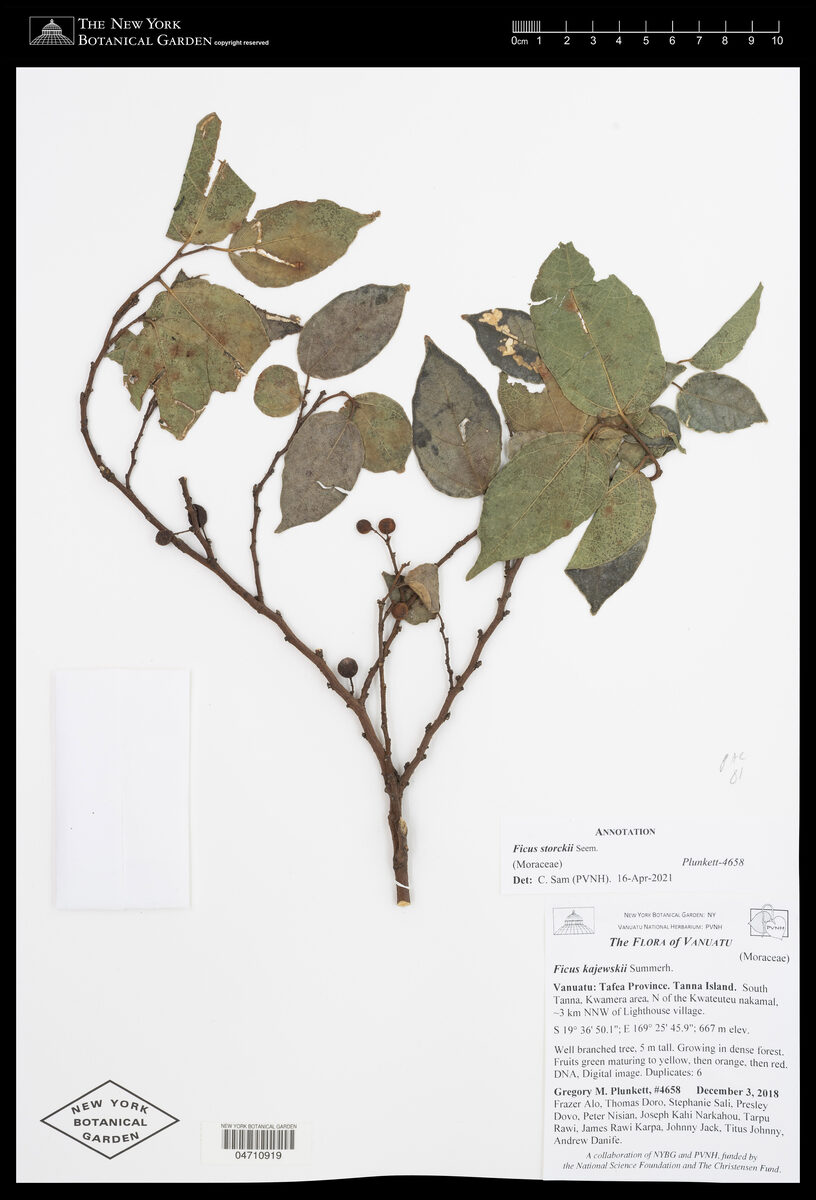
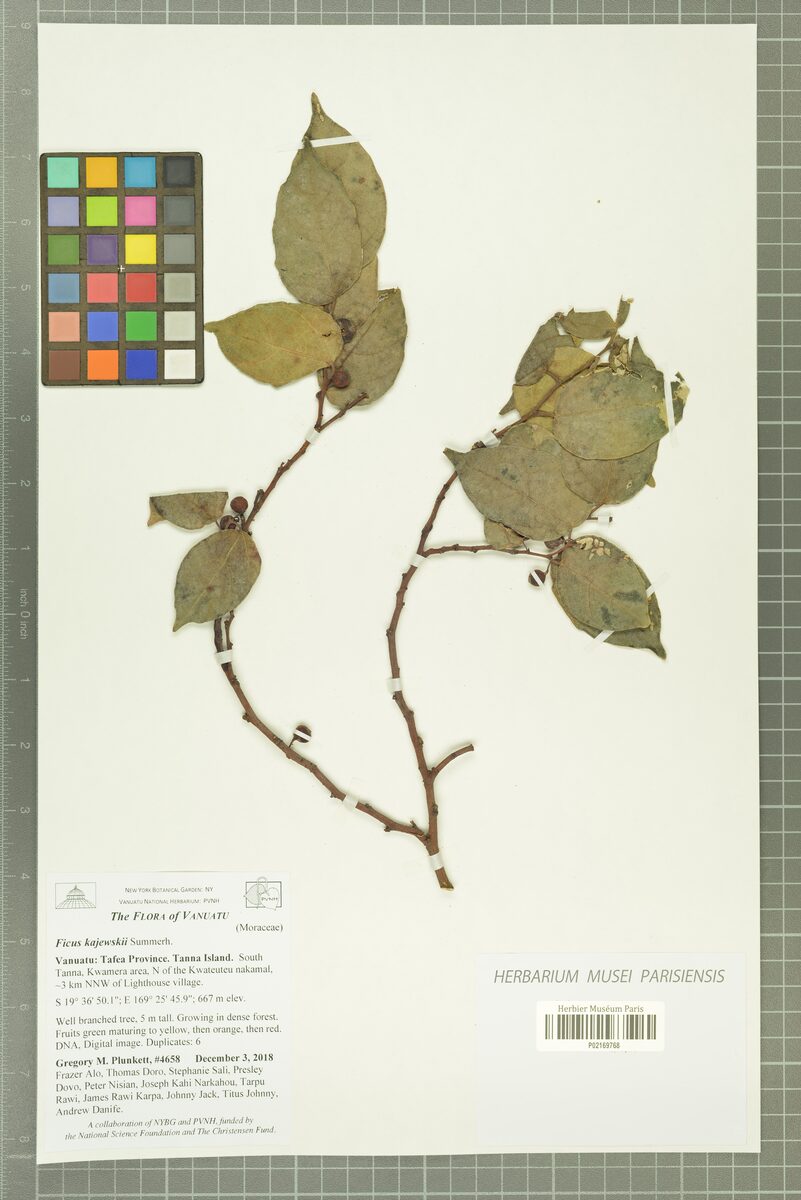
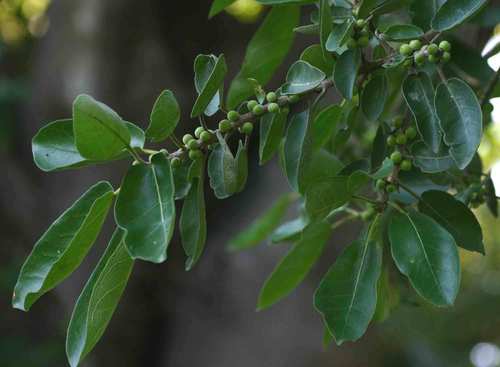
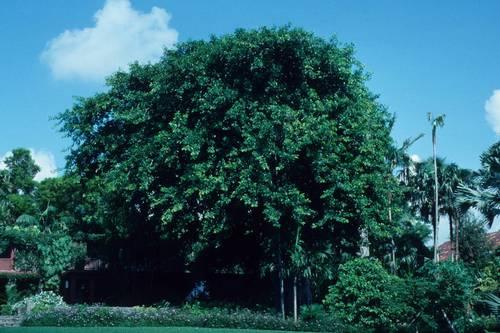
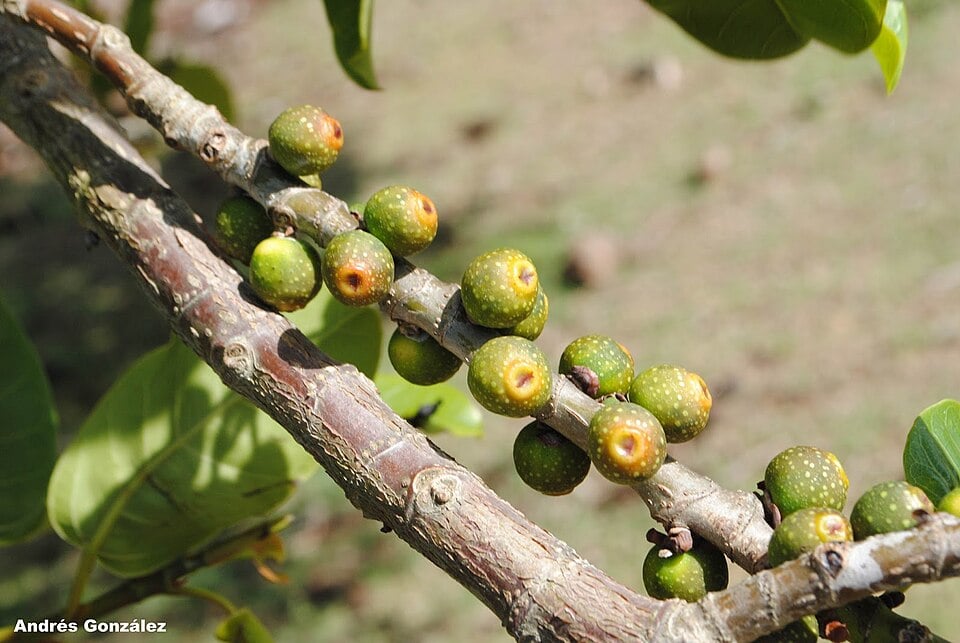
Artocarpus heterophyllus
Lam.
Jackfruit
iNaturalist· cc-by-nc-nd
(c) Brieuc Fertard, some rights reserved (CC BY-NC-ND), uploaded by Brieuc Fertard
gbif· cc-by-nc
riemi
iNaturalist· cc-by-sa
(c) Postdlf, some rights reserved (CC BY-SA)
iNaturalist· cc-by-sa
(c) Yercaud-elango, some rights reserved (CC BY-SA)
iNaturalist· cc-by-sa
(c) Farmfirst, some rights reserved (CC BY-SA)
Summary
Source: WikipediaA fast-growing evergreen tree reaching 15 m (49 ft) in height and spread. Hardy to UK zone 10 and frost-tender. Pollinated by insects and wind. Adapts to light sandy, medium loamy, and heavy clay soils with preference for good drainage; tolerates very alkaline pH. Grows in semi-shade or full sun. Prefers moist soil.
Description
An evergreen tree up to 20 m tall and in the breadfruit family. Trees form many branches but have one or two main trunks. The bark is smooth and dark green. Leaves of young trees have 1 or 2 lobes but mature leaves are long (15 cm) and entire. They are leathery, deep green and glossy. Flowers occur on spikes, on stalks from the trunk or main branches. Some stalks only have male flowers, others only have female flowers while some have both male and female spikes. Generally male flowers are on short stalks among the leaves, and female flowers are on trunks. Male flowers are 5 cm long by 2 cm wide and are dull green. Female flowers are bright green. The very large spiny fruit grow on main branches and the trunk. The fruit is a composite fruit made up from the many individual flowers of the flower cluster. Fruit can be 1 m long and weigh 36 kg. They have 6 sided fleshy spines. Each seed is surrounded by a yellow fleshy sheath. Seed are 2-4 cm long and 1-2 cm wide. There can be 100-500 seed in a fruit. Unlike breadfruit, there are no seedless Jackfruit. When ripe the unopened fruit has a strong smell.
Edible Uses
Edible Parts: Flowers Fruit Leaves Seed Shoots Edible Uses: Gelatine Gum Edible portion: Fruit, Seeds, Leaves, Flowers. Fruit - raw or cooked in a variety of ways. The pulp of young fruit is rich in carbohydrates and is usually cooked as a vegetable. The fruit becomes sweeter as it ripens, as some of the carbohydrates are converted into sugars. It is often eaten raw at this stage, but is also still cooked as a vegetable. The rind of the fruit yields a fair jelly. The fruit case is enormous, it can be 30 - 50cm long, weigh up to 20kg and contain up to 500 individual golden-coloured fruits. They have rather a strong smell which some people do not like, though they can be dried when the smell is less. Seed - cooked. Lovely when boiled or roasted, with a flavour and texture similar to chestnuts. They can be ground into a powder and used in making biscuits. The seeds have a high starch content and about 5% protein. When boiling the seeds, the water is sometimes changed 2 or three times in order to remove an objectionable odour. Very young fruits and leaf shoots - cooked in soups and stews. Young male flowers are eaten mixed with chillies, sugar, salt etc. There can be 100-500 seed in a fruit. Unlike breadfruit, there are no seedless Jackfruit. When ripe the unopened fruit has a strong smell.
Traditional Uses
The flesh of ripe fruits can be eaten raw. Unripe fruit can be cooked and eaten as a vegetable. They are fried in curries, preserved in syrup, dried, cooked in milk or made into alcoholic drinks. Caution: Alcohol is a cause of cancer. Unripe fruit are pickled. The seeds (5%) can be roasted and eaten. They are also boiled. (Some kinds have more seeds). The young leaves and flowers are edible. They are eaten mixed with chilis, fish paste, sugar, salt etc.
Medicinal Uses
Abortifacient Antiasthmatic Antidiarrhoeal Aphrodisiac Febrifuge Mouthwash Sedative Skin Stomachic Tonic Vermifuge The ashes of leaves, with or without oil, are used to treat ulcers, diarrhoea, boils, stomach-ache and wounds. The pulp and seeds of the fruit are regarded as a cooling tonic. The seeds are said to be an aphrodisiac. The sap is an anti-syphilitic and a vermifuge. The wood is claimed to have sedative properties, and its pith is said to be able to induce abortion. A root decoction is used to alleviate fever, treat diarrhoea, skin diseases and asthma. The bacteriolytic activity of the latex is equal to that of papaya latex. Dried latex yields artotenone, a compound with marked androgenic action; it can also be mixed with vinegar to promote healing of abscesses, snakebite and glandular swellings.
Distribution
A tropical plant. It grows in the tropical lowlands and up to about 1200 m altitude. It grows in Nepal up to 800 m altitude. It can stand some drought, but not water-logging. Trees do best where there is year round rainfall. An annual rainfall between 1,000-2,400 mm is best. It yields poorly where humidity is low. It does best in a well drained, frost-free location that is warm and sunny. They are slightly more tolerant of cold than breadfruit. It suits areas with a temperature range 22-35°C. Trees can survive occasional frosts down to 0°C. It is best with a pH of 6-6.5. They have some wind and salt tolerance. It grows between 25°N and 30°S. In XTBG Yunnan. It suits hardiness zones 10-12.
Where It Grows
Africa, Amazon, Andamans, Asia, Australia, Bali, Bangladesh, Bhutan, Brazil, Cambodia, Cameroon, Cape Verde, Caribbean, Central Africa, Central America, China, Colombia, Congo DR, Cook Islands, Cuba, Dominica, Dominican Republic, East Africa, East Timor, Fiji, Ghana, Guam, Guianas, Guinea-Bissau, Guyana, Haiti, Himalayas, India*, Indochina, Indonesia, Jamaica, Kiribati, Laos, Madagascar, Malaysia, Maldives, Mauritius, Mexico, Micronesia, Middle East, Mozambique, Myanmar, Nauru, Nepal, Northeastern India, North America, Pacific, Pakistan, Papua New Guinea, PNG, Philippines, Pohnpei, Puerto Rico, Samoa, Sao Tome and Principe, Saudi Arabia, SE Asia, Sierra Leone, Sikkim, Singapore, Solomon Islands, South America, Southern Africa, Sri Lanka, Suriname, Tanzania, Thailand, Timor-Leste, Uganda, USA, Vanuatu, Vietnam, West Africa, West Indies, West Timor, Yap,
Cultivation
Trees are usually sown from seeds, but it is best to sow them in their final location as the plants don't transplant easily. They have a long delicate taproot which makes transplanting difficult. Fresh seed must be used (less than 4 weeks). If fresh seed are planted immediately they grow more quickly and more seeds germinate. It is better to use larger seed. The fleshy layer around the seeds should be removed. Seeds can be soaked in water for 24 hours to give better germination. It is best to sow seeds with the embryo pointing downwards and also with the narrow end pointing downwards. Seeds germinate in 3-8 weeks. A spacing of 12 m is suitable. Where trees are used as a wind break, trees are spaced 6 m apart. Air-layering can be used, and stem cuttings are also possible. Air layering is best done in the rainy season. Rooting hormones can be used to help roots develop. The shoots used for air layering should be 2-3 years old and brown in colour. To produce air layers, a small branch 3-4 cm across, is cut below a node and only part way around the stem. A ring 5-7 cm wide is cut and a layer of sand wrapped around the stem and covered with plastic. Using 1% IBA growth substances helps shoots to strike and form roots. Roots form in about 22 days and the stem can be cut off and planted after about 2-3 months. Because trees vary in their growth rate, how quickly they flower and fruit, and in the fruit quality, it is best to grow plants by using vegetative parts from good trees. This can be done by budding or grafting onto 12 month old seedlings already established in the field. Budding and grafting are not easy with jackfruit. Because the fruit develops on the trunk, early pruning to allow 2-3 trunks to develop is helpful. As well, trees can be topped to prevent them becoming too tall and large.
Propagation
Seed - under suitable conditions, germination begins within 10 days, and 80-100% germination is achieved within 35-40 days after sowing. The seed quickly loses viability and so should be sown as soon as possible. Seedlings produce a long taproot and can be difficult to transplant, so it is best to pot them up into deep pots as soon as they are large enough to handle and to plant them out into their permanent positions as soon as possible. The seed germinates best at a temperature of 24 - 27°c. Root cuttings. Air layering. Stem cuttings are also possible. Air layering is best done in the rainy season. Rooting hormones can be used to help roots develop. The shoots used for air layering should be 2-3 years old and brown in colour. To produce air layers, a small branch 3-4 cm across, is cut below a node and only part way around the stem. A ring 5-7 cm wide is cut and a layer of sand wrapped around the stem and covered with plastic. Using 1% IBA growth substances helps shoots to strike and form roots. Roots form in about 22 days and the stem can be cut off and planted after about 2-3 months.
Other Uses
Adhesive Dye Fodder Fuel Gum Houseplant Latex Resin Soil stabilization String Tannin Varnish Weaving Wood Other uses rating: Medium (3/5). Suitable for growing indoors. Agroforestry Uses: The tree has a wide-ranging root system and can be planted to control floods and soil erosion in farms. It is suitable for use in reforestation projects. The tree is often used in mixed plantings. It can be used as a shade tree for coffee, planted with coconut groves, has been used as an intercrop in durian orchards, and with mango and citrus. Young jackfruit orchards may be intercropped with annual cash crops such as banana, sweet corn and groundnut. Other Uses The inner part of the bark or bast is occasionally made into cordage or cloth. The latex obtained from the trunk and branches yields 71.8% resin, consisting of 63.3% fluavilles (yellow) and 8.5% albanes (white). These resins may be valuable in varnishes. The latex is commonly used as adhesive for mending broken chinaware or earthenware, caulking boats, mending holes of buckets and trapping birds. In India and Brazil, the latex serves as a substitute for rubber. The bark yields a dark, water-soluble resinous gum that contains 3.3% tannin. When boiled with alum, the sawdust or chips of the heartwood produce a rich yellow dye used for silk and the cotton robes of Buddhist priests. Wood is yellow at first, becoming red. It is classified as medium hardwood. It is resistant to termite attack and fungal and bacterial decay and is easy to season. It takes polish beautifully. Though not as strong as teak, it is considered superior to that wood for furniture, construction, turnery and inlay work, masts, oars, implements and musical instruments. The wood is widely used in India and Sri Lanka and is even exported to Europe. Roots are highly prized for carvings and picture framing. The wood is used for fuel. Special Uses Carbon Farming Food Forest
Production
Jackfruit is a fast growing tree. They can be 7 m tall by 3 years old. Trees begin bearing after about 8 years. The fruiting season lasts about 4 months in subtropical places, but fruit can be produced year round in tropical places. Fruit take about 100 to 120 days from when the flower is pollinated until a fully mature fruit is developed but can take another 4 months to ripen. Trees tend to have heavy crops every second year. Pollination is by wind but hand pollination has been used to improve the amount of fruit set. Fruit can be up to 50 kg in weight. Fruit change from green to yellow when mature. Up to 250 fruit can be produced each year on large trees. Fruit do not store well but can be kept in a cool store for 4-6 weeks at 11°-12°C and with high humidity.
Other Information
Gaining importance in some areas of Papua New Guinea, such as the Sepik. At present it is mainly only the seeds that are eaten. In some areas of Bangladesh it is a very important food. It is a cultivated food plant. It is sold in local markets.
Notes
Jackfruit wood is a useful timber. There are about 50 Artocarpus species. They are in the tropics and subtropics of Asia and the Pacific. It possibly has anti-cancer properties. Fruit are high in folates 53-84μg/100.
Nutrition
| Part | Moisture | kJ | kcal | Protein | Vit A | Vit C | Iron | Zinc |
|---|---|---|---|---|---|---|---|---|
| Seed boiled | 57.6 | 673 | 161 | 5 | — | 10 | 0.7 | — |
| Fruit raw | 74.5 | 395 | 94 | 1.5 | 30 | 6.7 | 0.6 | 0.4 |
| Leaves | 75.5 | 360 | 86 | 5 | — | — | 17.5 | — |
| Seed raw | 60.9 | 224 | 54 | 4.3 | — | 10 | 1.2 | — |
| Immature fruit + Seed | 85.8 | — | — | 1.6 | — | 13 | 0.1 | — |
| Flowers | — | — | — | — | — | — | — | — |
Synonyms
Also Known As
Ampalibe, Banun, Bu luo mi, Cempedak hutan, Ekifenensi, Fene, Herali, Jaca-dura, Jaca-mole, Jaca, Jacquier, Jak, Jakobo, Jangphong, Jaquero, Kaathal, Kadal, Kaihal, Kanoon, Kanthal, Katahal, Katahar, Kathal ke beej, Kathal, Katthar, Khanum, Khanun, Khatal, Khnaor, Kifenensi, Kos, Kothal, Kulu jaka, Lamasa, Lamkhong, Lamkhuang, Langka, Long di biu, Ma mi, Mak lang, Makmi, Malasa, Ma mi, Mfenesi mfuu, Mfenesi, Mfenesi, Mi duo luo, Miiz hnang, Miiz, Mit, Moe ulu initia, Mung-dung, Murasabalam, Nangka, Ndung, Nongko, Pala, Pana, Panasa chettu, Pandicho, Panwe, Peignai, Peinne, Phanas, Pilaka, Pilapalam, Plavu, Podushi, Pohon nangka, Polos, Rima, Sakkeyo, Tak bela, Te mai rekereke, Thaiphlung, Thaipung, Theibong, Tshackka, Tsjaka, Uto ni idia, Varaka, Yaca, Yakobo
References (207)
- Jackfruit references
- AAK, 1980, Bertanam Pohon Buah-buahan. Penerbitan Yayasan Kanisius, Jogyakarta. p 76 (As Artocarpus integra)
- Abbiw, D.K., 1990, Useful Plants of Ghana. West African uses of wild and cultivated plants. Intermediate Technology Publications and the Royal Botanic Gardens, Kew. p 42
- Ajesh, T. P., et al, 2012, Ethnobotanical Documentation of Wild Edible Fruits used by Muthuvan Tribes of Idukki, Kerala-India. International Journal of Pharma and Bio Sciences 3(3): 479-487
- Alexander, D.M., Scholefield, P.B., Frodsham, A., 1982, Some tree fruits for tropical Australia. CSIRO, Australia. p 27
Show all 207 references Hide references
- Ali, A. M. S., 2005, Homegardens in Smallholder Farming Systems: Examples from Bangladesh. Human Ecology, Vol. 33, No. 2 pp. 245-270
- Allen, B.M., 1975, Common Malaysian Fruits. Longmans. p 23
- Ambasta S.P. (Ed.), 2000, The Useful Plants of India. CSIR India. p 57
- Anderson, E. F., 1993, Plants and people of the Golden Triangle. Dioscorides Press. p 203
- Arinathan, V., et al, 2007, Wild edibles used by Palliyars of the western Ghats, Tamil Nadu. Indian Journal of Traditional Knowledge. 6(1) pp 163-168
- Argent, G et al, nd, Manual of the Larger and More important non Dipterocarp Trees of Central Kalimantan Indonesia. Volume 2 Forest Research Institute, Samarinda, Indonesia. p 433
- Arora, R. K., 2014, Diversity in Underutilized Plant Species - An Asia-Pacific Perspective. Bioversity International. p 58
- Ashton, M. S., et al 1997, A Field Guide to the Common Trees and Shrubs of Sri Lanka. WHT Publications Ltd. pdf p 276
- Awasthi, A.K., 1991, Ethnobotanical studies of the Negrito Islanders of Andaman Islands, India - The Great Andamanese. Economic Botany 45(2) pp274-280. (As Artocarpus integra)
- Azam, F. M. S., et al, 2014, Are Famine Food Plants Also Ethnomedicinal Plants? An Ethnomedicinal Appraisal of Famine Food Plants of Two Districts of Bangladesh. Evidence-Based Complementary and Alternative Medicine Volume 2014, Article ID 741712, 28 pages
- Baishya, S. Kr., et al, 2013, Survey of Wild Edible Fruits of Dhubri District, Assam, India. Plant Archives Vol 13 (1): 155-158
- Bajpai, O., et al, 2015, Tree species of the Himalayan Terai region of Uttar Pradesh, India: a checklist. Check List 11(4): 1718
- Balkrishna, A., et al, 2022, Indigenous Uses of Plants among Forest-dependent Communities of Seijosa, Arunachal Pradesh. International Journal of Economic Plants 2022, 9(1):064-080
- Barrau, J., 1979, Breadfruit and relatives, in Simmonds N.W.,(ed), Crop Plant Evolution. Longmans. London. p 201
- Barwick, M., 2004, Tropical and Subtropical Trees. A Worldwide Encyclopedic Guide. Thames and Hudson p 35
- Bircher, A. G. & Bircher, W. H., 2000, Encyclopedia of Fruit Trees and Edible Flowering Plants in Egypt and the Subtropics. AUC Press. p 43 (Also as Artocarpus brasiliensis)
- Blench, R., 2004, Fruits and Arboriculture in the Indo-Pacific Region. Indo-Pacific Prehistory Association Bulletin 24. (Taipei Papers Volume 2) p 34
- Bodkin, F., 1991, Encyclopedia Botanica. Cornstalk publishing, p 105
- Bodner, C. C. and Gereau, R. E., 1988, A Contribution to Bontoc Ethnobotany. Economic Botany, 43(2): 307-369
- Bole, P.V., & Yaghani, Y., 1985, Field Guide to the Common Trees of India. OUP p 59
- Borrell, O.W., 1989, An Annotated Checklist of the Flora of Kairiru Island, New Guinea. Marcellin College, Victoria Australia. p 104
- Brandis, D.,1874, Forest Flora of North West and Central India. p426. Kew Herb., London 426.
- Bremness, L., 1994, Herbs. Collins Eyewitness Handbooks. Harper Collins. p 39
- Brouk, B., 1975, Plants Consumed by Man. Academic Press, London. p 108
- Brown, 19 , Useful Plants of the Philippines. p 463
- Brown, W.H., 1920, Wild Food Plants of the Philippines. Bureau of Forestry Bulletin No. 21 Manila. p 40 (As Artocarpus integra)
- Brucher, H., 1977, Tropische Nutzpflanzen. Springer Verlag. p 354
- Burkill, I.H.,1935, A Dictionary of the Economic Products of the Malay Peninsula. p 255
- Call, C. A., et al, 2004, Participatory Rural Appraisal in the Upland Ecosystem of Mt Malindang, Misamis Occidental, Philippines. Biodiversity Research Programme for Development in Mindanao. p 57
- Cao, Y., et al, 2020, Ethnobotanical study on wild edible plants used by three trans-boundary ethnic groups in Jiangcheng County, Pu’er, Southwest China. Journal of Ethnobiology and Ethnomedicine (2020) 16:66
- Chai, P. P. K. (Ed), et al, 2000, A checklist of Flora, Fauna, Food and Medicinal Plants. Lanjak Entimau Wildlife Sanctuary, Sarawak. Forestry Malaysia & ITTO. p 168
- Chakraborty, S. & Chaturbedi, H. P., 2014, Some Wild Edible Fruits of Tripura- A Survey. Indian Journal of Applied research. (4) 9
- Chandler,W.H.,1950, Evergreen Orchards. Lea & Febinger, Philadelphia p 343
- Chandrashekara, U. M., 2009, Tree species yielding edible fruit in the coffee-based homegardens of Kerala, India: their diversity, uses and management. Food Sec. 1:361-370
- Chatterjee, A. S., 1997, Fruit Trees in Cambodian Home Gardens. Trainers' training manual. Home garden series No.3 p 15
- Cheifetz, A., (ed), 1999, 500 popular vegetables, herbs, fruits and nuts for Australian Gardeners. Random House p 173
- Chin, H.F., & Yong, H.S., 1996, Malaysian Fruits in Colour. Tropical press, Kuala Lumpur p 26
- Clarke, W.C. & Thaman, R.R., 1993, Agroforestry in the Pacific Islands: Systems for sustainability. United Nations University Press. New York. p 223
- Cobley, L.S. (rev. W.M.Steele), 1976, An Introduction to the Botany of Tropical Crops. Longmans. p189
- Cooper, W. and Cooper, W., 2004, Fruits of the Australian Tropical Rainforest. Nokomis Editions, Victoria, Australia. p 321
- Corner, E.J.H., 1940, Wayside Trees of Malaya.
- Coronel, R.E., 1982, Fruit Collections in the Philippines. IBPGR Newsletter p 6
- Cull, B.W., 1995, Fruit Growing in Warm Climates. Reed. p 165
- Cundall, P., (ed.), 2004, Gardening Australia: flora: the gardener's bible. ABC Books. p 192
- Dangol, D. R. et al, 2017, Wild Edible Plants in Nepal. Proceedings of 2nd National Workshop on CUAOGR, 2017.
- Das, T. & Das, A. K., 2005, Inventorying plant biodiversity in homegardens: A case study in Barak Valley, Assam, North East India. CURRENT SCIENCE, VOL. 89, NO. 1, 10 JULY 2005
- Dastur, J.F., 1951, Useful Plants of India and Pakistan. p 36
- De Candolle, A.P., 1886, Origin of Cultivated Plants 2nd ed Reprinted 1967 Hafner. p 300
- Devi, O.S., P. Komor & D. Das, 2010, A checklist of traditional edible bio-resources from Ima markets of Imphal Valley, Manipur, India. Journal of Threatened Taxa 2(11): 1291-1296
- Dharani, N., 2002, Field Guide to common Trees & Shrubs of East Africa. Struik. p 54
- Dobriyal, M. J. R. & Dobriyal, R., 2014, Non Wood Forest Produce an Option for Ethnic Food and Nutritional Security in India. Int. J. of Usuf. Mngt. 15(1):17-37
- Duarte, M. C., et al, 2022, Diversity of Useful Plants in Cabo Verde Islands: A Biogeographic and Conservation Perspective. Plants 2022, 11, 1313 p 14
- Dutta, S., 1956, Cultivation of Jackfruit in Assam. India J. Hort. 13:187-196
- Elevitch, C.R.(ed.), 2006, Traditional Trees of the Pacific Islands: Their Culture, Environment and Use. Permanent Agriculture Resources, Holualoa, Hawaii. p 110
- Engel, D.H., & Phummai, S., 2000, A Field Guide to Tropical Plants of Asia. Timber Press. p 70, 94
- Englberger, L., et al, 2006, Documentation of the traditional food system of Pohnpei. Indigenous People's food systems. Chp 6 p 119
- Etherington, K., & Imwold, D., (Eds), 2001, Botanica's Trees & Shrubs. The illustrated A-Z of over 8500 trees and shrubs. Random House, Australia. p 106
- Ethnobotany of Karbis. Chapter 4 in p 83, 103
- Facciola, S., 1998, Cornucopia 2: a Source Book of Edible Plants. Kampong Publications, p 154
- Firminger, W.K., 1947, Firminger’s Manual of gardening in India. Thacker Spink, New Delhi. p 186-188.
- Flora of Pakistan. www.eFloras.org
- Flowerdew, B., 2000, Complete Fruit Book. Kyle Cathie Ltd., London. p 155
- French, B., 1986, Food Plants of Papua New Guinea, Asia Pacific Science Foundation p 29
- French, B.R., 2010, Food Plants of Solomon Islands. A Compendium. Food Plants International Inc. p 174
- Friday, J. B., 2005, Forestry and Agroforestry Trees of East Timor. http://www.ctahr.hawaii.edu/forestry/data/Timor/Timor trees.html
- Fu, Yongneng, et al, 2003, Relocating Plants from Swidden Fallows to Gardens in Southwestern China. Economic Botany, 57(3): 389-402
- Garner, R.J., and Chaudhri, S.A., (Ed.) 1976, The Propagation of Tropical fruit Trees. FAO/CAB. p 269
- Gautim, R. S., et al, 2020, Wild Edible Fruits of Nepal. Int. J. Appl. Sci. Biotechnol. Vol 8(3): 289-304
- Giraldi, M. & Hanazaki, N., 2014, Use of Cultivated and Harvested Edible Plants by Caiçaras—What Can Ethnobotany Add to Food Security Discussions? Human Ecology Review, Volume 20, Number 2, 2014
- Goode, P., 1989, Edible Plants of Uganda. FAO p 27 (As Artocarpus integer)
- Hariyadi, B., 2008, The Entwined Tree: Traditional Natural Resource Management of Serampas, Jambi, Indonesia. Ph. D thesis. Univ. or Hawaii. p 444 (As Artocarpus integra)
- Hearne, D.A., & Rance, S.J., 1975, Trees for Darwin and Northern Australia. AGPS, Canberra p 25, Pl 6
- Hedrick, U.P.(ed), 1919, Sturtevant’s Edible Plants of the World p 69 (Also as Artocarpus brasiliensis)
- Heyne, 1927, Nutt. Plant. Ned Ind. p 562.
- Hooker, J.D., 1894, Fl. Br. Ind.. Vol V, 541.
- Hu, Shiu-ying, 2005, Food Plants of China. The Chinese University Press. p 355
- Huxley, A. (Ed.), 1977, The Encyclopedia of the Plant Kingdom. Chartweil Books. p 62
- INFOODS:FAO/INFOODS Databases
- Jacquat, C., 1990, Plants from the Markets of Thailand. D.K. Book House p 65
- Jahan, S. et al, 2011, Nutritional Profile of Some Tropical Fruits in Bangladesh: Specially Anti-Oxidant Vitamins and Minerals. Bangladesh Journal of Medical Science Vol. 10 No. 2
- Japanese International Research Centre for Agricultural Science www.jircas.affrc.go.jp/project/value_addition/Vegetables
- Jardin, C., 1970, List of Foods Used In Africa, FAO Nutrition Information Document Series No 2.p 11, 39
- Jarrett, F.M.,1959, Studies in Artocarpus and allied genera 111. A revision of Artocarpus subgenus Artocarpus. J.Arn.Arbor.XL(2):113-363.
- Jauhari, O.S., and Mehra, R.C., 1960, Air layering in Artocarpus heterophyllus Lam. and Psidium guajava L. by treatment with growth regulators. Allahabad Fmr. 34:137-147.
- John, L., & Stevenson, V., 1979, The Complete Book of Fruit. Angus & Robertson p 159
- Jose, D. T. & Sasidharan, N., 2016, Checklist of wild edible plants of Aralam Wildlife sanctuary, Kerala, India. South Indian Journal Of Biological Sciences 2016; 2(1); 141‐144
- Joshi, N., et al, 2007, Traditional neglected vegetables of Nepal: Their sustainable utilization for meeting human needs. Tropentag 2007. Conference on International Agricultural Research for Development.
- Kahlon, L. K. & Singh, R., 2019, Traditional knowledge & Dynamics of edible plants of primitive tribal group ‘Paudi Bhuyan’ with changing demography migration patterns in Northern Odisha. Indian Journal of Traditional Knowledge Vol 18(1), pp 7-15
- Katende, A.B., Birnie, A & Tengnas B., 1995, Useful Trees and Shrubs for Uganda. Identification, Propagation and Management for Agricultural and Pastoral Communities. Technical handbook No 10. Regional Soil Conservation Unit, Nairobi, Kenya. p 112
- Khan, D. & Shaukat, S.S., 2006, The Fruits of Pakistan: Diversity, Distribution, Trends of Production and Use. Int. J. Biol. Biotech., 3(3):463-499
- Khan, K.F., 1946, Clones of Jakfruit (Artocarpus integrifolia ) Indian J. of Hort. Vol IV Jun/Dec No 1-2.
- Kiple, K.F. & Ornelas, K.C., (eds), 2000, The Cambridge World History of Food. CUP p 1790
- Kohila, A. & Kensa, V. M., 2019, Survey of Wild Edible Plants of Dhanakarkulam Panchayath, Tirunelveli District, Tamil Nadu, India. Kong. Res. J. 6(2): 20-27, 2019
- Krishen P., 2006, Trees of Delhi, A Field Guide. DK Books. p 144
- Kuhnlein, H. V., et al, 2009, Indigenous Peoples' food systems. FAO Rome p 119
- J. B. A. P. M. de Lamarck & L. A. J. Desrousseaux, Encycl. 3:209. 1789 "heterophylla"
- Lalfakzuala, R., 2007, Ethnobotanical usages of plants in western Mizoram. Indian Journal of Traditional Knowledge. Vol 6(3) pp 480-493
- Latham, P., 2004, Useful Plants of Bas-Congo province. Latham & DFID p 43
- Latham, P. & Mbuta, A. K., 2014, Useful Plants of Bas-Congo Province, Democratic Republic of Congo. Volume 1. Salvation Army. p 62
- Latham, P. & Mbuta, A. K., 2017, Plants of Kongo Central Province, Democratic Republic of Congo. Volume 1. 3rd ed p 68
- Lazarides, M. & Hince, B., 1993, Handbook of Economic Plants of Australia, CSIRO. p 26
- Leal, M. L. et al, 2018, Knowledge, use, and disuse of unconventional food plants. Journal of Ethnobiology and Ethnomedicine (2018) 14:6
- Lembaga Biologi Nasional, 1977, Buah-Buahan, Balai Pustaka, Jakarta. p 98
- Lembogi Biologi Nasional, 1980, Sayur-sayuran. Balai Pustaka, Jakarta. p 30
- Leon, J., 1968, Fundamentos Botanicos de Los Cultivos Tropicales p 290
- Little, E. L. & Wadsworth, F. H., 1964, Common Trees of Puerto Rico and the Virgin Islands. USDA Agriculture Handbook No. 249
- Llamas, K.A., 2003, Tropical Flowering Plants. Timber Press. p 277
- Loh, D.W., 1977, Jackfruit in Hale, P.R.(ed),1977, Liklik buk p 31. Melanesian Council of Churches.
- Lorenzi, H., Bacher, L., Lacerda, M. & Sartori, S., 2006, Brazilian Fruits & Cultivated Exotics. Sao Paulo, Instituto Plantarum de Estuados da Flora Ltda. p 435
- Lyle, S., 2006, Discovering fruit and nuts. Land Links. p 79
- Macmillan, H.F. (Revised Barlow, H.S., et al) 1991, Tropical Planting and Gardening. Sixth edition. Malayan Nature Society. Kuala Lumpur. p 292
- Majumdar, K and Datta, N., 2009, Traditional wild edible fruits for the forest dwellers of Tripura, India. Pleione 3(2) 167-178
- Manandhar, N.P., 2002, Plants and People of Nepal. Timber Press. Portland, Oregon. p 98
- Martin, M.A., 1971, Introduction L'Ethnobotanique du Cambodge. Centre National de la Recherche Scientifique. Paris. (As Artocarpus integra)
- Martin, F.W. & Ruberte, R.M., 1979, Edible Leaves of the Tropics. Antillian College Press, Mayaguez, Puerto Rico. p 205 (As Artocarpus integra)
- Martin, F. W., et al, 1987, Perennial Edible Fruits of the Tropics. USDA Handbook 642 p 37
- Mbuya, L.P., Msanga, H.P., Ruffo, C.K., Birnie, A & Tengnas, B., 1994, Useful Trees and Shrubs for Tanzania. Regional Soil Conservation Unit. Technical Handbook No 6. p 109
- McMakin, P.D., 2000, Flowering Plants of Thailand. A Field Guide. White Lotus. p 107
- Medhi, P. & Borthakur, S. K., 2012, Phytoresources from North Cachur Hills of Assam -3: Edible plants sold at Hflong market. Indian Journal of Natural Products and Resources. 3(1) pp 84-109
- Menninger, E.A., 1977, Edible Nuts of the World. Horticultural Books. Florida p 73
- Merrill, 1917, Interpret. Herb. Amboin. 190
- Miya, M. S. & Gautum, D., 2021, Checklist of floral species at the Institute of Forestry, Pokhara Campus, Pokhara, Nepal. Journal of Institute of Forestry, Nepal 18 (2021) 133-177
- Morton, J.F., 1965, The Jackfruit (Artocarpus heterophyllus Lam.) its culture, varieties and utilization. Proc. Fla. St. Hort. Soc. 78:336-44.
- Morton, J. F., 1987, Fruits of Warm Climates. Wipf & Stock Publishers p 58
- Murakami, A. et al, 2014, Screening for the In Vitro Anti-tumor-promoting Activities of Edible Plants from Malaysia. Bioscience, Biotechnology, and Biochemistry, 64:1, 9-16.
- Murtem, G. & Chaudhrey, P., 2016, An ethnobotanical note on wild edible plants of Upper Eastern Himalaya, India. Brazilian Journal of Biological Sciences, 2016, v. 3, no. 5, p. 63-81
- Naik, K.C., 1949, South Indian Fruits and their culture, Vanadachary, Madras p 434
- Neal,C.M., 1965, In Gardens of Hawaii. p302 Bishop Museum Press.
- Norrington, L., & Campbell, C., 2001, Tropical Food Gardens. Bloomings Books. p 105
- Ochse, J.J. et al, 1931, Vegetables of the Dutch East Indies. Asher reprint. p 490 (As Artocarpus integra)
- Ochse, J.J., 1931, Fruits and Fruit Culture in the Dutch East Indies.p70
- Ochse, J.J., Dijkman, M.J., Soule, M.J. & Wehlburg, C., 1961, Breadfruit. in Tropical and Subtropical Agriculture. p 652.
- Omawale, 1973, Guyana's edible plants. Guyana University, Georgetown p 25
- Ong, H.C. et al, 2012, Traditional knowledge and usage of edible plants among the Temuan villagers, Malaysia. Indian Journal of Traditional Knowledge. 11(1) pp 161-165
- Owen, S., 1993, Indonesian Food and Cookery, INDIRA reprints. p 74
- Parham, B. E. V., 1972, Plants of Samoa. New Zealand Department of Scientific and Industrial Research. Information Series. No. 85 p 138 (As Artocarpus integra)
- Payne, S., & W.J.A., 1979, Cooking with Exotic Fruit. Batsford, London. p83
- Partha, P., 2014, Ethnobotany of the Laleng (Patra) Community in Bangladesh. Journal of Pharmacognosy and Phytochemistry. 2(6):173-184
- Pawera, L., et al, 2020, Wild Food Plants and Trends in Their Use: From Knowledge and Perceptions to Drivers of Change in West Sumatra, Indonesia, Foods. 2020, 9, 1240
- Peralta,de, , 1928, Philipp. Agric. 17:324.
- Phon, P., 2000, Plants used in Cambodia. © Pauline Dy Phon, Phnom Penh, Cambodia. p 51
- Plants of Haiti Smithsonian Institute http://botany.si.edu/antilles/West Indies
- Plowes, N. J. & Taylor, F. W., 1997, The Processing of Indigenous Fruits and other Wildfoods of Southern Africa. in Smartt, L. & Haq. (Eds) Domestication, Production and Utilization of New Crops. ICUC p 185
- Pradhan, R., et al, 2020, Potential Wild Edible Plants and its Significance in Livelihood of Indigenous People of Male Mahadeshwara Hills, Karnataka. Economic Affairs Vol. 64, No. 4 pp. 01-14
- Priyadi, H., et al, Five hundred plant species in Gunung Halimun Salak National Park West Java. A checklist including Sundanese names, distribution and use. CIFOR, FFPRI, SLU p 133
- PROSEA (Plant Resources of South East Asia) handbook, Volume 2, 1991, Edible fruits and nut. p 86
- Purseglove, J.W., 1968, Tropical Crops:Dicotyledons, Longmans. p 384
- Rajapaksha, U., 1998, Traditional Food Plants in Sri Lanka. HARTI, Sri Lanka. p 301
- Rao, M. L. S., et al, 2014, Indigenous Plant Foods which are commonly consumed by the tribal communities in Dumbriguda Area of Visakhapatnam District, Andhra Pradesh, India. Biolife. Vol 2, Issue 3
- Rashid, H. E., 1977, Geography of Bangladesh. Westview. p 338 (As Artocarpus integrifolia)
- Recher, P, 2001, Fruit Spirit Botanical Gardens Plant Index. www.nrg.com.au/~recher/ seedlist.html p 1
- Ridley, 1902, Agric. Bull. Straits and FMS 1 p 533.
- Rowe-Dutton,P.,1976, in Garner, R.J. et al, The Propagation of Tropical Fruit Trees. p269 FAO/CAB
- Sahni, K.C., 2000, The Book of Indian Trees. Bombay Natural History Society. Oxford. p 159
- Saikia, M., 2015, Wild edible vegetables consumed by Assamese people of Dhemaji District of Assam, NE India and their medicinal values. Archives of Applied Science Research, 2015, 7 (5):102-109
- Sakunpak, A. & Panichayupakaranant, P., 2012, Antibacterial activity of Thai edible plants against gastrointestinal pathogenic bacteria and isolation of a new broad spectrum antibacterial polyisoprenylated benzophenone, chamuangone. Food Chemistry 130 (2012) 826–831
- Sasi, R. & Rajendran, A., 2012, Diversity of Wild Fruits in Nilgiri Hills of the Southern Western Ghats - Ethnobotanical Aspects. IJABPT, 3(1) p 82-87
- Segura, S., et al, 2018, The edible fruit species in Mexico. Genet Resour Crop Evol (2018) 65:1767–1793
- Selvam, V., 2007, Trees and shrubs of the Maldives. RAP Publication No. 2007/12 p 32
- Sharma, B.B., 2005, Growing fruits and vegetables. Publications Division. Ministry of Information and broadcasting. India. p 70
- Shrestha, S., 2021, Wild Edible Plants of Dhankuta, Eastern Nepal. Rupantaran : A Multidisciplinary Journal Vol. V : pp 100-109, September, 2021 p 102
- Simmonds,N.W.,1976, Evolution of Crop Plants.p201 Longman
- Singh, R., 1969, Fruits. National Book Trust of India. p 115
- Singh, H.B., Arora R.K.,1978, Wild edible Plants of India. Indian Council of Agricultural Research, New Delhi. p 50, 81
- Slik, F., www.asianplant.net
- Smith, K., 1998. Growing Uncommon Fruits and Vegetables. New Holland. p 79
- Solomon, C., 2001, Encyclopedia of Asian Food. New Holland. p 187
- Staples, G.W. and Herbst, D.R., 2005, A tropical Garden Flora. Bishop Museum Press, Honolulu, Hawaii. p 404
- Striegel, L., et al, 2019, Promising Tropical Fruits High in Folates. Foods 2019, 8, 363; doi:10.3390/foods8090363. www.mdpi.com/journal/foods
- Sujanapal, P., & Sankaran, K. V., 2016, Common Plants of Maldives. FAO & Kerala FRI, p 44
- Sujarwo, W., et al, 2016, Traditional knowledge of wild and semi-wild edible plants used in Bali (Indonesia) to maintain biological and cultural diversity. Plant Biosystems, 2016, Vol. 150, No. 5, 971-976
- Sukarya, D. G., (Ed.) 2013, 3,500 Plant Species of the Botanic Gardens of Indonesia. LIPI p 137
- Sukenti, K., et al, 2016, Ethnobotanical study on local cuisine of the Sasak tribe in Lombok Island, Indonesia. Journal of Ethnic Foods. 3 (2016) 189-200 p 198
- Swaminathan, M.S., and Kochnar, S.L., 2007, An Atlas of major Flowering Trees in India. Macmillan. p 243
- Tabuti, J. R. S., 2012, Important Woody Plant Species, their Management and Conservation Status in Balawoli Sub-country, Uganda. Ethnobotany Research & Applications 10:269-286
- Tankard, G., 1990, Tropical fruit. An Australian Guide to Growing and using exotic fruit. Viking p 52
- Tate, D., 1999, Tropical Fruit. Archipelago Press. Singapore. p 28
- Teron, R. & Borthakur, S. K., 2016, Edible Medicines: An Exploration of Medicinal Plants in Dietary Practices of Karbi Tribal Population of Assam, Northeast India. In Mondal, N. & Sen, J.(Ed.) Nutrition and Health among tribal populations of India. p 153
- Terra, G.J.A., 1966, Tropical vegetables. Communication 54e Royal Tropical Institute. Amsterdam.
- Terra, G.J.A., 1973, Tropical Vegetables. Communication 54e Royal Tropical Institute, Amsterdam, p 26 (As Artocarpus integra)
- Thaman, R. R., 1987, Plants of Kiribati: A listing and analysis of vernacular names. Atoll Research Bulletin No. 296
- Thomas, C.A., 1980, Jackfruit, Artocarpus heterophyllus (Moraceae) as Source of Food and Income. Econ. Bot. 34(2):154-159.
- Tomar, A., Kumar, A., & Dubey, K., 2002, Underutilized Wild Edible fruits of Nutritional and Medicinal Value. J. Res. Educ. Indian Med., Vol XX1
- Tugume, P. & Nyakoojo, C., 2020, Traditional use of wild edible plants in the communities adjacent to Mabira Central Forest Reserve, Uganda. Ethnobotany Research & Applications 20:15 (2020)
- United Nations University. Appendix One hundred Pacific Island agroforestry trees (2)
- USDA, ARS, National Genetic Resources Program. Germplasm Resources Information Network - (GRIN). [Online Database] National Germplasm Resources Laboratory, Beltsville, Maryland. Available: www.ars-grin.gov/cgi-bin/npgs/html/econ.pl (10 April 2000)
- van Wyk, B., 2005, Food Plants of the World. An illustrated guide. Timber press. p 76
- Vasquez, R. and Gentry, A. H., 1989, Use and Misuse of Forest-harvested Fruits in the Iquitos Area. Conservation Biology 3(4): 350f
- Vivien, J., & Faure, J.J., 1996, Fruitiers Sauvages d'Afrique. Especes du Cameroun. CTA p 227
- Walter, A. & Lebot, V., 2007, Gardens of Oceania. ACIAR Monograph No. 122. CD-ROM minor species p 7
- Wiersema, J. H. & Leon, B., 2013, World Economic Plants. A Standard Reference CRC Press. 2nd Ed. p 73
- Zawiah, N. & Othaman, H., 2012, 99 Spesies Buah di FRIM. Institut Penyelidikan Perhutanan Malaysia. p 34
- Wealth of India, 1948, p125.
- Wickens, G.E., 1995, Edible Nuts. FAO Non-wood forest products. FAO, Rome. p144
- Wight, R., 1963, Icones Plantarum Indiae Orientalis. Vol 1 p 678.
- Williams, C.N., Chew, W.Y., and Rajaratnam, J.A., 1989, Tree and Field Crops of the Wetter Regions of the Tropics. Longman, p 127
- Wiriadinata, H., Ethnobotany of Economic Plants in the Baliem Valley, Jayawijaya, Irian Jaya, Indonesian Institute of Science, Bogor, Indonesia
- World Checklist of Useful Plant Species 2020. Royal Botanic Gardens, Kew
- www.eFloras.org Flora of China
- www.worldagroforestrycentre.org/treedb/
- Young, J., (Ed.), 2001, Botanica's Pocket Trees and Shrubs. Random House. p 108
- Zeven, A. C. & de West, J. M. J., 1982, Dictionary of cultivated plants and their regions of diversity. Wageningen. p 76