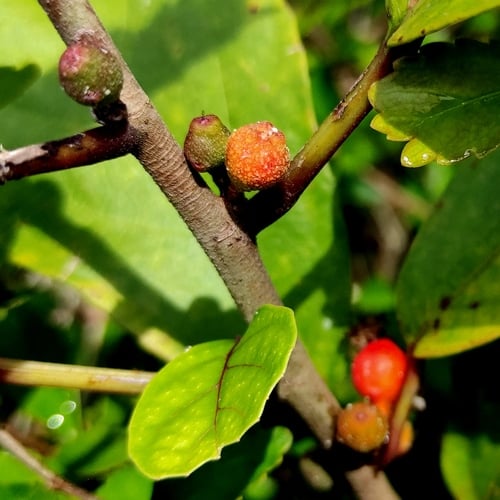
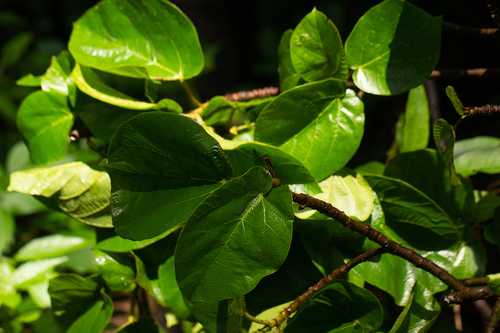
Ficus pseudopalma
Blanco
Palm-leaf-fig, Philippine fig
iNaturalist· cc-by-nc
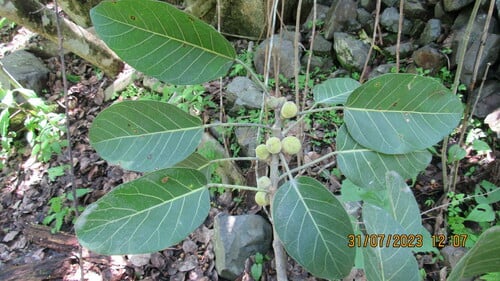
(c) José Ignacio Márquez Corro, some rights reserved (CC BY-NC), uploaded by José Ignacio Márquez Corro
iNaturalist· cc-by-nc
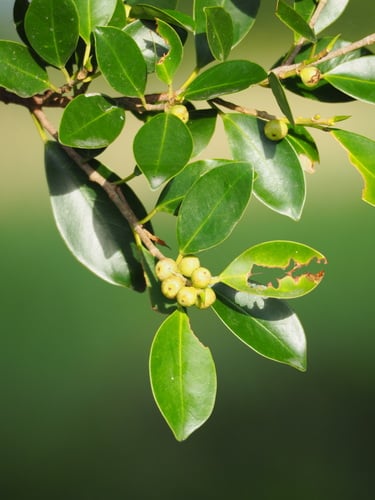
(c) Liselle Santos, some rights reserved (CC BY-NC), uploaded by Liselle Santos
iNaturalist· cc-by-nc
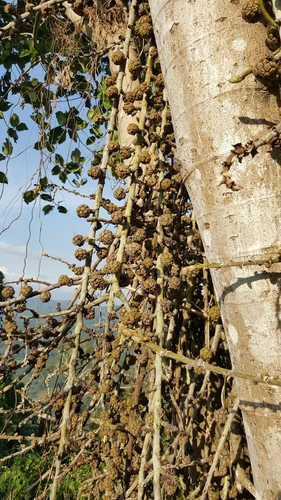
(c) choquetterebecca, some rights reserved (CC BY-NC)
Summary
Source: WikipediaFicus pseudopalma is a species of fig, (subgenus Sycamorus) in the mulberry family (Moraceae). It is known by the common names Philippine fig, dracaena fig, and palm-leaf fig. In nature it is endemic to the Philippines, especially the island of Luzon. It is known elsewhere as an ornamental plant. This is a shrub or rarely branching small tree growing erect with a naked unbranched mesocaul stem topped with a cluster of wavey-edged leaves to give it the appearance of a palm. Indeed, the species name pseudopalma means "false palm". The leaves are 75–100 cm (30–40 in) long and up to 15 cm (6 in) wide, with a yellow midrib and edged with dull teeth. The edges of the leaf are elevated above the midrib, forming a sort of trough. The fruit is a dark green fig that grows in pairs, each fruit 2.5 cm (1 in) diameter; it is edible but not very tasty. In Luzon, this plant occurs in grassland and forest habitat, where it is considered common. The new shoots of the plant are eaten as a type of vegetable, and there are a number of traditional medicinal uses, such as a remedy for kidney stones made from the leaves. In Bicol Region the plant is known as Lubi-lubi and the leaves are cooked in coconut milk. In 2003 the leaves were sold in markets for US$0.74 per kilogram, and the plant can be grown in plantations without pesticides for an adequate profit. This shrub has been used as a landscaping plant in Hawaii, but it never escaped cultivation or became established in the wild because the species of wasp that pollinates it was never brought to the islands.
Description
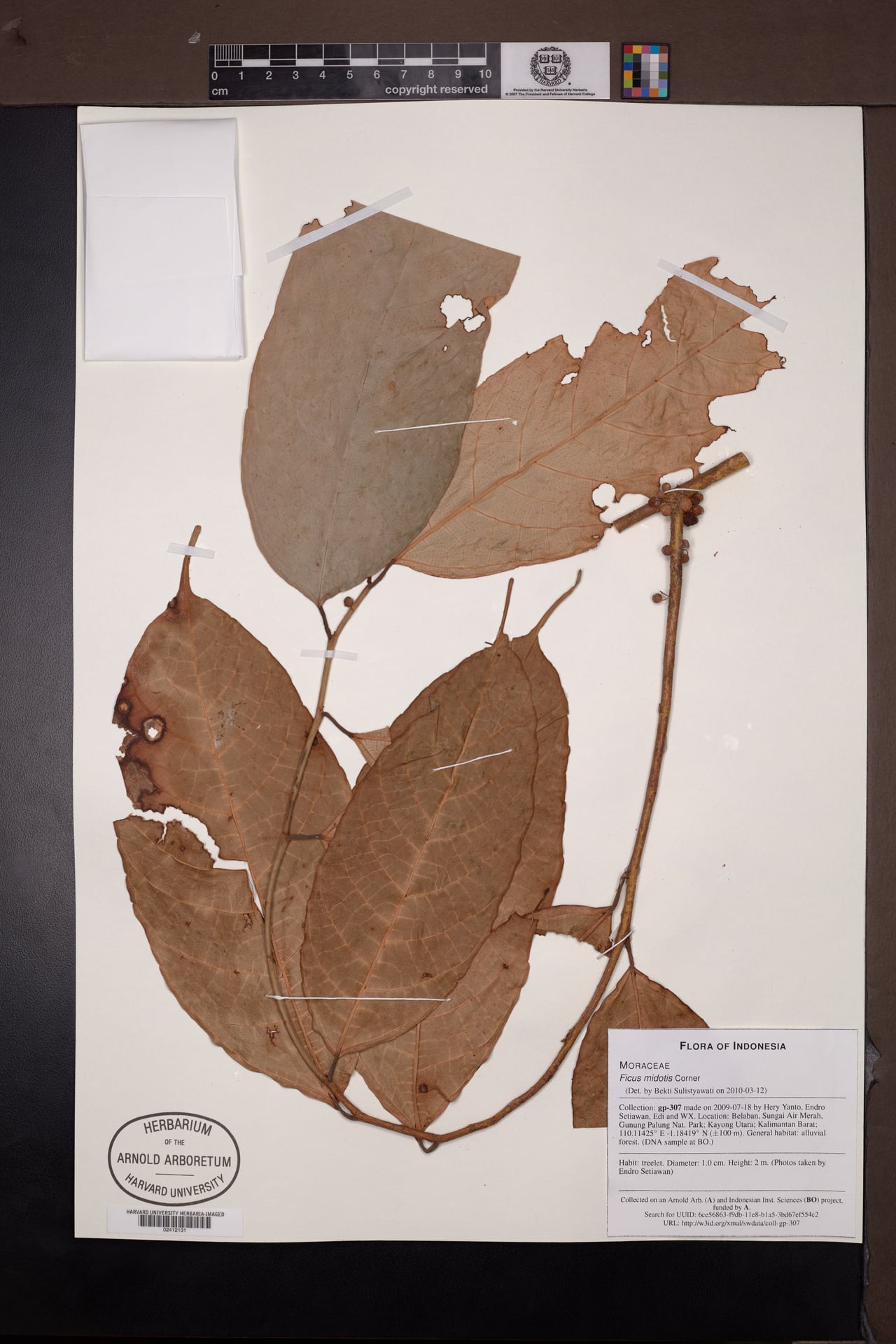
A fig. It is a small palm like tree. It grows 6 m tall. It spreads 3 m wide. It has a few branches of a few stems from the base. The leaves are alternate and crowded towards the ends of branches. The leaves are smooth and shiny on the upper surface while paler beneath. They can be 1 m long. The flowers parts are fused toward the base and occur one or two together. They are a dull red or purplish when mature. The plant is an unusual and ornamental fig. The fruit are oblong and ridged. They are greenish-purple with white spots. It is pollinated by the fig wasp, Ceratosolen bakeri.
Edible Uses
Young leaves are cooked as a vegetable or eaten raw in salads. The fruit are eaten raw.
Traditional Uses
The young leaves are cooked and eaten as a vegetable. They are also eaten raw in salads. The fruit are eaten raw.
This uses section is brief — help expand it
Medicinal Uses
A decoction of the leaves is used in the treatment of diabetes and kidney stones. The plant contains flavonoids, unsaturated sterol and triterpene, steroid glycoside, saponin, tannin and phenol.
Distribution
A tropical plant. It is native to the Philippines. They are common in dry wooded areas of the Philippines and range from the seacoast to 1600 m altitude. It can grow in infertile soils. It can tolerate shade. It suits hardiness zones 11-12.
Where It Grows
Asia, Australia, Hawaii, North America, Pacific, Philippines, SE Asia, Singapore, USA, Venezuela,
Cultivation
It can be grown from seeds.
Production
It is fast growing.
Other Information
It is cultivated.
Notes
There are about 800-1000 Ficus species. They are mostly in the tropics. There are 120 Ficus species in tropical America.
Synonyms
Also Known As
Dinad'alit, Dracaena fig, Niog-niogan, Palm fig, Reprepolyo
References (14)
- Barwick, M., 2004, Tropical and Subtropical Trees. A Worldwide Encyclopedic Guide. Thames and Hudson p 186
- Bodner, C. C. and Gereau, R. E., 1988, A Contribution to Bontoc Ethnobotany. Economic Botany, 43(2): 307-369
- Cundall, P., (ed.), 2004, Gardening Australia: flora: the gardener's bible. ABC Books. p 603
- Etherington, K., & Imwold, D., (Eds), 2001, Botanica's Trees & Shrubs. The illustrated A-Z of over 8500 trees and shrubs. Random House, Australia. p 328
- Facciola, S., 1998, Cornucopia 2: a Source Book of Edible Plants. Kampong Publications, p 155
Show all 14 references Hide references
- Fl. Filip. 680. 1837
- Kermath, B. M., et al, 2014, Food Plants in the Americas: A survey of the domesticated, cultivated and wild plants used for Human food in North, Central and South America and the Caribbean. On line draft. p 372
- Kunkel,
- Lugod, G.C. and de Padua L.S., 1979, Wild Food Plants in the Philippines. Vol. 1. Univ. of Philippines Los Banos. p 55
- Martin, F.W. & Ruberte, R.M., 1979, Edible Leaves of the Tropics. Antillian College Press, Mayaguez, Puerto Rico. p 206
- Menisa, A. A., et al, 2012, Survey and characterization of Indigenous Food Plants in Ilocos Norte, Philippines. SEARCA Discussion Paper series No. 2011-2
- Monsalud, M.R., Tongacan, A.L., Lopez, F.R., & Lagrimas, M.Q., 1966, Edible Wild Plants in Philippine Forests. Philippine Journal of Science. p 501
- Polinag, M. A., 2003, Food from the Wilderness. Department of Environment and Natural Resources. Laguna.
- Staples, G.W. and Herbst, D.R., 2005, A tropical Garden Flora. Bishop Museum Press, Honolulu, Hawaii. p 411