Ficus caballina
Standl.
Caballina fig
iNaturalist· cc-by-nc
(c) Guillaume Léotard, some rights reserved (CC BY-NC)
iNaturalist· cc-by-nc
(c) Guillaume Léotard, some rights reserved (CC BY-NC)
iNaturalist· cc-by-nc
(c) Guillaume Léotard, some rights reserved (CC BY-NC)
Description
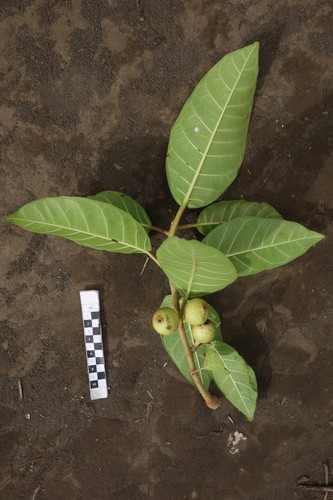
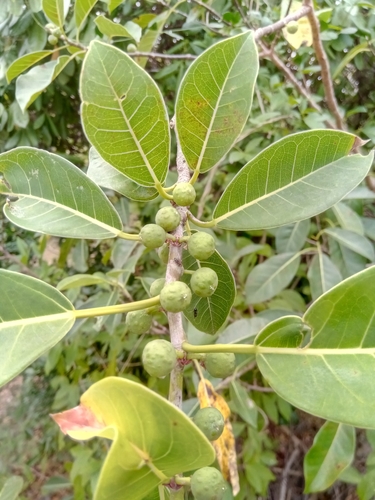
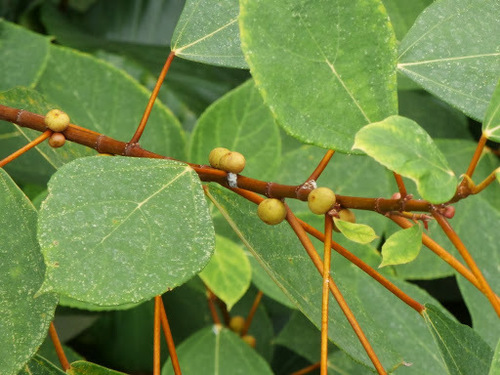
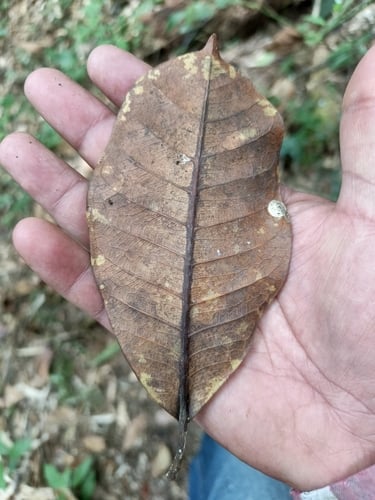
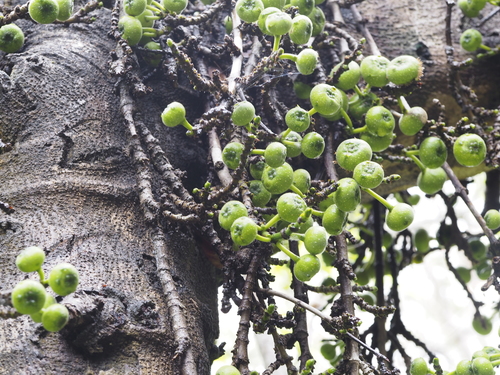
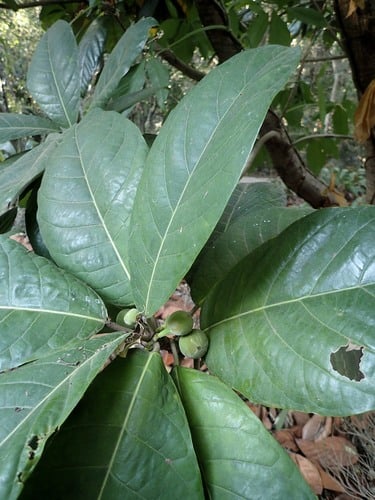
A tree. It grows 25 m tall. The leaves are narrowly oval and 23-32 cm long by 7-11 cm wide. The fig fruit usually occur as several together on spurs. They are round and about 1 cm across. They have very small hairs. They turn yellow to orange as they ripen.
Edible Uses
Fruit - raw. Very small, but a sweet flavour. The globose fruit is pale red when mature, around 5 - 6mm in diameter.
Medicinal Uses
An exudate from the stems is used to treat sprains, wounds, cuts and skin infections. The thick white latex obtained from the stems is used like 'plaster of Paris' to set bones. The latex sets rapidly to a rather hard mass.
Distribution
It is a tropical plant.
Where It Grows
Amazon, Bolivia, Brazil, Colombia, Ecuador, Guianas, Peru, South America, Venezuela,
Cultivation
Fig trees have a unique form of fertilization, each species relying on a single, highly specialized species of wasp that is itself totaly dependant upon that fig species in order to breed. The trees produce three types of flower; male, a long-styled female and a short-styled female flower, often called the gall flower. All three types of flower are contained within the structure we usually think of as the fruit. The female fig wasp enters a fig and lays its eggs on the short styled female flowers while pollinating the long styled female flowers. Wingless male fig wasps emerge first, inseminate the emerging females and then bore exit tunnels out of the fig for the winged females. Females emerge, collect pollen from the male flowers and fly off in search of figs whose female flowers are receptive. In order to support a population of its pollinator, individuals of a Ficus spp. must flower asynchronously. A population must exceed a critical minimum size to ensure that at any time of the year at least some plants have overlap of emmission and reception of fig wasps. Without this temporal overlap the short-lived pollinator wasps will go locally extinct.
Other Uses
When the yellowish or medium brown bark is cut, it exudes a fair quantity of insipid latex which coagulates readily. It has local medicinal uses. The wood is oatmeal-coloured with pale gray areas caused by stain. Coarse textured; straight or slightly wavy-grained; it has no distinctive odour, but is sometimes slightly bitter. The wood is light in weight, but fairly firm; easy to cut; checks slightly in drying. It has no recorded uses.
Synonyms
Also Known As
Bibosi, Higuerote, Lechero, Mutumutu, Renaquillo
References (1)
- Grandtner, M. M. & Chevrette, J., 2013, Dictionary of Trees, Volume 2: South America: Nomenclature, Taxonomy and Ecology. Academic Press p 252