Ficus burtt-davyi
Hutch
Scrambling fig
iNaturalist· cc-by-nc
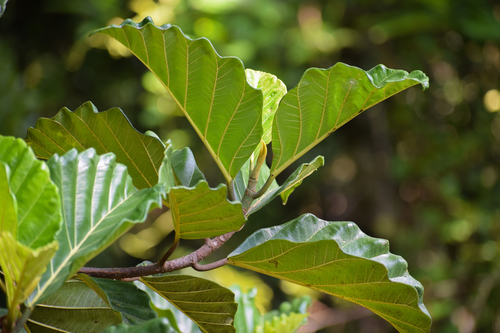
(c) Nick Helme, some rights reserved (CC BY-NC), uploaded by Nick Helme
iNaturalist· cc-by-nc
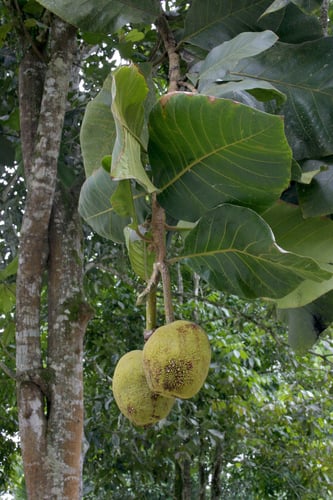
(c) Dewald du Plessis, some rights reserved (CC BY-NC)
Summary
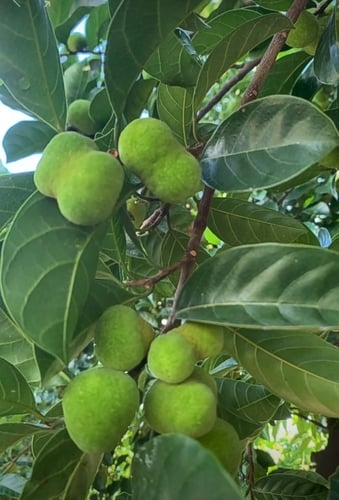
Source: WikipediaFicus burtt-davyi is a fig species endemic to Southern Africa, belonging to the Mulberry family of Moraceae. It grows in coastal and inland forests up to 1,500 m (4,920 ft), from the vicinity of Mossel Bay in the Southern Cape to southern Mozambique - the forms growing on coastal dunes in the northern part of its range are salt tolerant and form low thickets on the margins of woodland. In the southern and eastern Cape forests the species becomes a strangler or liana, while when found on rocky outcrops and cliffs it usually develops into a rock-splitter. In its epiphytic form this species starts its life in the forks of tree branches, where an accumulation of organic debris aids germination and initial development. It sends down long, thin roots to reach soil and water below. The roots thicken and grow in number with the passage of time, and can eventually enclose the supporting tree, strangling and killing it, leaving the fig to stand alone with no competition for resources. Growing without support the stems may reach 1m in diameter, and up to 20m in height, with a dense canopy and making an excellent shade tree. Bark is thin, smooth, grey and fibrous, and is much used by indigenous tribes as rough cordage. Branchlets are covered with minute, soft, erect hairs. Its tolerance of drought conditions makes it a favourite species among Bonsai growers. Fruits are important as both food and in traditional medicine, and contain laxative substances, flavonoids, sugars, vitamins A and C, acids and enzymes. The latex is an allergen and serious eye irritant. There are some 900 species of figs worldwide, each employing the same remarkable manner of pollination where, with rare exceptions, each species of fig relying on one particular species of fig wasp from the family Agaonidae to carry out the fertilisation. F. burtt-davyi is no exception to the rule and depends on the minute fig wasp Elisabethiella baijnathi Wiebes. to effect this. Pollinator-specific volatile attractants are released through the ostioles of ripe figs and in the case of F. burtt-davyi attract only adult female Elisabethiella baijnathi. Fig trees are keystone species in many tropical and subtropical ecosystems. Due to their steady production of fruit throughout the year, they feed a wide spectrum of animal life, and are repaid by animals' dispersing their seeds. Fruits are green with white spots when immature, yellowish when ripe, growing singly or in pairs from leaf axils, 5-10mm in diameter. Fourcade described the wood as "very light and soft, very weak, elastic, porous, with alternate concentric layers of soft and firm tissue; medullary rays fine and close; pores moderately large and numerous, irregularly distributed; colour white or grey, tinged with brown; makes rough boards, but decays rapidly if exposed to the weather." The species was named in honour of the botanist Joseph Burtt Davy, who worked in South Africa between 1903 and 1919.
Description
A fig. It is a shrub or small scrambling tree. It can be a woody creeper in the forest. The main stem is short and there are often several stems. The bark is smooth and silvery grey. It has a milky sap when cut. The leaves are alternate and simple. They are narrowly oval and 3-12 cm long by 1-5 cm wide. They have a distinct V shaped pair of veins from the base. The fruit or figs occur singly or in pairs on the twigs of the previous years growth. They are round and 12 mm across.
Edible Uses
The round figs are eaten as a snack, though they are only occasionally consumed by people.
Traditional Uses
The fruit are eaten as a snack.
This uses section is brief — help expand it
Distribution
It is a subtropical plant. It grows on rocky outcrops and in woodland. It can tolerate sea breezes. It can tolerate salt.
Where It Grows
Africa, East Africa, Eswatini, Mozambique, South Africa, Southern Africa, Swaziland,
Cultivation
The pollinating wasp is Elisabethiella baijnathi Wiebes.
Other Information
The fruit are only occasionally eaten by people.
Also Known As
Uluzi, Umthombe
References (5)
- Long, C., 2005, Swaziland's Flora - siSwati names and Uses http://www.sntc.org.sz/flora/
- Ruiters-Welcome, A. K., 2019, Food plants of southern Africa. Ph.D. thesis. Univ. of Johannesburg p 79
- Schmidt, E., Lotter, M., & McCleland, W., 2007, Trees and shrubs of Mpumalanga and Kruger National Park. Jacana Media p 76
- Welcome, A. K. & Van Wyk, B.-E., 2019, An inventory and analysis of the food plants of southern Africa. South African Journal of Botany 122 (2019) 136–179
- www.figweb.org