Ficus calopilina
Diels
Kurbarab
gbif· cc0
President and Fellows of Harvard College
gbif· cc0
President and Fellows of Harvard College
gbif· cc0
President and Fellows of Harvard College
Description
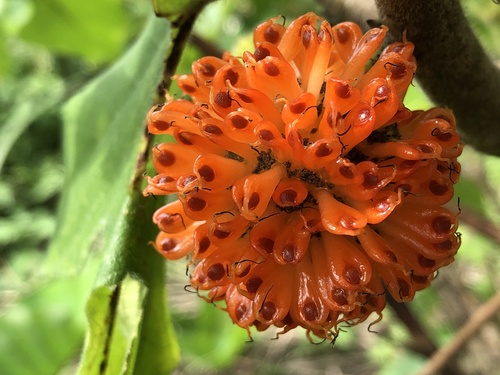
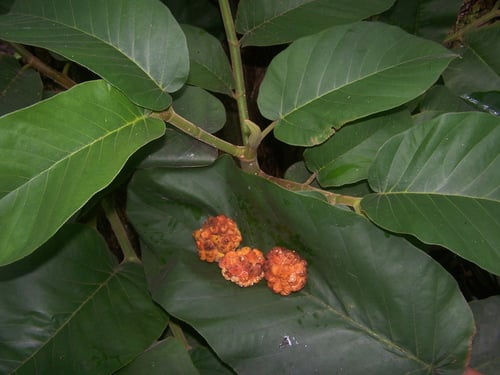
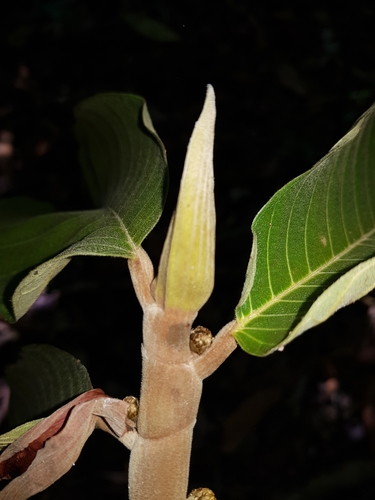
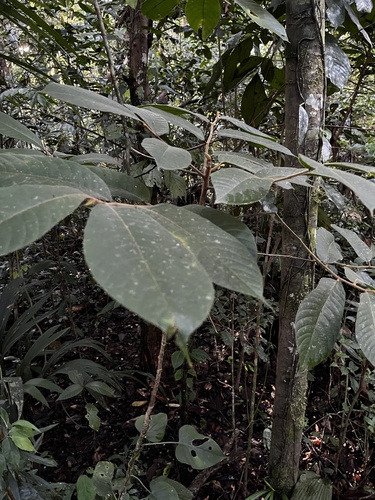
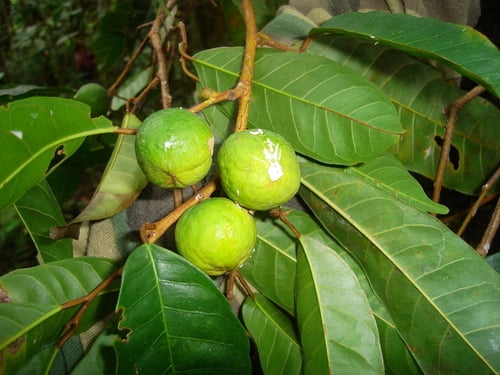
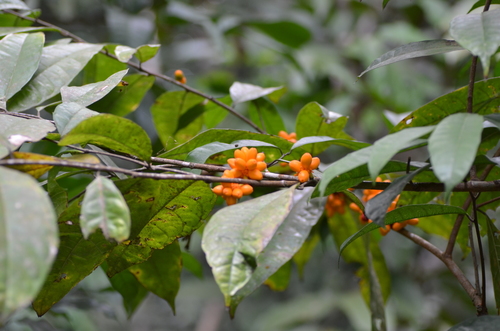
A fig. It is a tree. It grows 15 m tall. The leaves are arranged in spirals. It has oval leaves with a tail. They are 10-36 cm long by 6-21 cm wide. They are wedge shaped at the base. The figs are slightly flattened. They are 3-6 cm across. They occur in rounded clusters. These can be on the trunk or in the axils of leaves. They turn yellow-brown as they ripen.
Edible Uses
Fruit - raw. Edible but tasteless. The yellow to brown, subglobose to pear-shaped fruit can be 40 - 60mm in diameter.
Traditional Uses
The fruit can be eaten but have little taste.
This uses section is brief — help expand it
Medicinal Uses
The fruit latex is used to cover sores; the sores are subsequently covered by a leaf of the same plant.
Distribution
A tropical plant. It grows in primary and secondary mountain forests. It grows between 1,000-2,400 m above sea level. It is often along streams.
Where It Grows
Pacific, Papua New Guinea, PNG,
Cultivation
Fig trees have a unique form of fertilization, each species relying on a single, highly specialized species of wasp that is itself totaly dependant upon that fig species in order to breed. The trees produce three types of flower; male, a long-styled female and a short-styled female flower, often called the gall flower. All three types of flower are contained within the structure we usually think of as the fruit. The female fig wasp enters a fig and lays its eggs on the short styled female flowers while pollinating the long styled female flowers. Wingless male fig wasps emerge first, inseminate the emerging females and then bore exit tunnels out of the fig for the winged females. Females emerge, collect pollen from the male flowers and fly off in search of figs whose female flowers are receptive. In order to support a population of its pollinator, individuals of a Ficus spp. must flower asynchronously. A population must exceed a critical minimum size to ensure that at any time of the year at least some plants have overlap of emmission and reception of fig wasps. Without this temporal overlap the short-lived pollinator wasps will go locally extinct. A dioecious species, both male and female forms need to be grown if fruit and seed are required.
Other Uses
A fibre obtained from the bark is used to make twine.
Notes
There are about 800-1000 Ficus species. They are mostly in the tropics. There are 120 Ficus species in tropical America.
Synonyms
References (4)
- Borrell, O.W., 1989, An Annotated Checklist of the Flora of Kairiru Island, New Guinea. Marcellin College, Victoria Australia. p 105
- PROSEA (Plant Resources of South East Asia) handbook, Volume 12 (1), 1999, Medicinal and poisonous.
- Walter, A. & Sam C., 2002, Fruits of Oceania. ACIAR Monograph No. 85. Canberra. p 279
- World Checklist of Useful Plant Species 2020. Royal Botanic Gardens, Kew