Ficus macrophylla
Desf. ex Pers.
Moreton Bay Fig, Australian banyan
iNaturalist· cc-by-nc
(c) Kasey Joe-McIndoe, some rights reserved (CC BY-NC), uploaded by Kasey Joe-McIndoe
iNaturalist· cc-by-nc
(c) connor, some rights reserved (CC BY-NC), uploaded by connor
iNaturalist· cc-by-nc
(c) Xerxes Saher, some rights reserved (CC BY-NC), uploaded by Xerxes Saher
Summary
Source: WikipediaFicus macrophylla, commonly known as the Moreton Bay fig or Australian banyan, is a large evergreen banyan tree of the mulberry and fig family Moraceae. It is native to eastern Australia, from the Wide Bay–Burnett region of Queensland in the north to the Illawarra region of New South Wales. The infraspecies Ficus macrophylla f. columnaris is endemic to Lord Howe Island. Its common name refers to Moreton Bay in Queensland. It is best known for its imposing buttress roots. Ficus macrophylla is called a strangler fig because seed germination usually takes place in the canopy of a host tree, where the seedling lives as an epiphyte until its roots establish contact with the ground, when it enlarges and strangles its host, eventually becoming a freestanding tree by itself. Individuals may reach 60 m (200 ft) in height. The greatest exact height to be reported is 70.6 m (232 ft). It has an obligate mutualism with fig wasps; figs are pollinated only by fig wasps, and fig wasps can reproduce only in fig flowers. The wasp partner of the Moreton Bay fig is Pleistodontes froggattii. Many species of birds, including pigeons, parrots, and various passerines, eat the fruit. Ficus macrophylla is widely used as a feature tree in public parks and gardens in warmer climates such as California, Spain, Portugal, Italy, Malta, northern New Zealand (Auckland), and Australia. Old specimens can reach tremendous size, and their aggressive root system renders them unsuitable for all but the largest private gardens.
Description
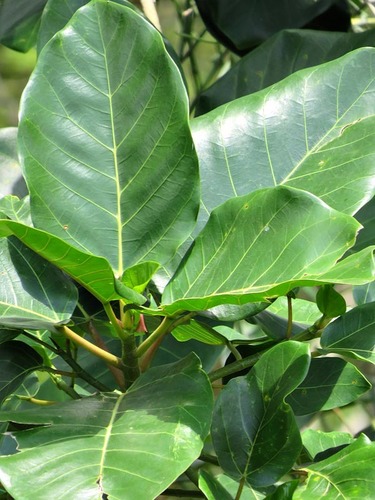
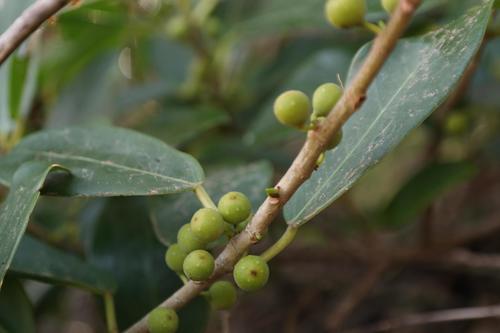
A fig. It is a large spreading tree. It is evergreen. It grows to 20-40-55 m high. It spreads about the same width. There are buttresses at the base. It has strangling roots. The trunk can be short. It has irregular flanges. The bark is grey-brown and smooth. The young shoots are rusty brown. The leaves are large and leathery and dark green. They are a rusty colour underneath. The fruit or figs are 2-2.5 cm across. The figs ripen to reddish-brown.
Edible Uses
Fruit - raw. Acceptable when fully ripe. The fruit is 18 - 25mm in diameter. Sweet and tasty, though most of the fruit consists of gritty seeds. The globose fig is purplish when ripe.
Traditional Uses
Young leaves are eaten in curries. The ripe fruit are eaten.
This uses section is brief — help expand it
Medicinal Uses
None known.
Distribution
It is a subtropical plant. It is native to E Australia. It grows in rainforest. It suits humid locations. It can tolerate salt laden winds. They can grow in temperate places and tolerate moderate frosts. In Melbourne Botanical Gardens. It suits hardiness zones 9-11. Ficus macrophylla subsp. columnaris occurs on Lord Howe Island.
Where It Grows
Africa, Asia, Australia*, East Africa, Hawaii, India, North America, Pacific, Pakistan, Southern Africa, USA, Zimbabwe,
Cultivation
Plants are grown from seed. The seed are removed from the fig and mixed with sand before sowing as they are very small. Take the seed from ripe purple fruit.
Propagation
Seed - best sown as soon as it is ripe, it germinates best at a temperature around 20°c. Air layering. Tip cuttings around 4 - 12cm long, taken from lateral branches. Cuttings of mature wood 10 - 12cm with a heel. Fairly easy, it is probably best if the cuttings are put in individual pots. Layering.
Other Uses
This species has a specialised relationship with fig wasps — figs are pollinated exclusively by fig wasps, which can only reproduce within fig flowers. The fruit provides food for the Grey-headed Flying-fox and the Wompoo Fruit-dove. The tree offers shade for livestock. Fibres from the plant were traditionally used in Australia for making fishing nets.
Notes
There are about 800-1000 Ficus species. They are mostly in the tropics. There are 120 Ficus species in tropical America.
Also Known As
Moreton Bay Fig
References (36)
- Barwick, M., 2004, Tropical and Subtropical Trees. A Worldwide Encyclopedic Guide. Thames and Hudson p 185
- Bodkin, F., 1991, Encyclopedia Botanica. Cornstalk publishing, p 473
- Boland, D. J. et al, , 2006, Forest Trees of Australia. CSIRO p 194
- Brickell, C. (Ed.), 1999, The Royal Horticultural Society A-Z Encyclopedia of Garden Plants. Convent Garden Books. p 439
- Cherikoff V. & Isaacs, J., The Bush Food Handbook. How to gather, grow, process and cook Australian Wild Foods. Ti Tree Press, Australia p 162
Show all 36 references Hide references
- Cribb, A.B. & J.W., 1976, Wild Food in Australia, Fontana. p 35
- Cronin, L., 1989, The Concise Australian Flora. Reed. p 147
- Cundall, P., (ed.), 2004, Gardening Australia: flora: the gardener's bible. ABC Books. p 603
- Elliot, W.R., & Jones, D.L., 1992, Encyclopedia of Australian Plants suitable for cultivation. Vol 4. Lothian. p 286
- Etherington, K., & Imwold, D., (Eds), 2001, Botanica's Trees & Shrubs. The illustrated A-Z of over 8500 trees and shrubs. Random House, Australia. p 328
- Flora of Australia, Volume 3, Hamamelidales to Casuarinales, Australian Government Publishing Service, Canberra (1989) p 41
- Flora of Australia Volume 49, Oceanic Islands 1, Australian Government Publishing Service, Canberra. (1994) p
- Flora of Pakistan. www.eFloras.org
- Greig, D., 1996, Flowering Natives for Home Gardens. Angus & Robertson. p 181
- GUPTA,
- Hall, N. et al, 1972, The Use of Trees and Shrubs in the Dry Country of Australia, AGPS, Canberra. p 382
- Haslam, S., 2004, Noosa's Native Plants. Noosa Integrated Catchment Assn. Inc. p 338
- Hearne, D.A., & Rance, S.J., 1975, Trees for Darwin and Northern Australia. AGPS, Canberra p 70, Pl 18
- Heyne, G. & P., 1985, Australian Plants for your Garden. Lothian. p 99
- Hibbert, M., 2002, The Aussie Plant Finder 2002, Florilegium. p 102
- Holliday, I., 1989, A Field Guide to Australian Trees. Hamlyn. p 198
- Jones D, L, 1986, Ornamental Rainforest Plants in Australia, Reed Books, p 219, 340
- Lazarides, M. & Hince, B., 1993, Handbook of Economic Plants of Australia, CSIRO. p 114
- Lord, E.E., & Willis, J.H., 1999, Shrubs and Trees for Australian gardens. Lothian. p 16
- Low, T., 1991, Wild Food Plants of Australia. Australian Nature FieldGuide, Angus & Robertson. p 81
- Low, T., 1992, Bush Tucker. Australia’s Wild Food Harvest. Angus & Robertson. p 64
- Morley, B.D., & Toelken, H.R., (Eds), 1983, Flowering Plants in Australia. Rigby. p 63
- Nicholson, N & H., 1996, Australian Rainforest Plants, Terania Rainforest Publishing. NSW. p 32
- Nicholson, N & H., 1996, Australian Rainforest Plants 3, Terania Rainforest Publishing. NSW. p 29
- Ratcliffe D & P., 1987, Australian Native Plants for Indoors. Little Hills press. p 90
- Recher, P, 2001, Fruit Spirit Botanical Gardens Plant Index. www.nrg.com.au/~recher/ seedlist.html p 6
- Ryan, M. (Ed.), 2003, Wild Plants of Greater Brisbane. Queensland Museum. p 269
- Smith, K & I., 1999, Grow your own bushfoods. New Holland. Australia. p 35
- Syn. pl. 2(2):609. 1807
- Williams, J.B., Harden, G.J., and McDonald, W.J.F., 1984, Trees and shrubs in rainforests of New South Wales and Southern Queensland. Univ. of New England, Armidale. p 66
- Young, J., (Ed.), 2001, Botanica's Pocket Trees and Shrubs. Random House. p 387