Eugenia reinwardtiana
(Blume) DC
Sweet cherry, Beach cherry, Cedar Bay Cherry
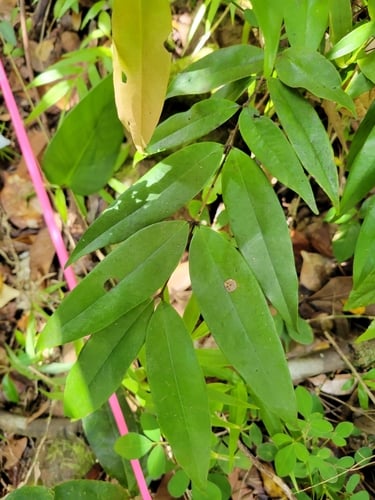
iNaturalist· cc-by-nc
(c) ryanthughes, some rights reserved (CC BY-NC)
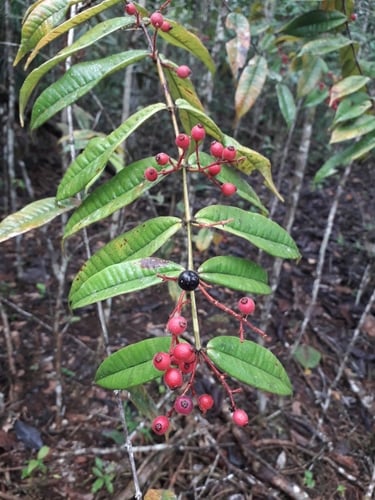
iNaturalist· cc-by-nc
(c) J.R. Kuethe, some rights reserved (CC BY-NC)
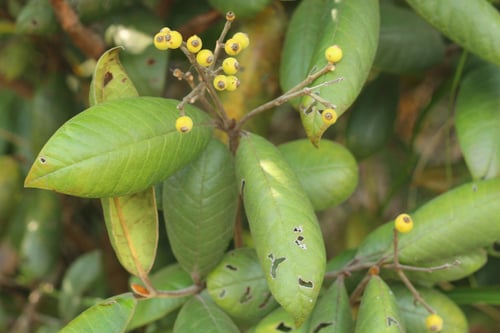
iNaturalist· cc-by
(c) Samuel Brown, some rights reserved (CC BY)
Summary
Source: WikipediaEugenia reinwardtiana is a shrub to small tree in the family Myrtaceae. Native to tropical forests in Indonesia, the Australian state of Queensland, and many Pacific Islands, its common names include Cedar Bay cherry, beach cherry, Australian beach cherry, mountain stopper, nīoi (Hawaiian), and a'abang (Chamorro). They are typically 2 to 6 m (6.6 to 19.7 ft) in height. The tree is particularly common around the Cedar Bay National Park in northern Australia and the edible fruit was especially popular with the hippies who lived there in the 1970s. The fruits are green at first, then ripen to a bright orange-red colour with a sweet taste and soft flesh.
Description
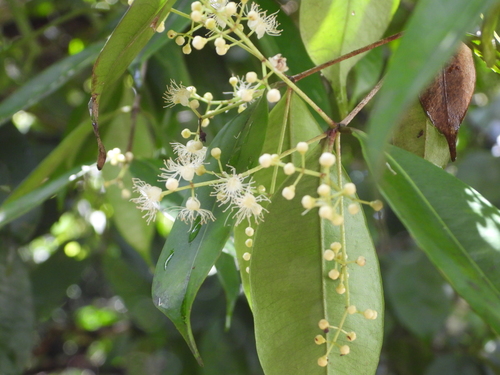
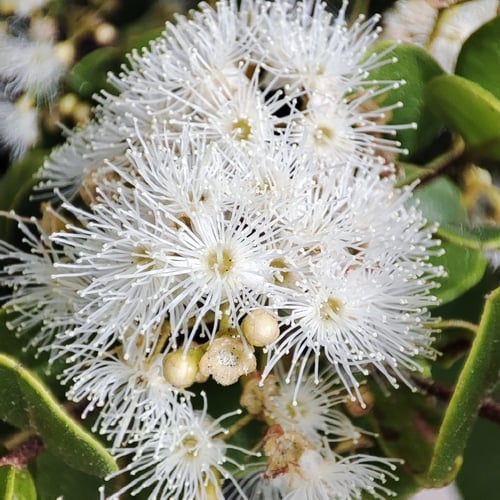
A tree up to 3-6 m tall. It spreads 0.5-2 m across. The bark is smooth and flaky. It is pale brown. The young shoots have short hairs pressed against the stem. The leaves are simple and 2-9 cm long by 1-4.5 cm across. They are smooth and have oil dots along them. The leaf stalks is short (0.2-0.4 cm long). The leaves are fairly thick with a blunt tip. The leaves are shiny on the upper surface. Young leaves are bronze red. The flowers are mostly 1-3 together. The flowers are white and about 1.2 cm across. Both male and female parts occur on the one flower. The fruit occur either singly or in bunches in the angles of leaves. The fruit are 1.5-2.1 cm long by 1.3-2.3 cm wide. When ripe the fruit are red. There is one seed inside. The seed is 0.7-1.2 cm long. The flesh is edible.
Edible Uses
The tree is cultivated to a limited extent for its edible sweetish fruit that is often eaten out-of-hand, used to flavour drinks and candies, or as a preserve. The fruit is a source of antioxidants. The tree is well-suited to amenity horticulture in the tropics, and is grown in the median strips in Cairns. It is readily propagated from fresh seed. This species is susceptible to myrtle rust (Austropuccinia psidii).
Traditional Uses
The flesh of the fruit is eaten. It can be used for jams and sauces.
This uses section is brief — help expand it
Distribution
A tropical plant. It is native to NE Australia. It is a tropical rainforest species. Often it occurs in coastal scrub. They can tolerate salt laden winds. They require a well drained soil. Trees will grow in full sunlight or heavy shade. They can tolerate very slight frosts. In the Cairns Botanical Gardens.
Where It Grows
American Samoa, Asia, Australia*, Brazil, Cook Islands, East Timor, Fiji, Hawaii, Indonesia, Marquesas, Micronesia, Niue, Pacific, Palau, Papua New Guinea, PNG, Rotuma, Samoa, SE Asia, South America, Timor-Leste, Tonga, Torres Strait, USA,
Cultivation
They can be grown from seed. They can also be grown from cuttings but the cuttings are slow to form roots.
Propagation
Seed - best sown as soon as it is ripe and before it dries out, though stored, dry seed will also germinate. Germination is slow.
Other Uses
The wood is hard and makes excellent firewood. It is also used traditionally to make coconut husking stakes and was once used to make rice-pounding pestles.
Production
Trees are very slow growing but commence flowering while still small. They can fruit after 2 years. Trees flower and fruit throughout the year. Most commonly flowering is June to February with fruit maturing August to March.
Other Information
Fruit are rich in Vitamin C.
Notes
There are about 550 Eugenia species. They are mostly in tropical and subtropical South America.
Nutrition
| Part | Moisture | kJ | kcal | Protein | Vit A | Vit C | Iron | Zinc |
|---|---|---|---|---|---|---|---|---|
| Fruit | 70.8 | 309 | 74 | 1.9 | — | — | 1.1 | 1.1 |
Synonyms
Also Known As
Agashiru, Pohon jambu ceri pantai, Unuoi
References (30)
- Anon., 2003, Native Plants for the Fitzroy basin. Society for Growing Australian Plants Inc. (Rockhampton Branch) p 55
- Barwick, M., 2004, Tropical and Subtropical Trees. A Worldwide Encyclopedic Guide. Thames and Hudson p 175
- Cooper W & Cooper W T, 1994, Fruits of the Rain Forest. RD Press p 122
- Cooper, W. and Cooper, W., 2004, Fruits of the Australian Tropical Rainforest. Nokomis Editions, Victoria, Australia. p 342
- Elliot, W.R., & Jones, D.L., 1992, Encyclopedia of Australian Plants suitable for cultivation. Vol 4. Lothian. p 246
Show all 30 references Hide references
- Facciola, S., 1998, Cornucopia 2: a Source Book of Edible Plants. Kampong Publications, p 157
- Fell, D.G. & Stanton, D.J., 2015: The vegetation and flora of Mabuyag, Torres Strait, Queensland. Memoirs of the Queensland Museum – Culture 8(1):1-33. Brisbane. ISSN 1440-4788.
- Fern, K., 2012, Tropical Species Database http://theferns.info/tropical/
- Franklin, J., Keppel, G., & Whistler, W., 2008, The vegetation and flora of Lakeba, Nayau and Aiwa Islands, Central Lau Group, Fiji. Micronesica 40(1/2): 169–225, 2008
- Hedrick, U.P., 1919, (Ed.), Sturtevant's edible plants of the world. p 300 (As Eugenia rariflora)
- Hibbert, M., 2002, The Aussie Plant Finder 2002, Florilegium. p 99
- INFOODSUpdatedFGU-list.xls
- Jackes, B.R., 2001, Plants of the Tropics. Rainforest to Heath. An Identification Guide. James Cook University. p 68
- Jones D, L, 1986, Ornamental Rainforest Plants in Australia, Reed Books, p 69, 340
- Leiper, G & Houser, J., Mutooroo. Plant Use by Australian Aboriginal People. Assembly press, Queensland. (As Syzygium carissioides)
- Lorenzi, H., Bacher, L., Lacerda, M. & Sartori, S., 2006, Brazilian Fruits & Cultivated Exotics. Sao Paulo, Instituto Plantarum de Estuados da Flora Ltda. p 456
- Melzer, R. & Plumb, J., 2011, Plants of Capricornia. Belgamba, Rockhampton. p 246
- Molyneux, B. and Forrester, S., 1997, The Austraflora A-Z of Australian Plants. Reed. p 95
- Mua Bioversity Profile, 2013, Profile for Management of the Habitats and Related Ecological and Cultural Resources of Mua Island. Torres Strait Regional Authority Land & Sea Management Unit. p 142
- Nicholson, N & H., 1996, Australian Rainforest Plants 3, Terania Rainforest Publishing. NSW. p 28
- Paczkowska, G . & Chapman, A.R., 2000, The Western Australian Flora. A Descriptive Calatogue. Western Australian Herbarium. p 386
- Radke, P & A, Sankowsky, G & N., 1993, Growing Australian Tropical Plants. Frith & Frith, Australia. p 36
- Recher, P, 2001, Fruit Spirit Botanical Gardens Plant Index. www.nrg.com.au/~recher/ seedlist.html p 2 (As Eugenia carissoides)
- Sukarya, D. G., (Ed.) 2013, 3,500 Plant Species of the Botanic Gardens of Indonesia. LIPI p 275
- Tanaka,
- Townsend, K., 1994, Across the Top. Gardening with Australian Plants in the tropics. Society for Growing Australian Plants, Townsville Branch Inc. p 207
- Wheeler, J.R.(ed.), 1992, Flora of the Kimberley Region. CALM, Western Australian Herbarium, p 531
- Whistler, W.A., 2004, Rainforest Trees of Samoa. Isle Botanica Honolulu, Hawaii. p 116
- Williams, K.A.W., 1999, Native Plants of Queensland Volume 4. Keith A.W. Williams North Ipswich, Australia. p 190
- World Checklist of Useful Plant Species 2020. Royal Botanic Gardens, Kew