Eucalyptus gunnii
J.D. Hooker
Cider Tree, Cider Gum
iNaturalist· cc-by-nc
(c) Steve Taylor, some rights reserved (CC BY-NC), uploaded by Steve Taylor
iNaturalist· cc-by-nc
(c) Jonathan Esling, some rights reserved (CC BY-NC)
iNaturalist· cc-by-sa
(c) Tony Rebelo, some rights reserved (CC BY-SA), uploaded by Tony Rebelo
Summary
Source: WikipediaEucalyptus gunnii, commonly known as cider gum, is a species of flowering plant in the family Myrtaceae. It is a small to medium-sized tree with mostly smooth bark, lance-shaped to egg-shaped adult leaves, flower buds in groups of three, white flowers and cylindrical to barrel-shaped fruit.
Description
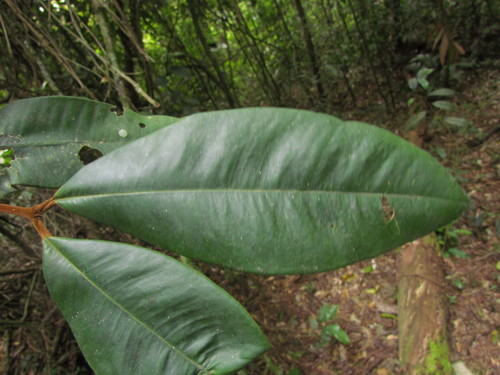
A tree which grows to 18-25 m high. It spreads to 6-12 m across. It keeps its leaves year round. The bark is thin and smooth and reddish. It peels off in flakes. The young leaves occur in pairs and almost circle the stem. The young leaves are rounded and blue and these are replaced by sickle shaped grey-green leaves. The leaves are 7.5-10 cm long. The bark becomes green-white and this is shed to reveal new grey-green bark. The flowers are cream-white and occur in clusters or three. They have a hinged lid which opens to allow insect pollination. The fruit are small and urn shaped.
Edible Uses
The sap of this tree — described in some sources as a stem exudate — has a sweet taste and can be drunk directly or fermented into a cider. It is obtained by wounding the bark in spring, and a tapped trunk can yield up to half a litre per day. The plant also produces an edible manna.
Traditional Uses
A cool refreshing liquid from wounds in the bark in spring is used as a drink. It is a substitute for maple syrup. The tree also produces an edible manna.
Medicinal Uses
Eucalyptus leaves are a traditional Aboriginal herbal remedy. The essential oil in the leaves is a powerful antiseptic used worldwide for relieving coughs, colds, sore throats and other infections, and features in many over-the-counter cold remedies. The leaf essential oil of this species is antiseptic. Aged oil is particularly potent, as ozone forms in it on exposure to air, giving it strong disinfectant action against lower life forms. It can be applied externally to cuts and skin infections, inhaled to clear blocked nasal passages, gargled for sore throats, or taken internally for a variety of complaints. As with all essential oils, larger doses can have a harmful effect on the body.
Known Hazards
Citronellal, an essential oil found in most Eucalyptus species is reported to be mutagenic when used in isolation. In large doses, oil of eucalyptus, like so many essential oils has caused fatalities from intestinal irritation. Death is reported from ingestion of 4 - 24 ml of essential oils, but recoveries are also reported for the same amount. Symptoms include gastroenteric burning and irritation, nausea, vomiting, diarrhoea, oxygen deficiency, ,weakness, dizziness, stupor, difficult respiration, delirium, paralysis, convulsions, and death, usually due to respiratory failure.
Distribution
It is native to Tasmania in Australia. It grows in temperate regions but can grow in the subtropics. It needs well drained soils but can grow in wet soils. It can grow in full sun or light shade. It can stand heavy frosts. It grows near the edge of the tree line at high altitudes on dolerite mountains in Tasmania. It does not suit chalk soils. It suits hardiness zones 7-9. Tasmania Herbarium. Arboretum Tasmania.
Where It Grows
Australia*, Britain, Caucasus, China, Europe, Falklands, Japan, New Zealand, North America, Russia, Slovenia, Tasmania*, USA,
Cultivation
Prefers a sunny position in a moderately fertile well-drained moisture retentive circum-neutral soil. Dislikes clay or chalk soils but succeeds in most other soils. Tolerates poor soils, especially those low in mineral elements. Dislikes shade. Tolerates dry soils and also drought once it is established. One of the hardiest Eucalyptus species, it is very frost resistant, tolerating long periods down to -14°c and short periods down to -18°c. Eucalyptus species have not adopted a deciduous habit and continue to grow until it is too cold for them to do so. This makes them more susceptible to damage from sudden cold snaps. If temperature fluctuations are more gradual, as in a woodland for example, the plants have the opportunity to stop growing and become dormant, thus making them more cold resistant. A deep mulch around the roots to prevent the soil from freezing also helps the trees to survive cold conditions. The members of this genus are remarkably adaptable however, there can be a dramatic increase in the hardiness of subsequent generations from the seed of survivors growing in temperate zones. A very ornamental tree, it is very fast growing when young and requires shelter from strong winds if it is not to become very wind-shaped. Trees can tolerate salt-laden winds. The plant has juvenile foliage which is quite different from the adult leaves. The leaves, especially when bruised, are very aromatic. Plants respond well to coppicing. Commonly planted in S.W. Europe as a timber tree and also for shelter, soil conservation and as an anti-malarial measure since it will dry out wet land that is suitable for mosquitoes to breed in. Plants are shallow-rooting and, especially in windy areas, should be planted out into their permanent positions when small to ensure that they do not suffer from wind-rock. They strongly resent root disturbance and should be container grown before planting out into their permanent position. Eucalyptus monocultures are an environmental disaster, they are voracious, allelopathic and encourage the worst possible attitudes to land use and conservation. The flowers are rich in nectar and are a good bee crop.
Propagation
Surface sow seed in February or March in a sunny greenhouse position. Species from high altitudes benefit from 6–8 weeks of cold stratification at 2°C. Pot seedlings into individual containers as soon as the second set of true leaves develops — leaving them longer risks poor establishment. Plant out into permanent positions in early summer with some cold protection through the first winter. Alternatively, sow in June and plant into final positions the following late spring. Seed remains viable for a long time.
Other Uses
The leaves yield 0.4–0.8% essential oil containing antifungal substances. The tree is coppiced for fuel, though the wood must be dried for at least 12 months before use. Planting in wet ground dries out the soil, making it unsuitable for mosquitoes to breed in.
Production
It forms hybrids with Eucalyptus subcrenulata and Eucalyptus dalrympleana. The tree can be tapped for sap when the trunk is 25 cm across. The flow of sap is best on warm sunny days. Tapping is done by drilling a hole about 5 mm deep into the phloem on the sunny side of the tree. A tube is inserted and a bucket hung below it. The sap can be boiled down to syrupy consistency.
Notes
There are at least 500 Eucalyptus species mostly originally in Australia.
Synonyms
References (31)
- Bodkin, F., 1991, Encyclopedia Botanica. Cornstalk publishing, p 428
- Bonney, N., 1997, Economic Native Trees and Shrubs for South Australia. Greening Australia (SA) inc. Campbelltown SA 5074 p 100
- Boyce, J., 2009, Van Diemen's land. Black Inc. p 116
- Bremness, L., 1994, Herbs. Collins Eyewitness Handbooks. Harper Collins. p 54
- Brickell, C. (Ed.), 1999, The Royal Horticultural Society A-Z Encyclopedia of Garden Plants. Convent Garden Books. p 422
Show all 31 references Hide references
- Coombes, A.J., 2000, Trees. Dorling Kindersley Handbooks. p 223
- Cundall, P., (ed.), 2004, Gardening Australia: flora: the gardener's bible. ABC Books. p 572
- Curtis, W.M., 1956, The Students Flora of Tasmania Vol 1 p 212, 213
- Elliot, W.R., & Jones, D.L., 1992, Encyclopedia of Australian Plants suitable for cultivation. Vol 4. Lothian. p 112
- Etherington, K., & Imwold, D., (Eds), 2001, Botanica's Trees & Shrubs. The illustrated A-Z of over 8500 trees and shrubs. Random House, Australia. p 302
- Facciola, S., 1998, Cornucopia 2: a Source Book of Edible Plants. Kampong Publications, p 141
- Greig, D., 1996, Flowering Natives for Home Gardens. Angus & Robertson. p 171
- Harris, E & J., 1983, Field Guide to the Trees and Shrubs of Britain. Reader's Digest. p 125
- Hedrick, U.P., 1919, (Ed.), Sturtevant's edible plants of the world. p 295
- Hibbert, M., 2002, The Aussie Plant Finder 2002, Florilegium. p 97
- Jackes, D. A., Edible Forest Gardens
- Joyce, D., 1998, The Garden Plant Selector. Ryland, Peters and Small. p 110
- Kirkpatrick, J.B. & Backhouse, S., 1985, Native Trees of Tasmania. p 79
- Lazarides, M. & Hince, B., 1993, Handbook of Economic Plants of Australia, CSIRO. p 102
- London J. Bot. 3:499. 1844
- Lord, E.E., & Willis, J.H., 1999, Shrubs and Trees for Australian gardens. Lothian. p 28
- Low, T., 1991, Wild Food Plants of Australia. Australian Nature FieldGuide, Angus & Robertson. p 154
- Lyle, S., 2006, Discovering fruit and nuts. Land Links. p 194
- Molyneux, B. and Forrester, S., 1997, The Austraflora A-Z of Australian Plants. Reed. p 86
- Self, M., 199, Phoenix Seeds catalogue. p 15
- Smith, K & I., 1999, Grow your own bushfoods. New Holland. Australia. p 110
- Tasmanian Herbarium Vascular Plants list p 40
- Upson, R., & Lewis R., 2014, Updated Vascular Plant Checklist and Atlas for the Falkland Islands. Falklands Conservation and Kew.
- Whiting, J. et al, 2004, Tasmania's Natural Flora. Tasmania's Natural Flora Editorial Committee PO Box 194, Ulverstone, Tasmania, Australia 7315 p 227
- www.ceres.org.au/bushfoodcatalogue
- Zeven, A. C. & de West, J. M. J., 1982, Dictionary of cultivated plants and their regions of diversity. Wageningen. p 66