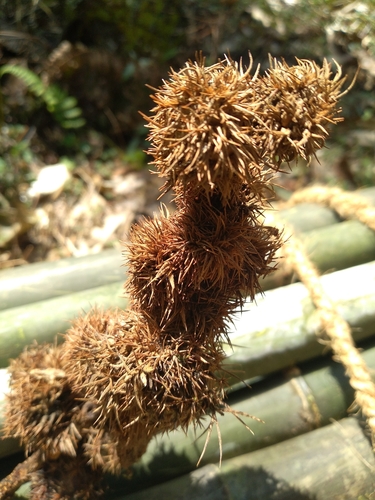
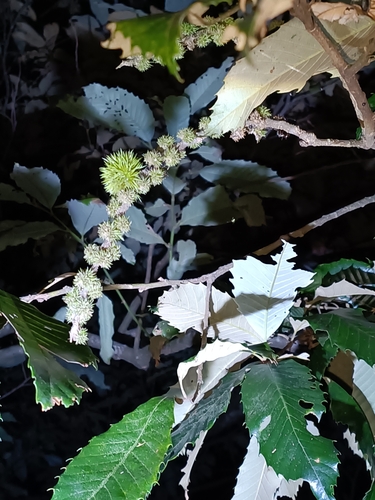
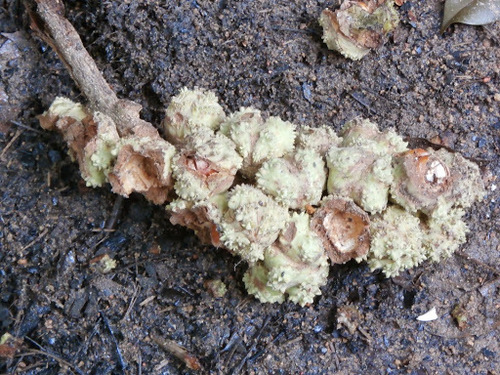
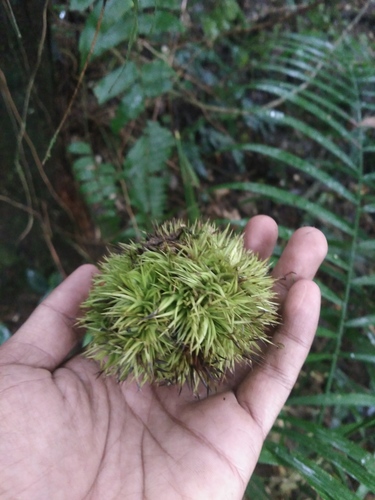
Lithocarpus densiflorus - (Hook.&Arn.)Rehder.
(Hook.&Arn.)Rehder.
Tanbark Oak
gbif· cc0
Ingrid P. Lin
gbif· cc-by
The New York Botanical Garden
gbif· cc0
GBIF
Description
Lithocarpus densiflorus is an evergreen Tree growing to 10 m (32ft) by 10 m (32ft) at a slow rate. See above for USDA hardiness. It is hardy to UK zone 7. It is in leaf all year, in flower from April to May. The species is monoecious (individual flowers are either male or female, but both sexes can be found on the same plant). Suitable for: light (sandy), medium (loamy) and heavy (clay) soils. Suitable pH: mildly acid, neutral and basic (mildly alkaline) soils. It can grow in semi-shade (light woodland) or no shade. It prefers moist soil.
Edible Uses
Oil. Seed - cooked. The seed was a staple food for several native North American Indian tribes. It contains bitter-tasting tannins and there are various ways of removing them. The fastest is by soaking the ground-up seed in hot water - if the water is changed at least once the tannins should be removed within 12 hours. Traditionally, the seeds were placed in a cloth bag and either buried in swampy ground or suspended in a running stream for a few months. Once the tannins have been removed, the seed is then dried, ground into a powder and can be used as a porridge or can be mixed with cereal flours in baking bread etc. It has a pleasant taste after it has been leached. The seed is up to 25mm long and wide. The seed is valued for its oil.
Medicinal Uses
Astringent Odontalgic Skin. The bark is very astringent. An infusion is used as a wash for face sores. The infusion can also be held in the mouth to tighten loose teeth.
Distribution
South-western N. America - Oregon and California.
Where It Grows
NORTHERN AMERICA: United States (Oregon (southwest), California)
Cultivation
Prefers a deep fertile soil with medium drainage. Perfectly hardy at Kew, trees produced seed at Kew in the very hot summer of 1989. A slow-growing tree in the wild, living up to 300 - 350 years old. Plants usually flower in the spring and sometimes again in the autumn. The seeds take two seasons to ripen. Prolific crops are usually produced every other year in the wild.
Propagation
The seed is best sown as soon as it is ripe in the autumn in a cold frame. It needs to be protected from mice, squirrels and other seed eaters. The seed has a short viability but can be stored for a few months if kept cool and slightly damp - the salad compartment of a fridge is a good storage place. Germination takes place in the winter or early spring. When they are large enough to handle, prick the seedlings out into individual pots. If the plants are 15cm or more tall by the summer they can be planted out into their permanent positions. Give them a good weed-excluding mulch and some protection from the cold for their first couple of years outdoors. If growth is not sufficient then grow them on in the greenhouse for their first winter and plant them out into their permanent positions in late spring or early summer, after the last expected frosts.
Other Uses
Dye Fuel Oil Preservative Tannin Wood. The bark is exceedingly rich in tannin, yielding up to 29%. It has been used as a brown dye and also to preserve rope that is being used in water. Wood - hard, strong, close grained, brittle. It is not commercially important and is used mainly for fuel.