Castanopsis indica
(Roxb. ex Lindl.) A. DC.
Indian chestnut, Indian castanopsis
iNaturalist· cc-by-nc
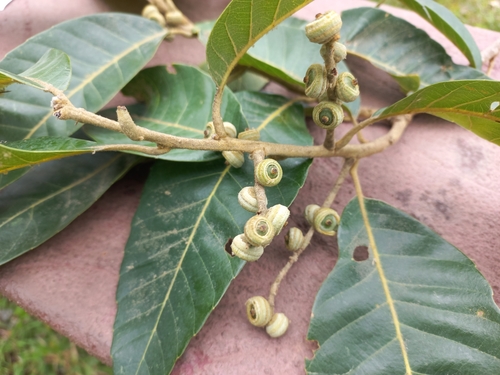
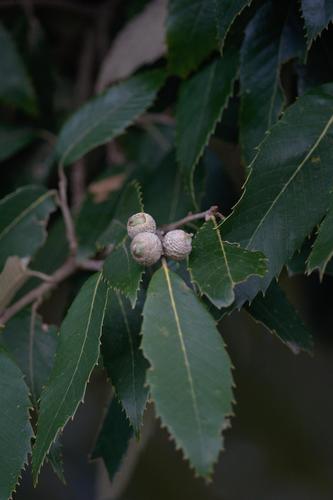
(c) Chen Shu, some rights reserved (CC BY-NC)
iNaturalist· cc-by-nc
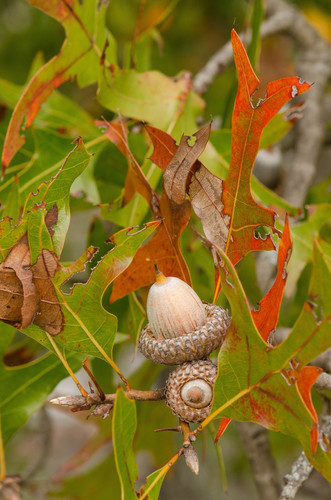
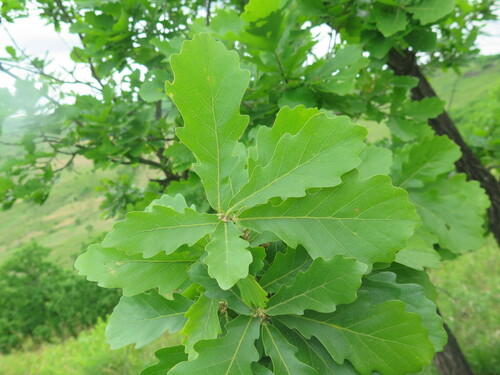
(c) Akmal Idham, some rights reserved (CC BY-NC)
iNaturalist· cc-by-nc
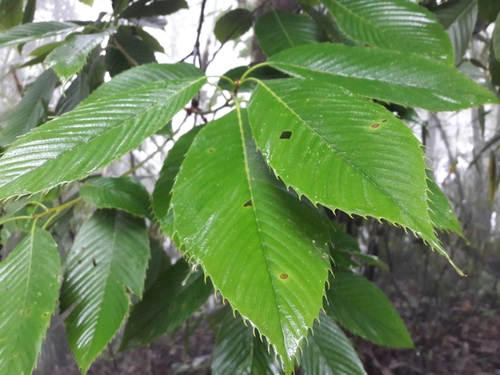
(c) Akmal Idham, some rights reserved (CC BY-NC)
Summary
Source: WikipediaCastanopsis indica is a tree in the family Fagaceae.
Description
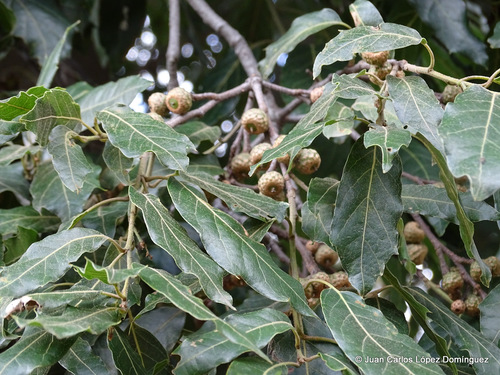
A large evergreen tree. It grows 25-30 m high. The trunk is 40-100 cm across. Trees form branches low down. The bark is grey-brown and cracked. The leaf stalk is 5-10 mm long. The leaves are alternate and 7-18 cm long by 3.5-8 cm wide. They are oblong or sword shaped and with teeth along the edge. The base is heart shaped or rounded. The leaf tapers to the tip and can have a sharp tip. Leaves are thickly papery. Underneath there are soft hairs. The flowers do not have stalks and are yellow. They are covered with soft brown hairs. The flowering stalk can be 40 cm long. The cup is round and 3.5-4 cm across. The fruit is a nut. It is enclosed in a covering with thick spines. The nut is cone shaped and 1-1.4 cm across. It is densely hairy.
Edible Uses
The nuts of the tree are considered edible. The wood is locally used in construction and the bark can be used in tanning. In Nepal the leaves are used to wrap things.
Traditional Uses
The fruit or nut is eaten after cooking. It is roasted. The young shoots are eaten as a vegetable.
This uses section is brief — help expand it
Distribution
A tropical and subtropical plant. It grows in northern provinces in Vietnam. It occurs in primary and secondary forest. It occurs below 700-800 m altitude. It grows in sandy soil. In Nepal it grows between 1000-2500 m altitude. It grows in broad leafed evergreen forest below 1500 m in southern China. In XTBG Yunnan.
Where It Grows
Asia, Bangladesh, Bhutan, China, Himalayas, India, Indochina, Laos, Myanmar, Nepal, Northeastern India, SE Asia, Sikkim, Thailand, Vietnam,
Cultivation
Plants are grown by seed.
Propagation
Seed - easy to germinate if sown fresh. Self-sown seedlings can be transplanted.
Other Uses
The bark is a rich source of tannins and can be used as a dye, to weatherproof fibres etc. The branches and stems of many Castanopsis species are used as bed logs in mushroom cultivation. A very attractive wood, of a yellow-brown or pinkish-brown colour, with a lustrous surface and a hard figury grain. The wood is hard, resistent to termites and insects. It resembles a dull-coloured Mexican prima vera (Roseodendron donnell-smithii), for which timber it might be substituted without fear of detection. Of good quality, it is used for construction and making furniture. The wood is a good fuel and can be used to make charcoal.
Production
In India plants flower and fruit February to December.
Other Information
The nuts are sold in local markets.
Notes
There are about 120 Castanopsis species. Many have edible nuts.
Nutrition
| Part | Moisture | kJ | kcal | Protein | Vit A | Vit C | Iron | Zinc |
|---|---|---|---|---|---|---|---|---|
| Nuts | 32 | — | — | 4.5 | — | — | 2.6 | 1.5 |
Synonyms
Also Known As
An do, Aulay katus, Bank katus, Berkap, Ca oi an do, Che si a bo, Chhakku-khokrak, De gai, Dhalne katus, Dhalnae katoos, Dhalney katus, Dieng-sarag, Ginsa, Gon, Hinguri, Isera, Jheru, Kasi, Katoos, Katus, Katwas, Khe-shing, Kinsa, Ko ket, Ko lakai, Ko luay, Ko nam njao, Ko som, Ko tang, Kozujang, Matsawi, Phongrong, Se-hawr, Serang, Sirang, Thezhusi, Thingsa chi, Thit-e, Thit-e-gyin, Yin du zhui, Zi li
References (55)
- Aiguo, C. & Zhiling, D., 2001, Managing Agricultural Resources for Biodiversity Conservation. Case Study Yunnan, Southwest China. Environment Liaison Center International. p 40
- Altschul, S.V.R., 1973, Drugs and Foods from Little-known Plants. Notes in Harvard University Herbaria. Harvard Univ. Press. Massachusetts. no. 641
- Ambasta S.P. (Ed.), 2000, The Useful Plants of India. CSIR India. p 110
- Anderson, E. F., 1993, Plants and people of the Golden Triangle. Dioscorides Press. p 205
- Aryal, K. P. et al, 2009, Uncultivated Plants and Livehood Support - A case study from the Cheopang people of Nepal. Ethnobotany Research and Applications. 7:409-422
Show all 55 references Hide references
- Bajracharya, D., 1980, Nutritive Values of Nepalese Edible Wild Fruits. Z. Lebensm. Unters. Forsch. 171: 363-366
- Castillo, C., 2013, The Archaeobotany of Khao Sam Kaeo and Phu Khao Thong: The Agriculture of Late Prehistoric Southern Thailand. Ph. D. thesis University College, London p 378
- Chase, P. & Singh, O. P., 2016, Bioresources of Nagaland: A Case of Wild 4 Edible Fruits in Khonoma Village Forest. in J. Purkayastha (ed.), Bioprospecting of Indigenous Bioresources of North-East India. p 50
- Dangol, D. R. et al, 2017, Wild Edible Plants in Nepal. Proceedings of 2nd National Workshop on CUAOGR, 2017.
- Dobriyal, M. J. R. & Dobriyal, R., 2014, Non Wood Forest Produce an Option for Ethnic Food and Nutritional Security in India. Int. J. of Usuf. Mngt. 15(1):17-37
- Ethnobotany of Karbis. Chapter 4 in p 104
- Forest Inventory and Planning Institute, 1996, Vietnam Forest Trees. Agriculture Publishing House p 261
- Fu, Yongneng, et al, 2003, Relocating Plants from Swidden Fallows to Gardens in Southwestern China. Economic Botany, 57(3): 389-402
- Gautam, R. S., et al, 2020, Wild Edible Fruits of Nepal. Int. J. Appl. Sci. Biotechnol. Vol 8(3): 289-304
- Ghimeray, A. K., Lamsal, K., et al, 2010, Wild edible angiospermic plants of the Illam Hills (Eastern Nepal) and their mode of use by local community. Korean J. Pl. Taxon. 40(1)
- Ghosh, C. & Das A. P., 2011, Some useful and poisonous tea garden weeds from the Darjiling District of West Bengal, India. Pleione 5(1): 91 - 114
- Huang Chengjiu, Zhang Yongtian, Bartholomew, B., Fagaceae, Flora of China.
- Hu, Shiu-ying, 2005, Food Plants of China. The Chinese University Press. p 344
- J. Bot. 1:182. 1863
- Jha, P. K., et al, 1996, Plant genetic resources of Nepal: A guide for plant breeders of agricultural, horticultural and forestry crops. Euphytica 87:189-210
- Jeeva, S., 2009, Horticultural potential of wild edible fruits used by the Khasi tribes of Meghalaya. Journal or Horticulture and Forestry Vol. 1(9) pp. 182-192
- Joshi, A. R.. and Joshi, J., 2009, Plant Diversity and Ethnobotanical Notes on tree species of Syabru Village, Langtang National Park, Nepal. Ethnobotanical Leaflets 13:651-64
- Kar, A., et al, 2013, Wild Edible Plant Resources used by the Mizos of Mizoram, India. Kathmandu University Journal of Science, Engineering and Technology. Vol. 9, No. 1, July, 2013, 106-126
- Khakurel, D., et al, 2021, Foods from the wild: Local knowledge, use pattern and distribution in Western Nepal. PLOS ONE.
- Lehmann, L., et al, Forests and Trees of the Central Highlands of Xieng Khouang, Lao P. D. R., A field guide.
- Luo, B., et al, 2019, Wild edible plants collected by Hani from terraced rice paddy agroecosystem in Honghe Prefecture, Yunnan, China. Journal of Ethnobiology and Ethnomedicine 15:56
- Maikhuri, R, K, and Gangwar, A. K., 1993, Ethnobiological Notes on the Khasi and Garo Tribes of Meghalaya, Northeast India, Economic Botany, Vol. 47, No. 4, pp. 345-357
- Manandhar, N.P., 2002, Plants and People of Nepal. Timber Press. Portland, Oregon. p 141
- Medhi, P. & Borthakur, S. K., 2012, Phytoresources from North Cachur Hills of Assam -3: Edible plants sold at Hflong market. Indian Journal of Natural Products and Resources. 3(1) pp 84-109
- Medhi, P., Sarma, A and Borthakur, S. K., 2014, Wild edible plants from the Dima Hasao district of Assam, India. Pleione 8(1): 133-148
- Mozhui, R., et al, 2011, Wild edible fruits used by the tribals of Dimapur district of Nagaland, India. Pleione 5(1): 56 - 64.
- Mukhia, P.K., et al, 2013, Wild plants as Non Wood Forest Products used by the rural community of Dagana, a southern foothill district of Bhutan, SAARC Journal, 27 pages
- Murtem, G. & Chaudhrey, P., 2016, An ethnobotanical note on wild edible plants of Upper Eastern Himalaya, India. Brazilian Journal of Biological Sciences, 2016, v. 3, no. 5, p. 63-81
- Pasha, M. K. & Uddin, S. B., 2019, Minor Edible Fruits of Bangladesh. Bangladesh J. Plant Taxon. 26(2): 299–313
- Polunin, O., & Stainton, A., 2006, Flowers of the Himalaya, Oxford India Paperbacks. p 376
- Ray, A., et al, 2020, How many Wild Edible Plants do we Use. Frontiers in Sustainable Food Systems. 4:56 p 12
- Sam, H. V. et al, 2004, Trees of Laos and Vietnam: A Field Guide to 100 Economically or Ecologically Important Species. BLUMEA 49: 201-349
- Sawian, J. T., et al, 2007, Wild edible plants of Meghalaya, North-east India. Natural Product Radiance Vol. 6(5): p 414
- Sharma, G., et al, 2016, Agrobiodiversity in the Sikkim Himalaya. International Centre for Integrated Mountain Development, ICIMOD Working Paper 2016/5 p 20
- Shrestha, S., 2021, Wild Edible Plants of Dhankuta, Eastern Nepal. Rupantaran : A Multidisciplinary Journal Vol. V : pp 100-109, September, 2021 p 103
- Singh, H.B., Arora R.K.,1978, Wild edible Plants of India. Indian Council of Agricultural Research, New Delhi. p 81
- Singh, V. B., et al, (Ed.) Horticulture for Sustainable Income and Environmental Protection. Vol. 1 p 215
- Slik, F., www.asianplant.net
- Sundriyal, M. & Sundriyal, R. C., 2004, Structure, Phenology, Fruit Yield, and Future Prospects of some Prominent Wild Edible Plant Species of the Sikkim Himalaya, India. Journal of Ethnobiology 24(1): 113-138
- Taram, M., et al, 2018, Wild Food Plant Resources of Komkar Adi Tribe of Upper Siang District in Arunachal Pradesh, India. Bulletin of Arunachal Forest Research, Vol. 33(2), 27-35
- Teron, R. & Borthakur, S. K., 2016, Edible Medicines: An Exploration of Medicinal Plants in Dietary Practices of Karbi Tribal Population of Assam, Northeast India. In Mondal, N. & Sen, J.(Ed.) Nutrition and Health among tribal populations of India. p 152
- Tsering, J., et al, 2017, Ethnobotanical appraisal on wild edible plants used by the Monpa community of Arunchal Pradesh. Indian Journal of Traditional Knowledge. Vol 16(4), October 2017, pp 626-637
- Uprety, Y., et al, 2011, Plant biodiversity and ethnobotany inside the projected impact area of the Upper Seti Hydropower Project, Western Nepal. Environ. Dev. Sustain. (2011) 13:463-492
- Uprety, Y., et al, 2012, Diversity of use and local knowledge of wild edible plant resources in Nepal. Journal of Ethnobotany and Ethnomedicine 8:16
- Uprety, Y., et al, 2016, Traditional use and management of NTFPs in Kangchenjunga Landscape: implications for conservation and livelihoods. Journal of Ethnobiology and Ethnomedicine (2016) 12:19
- Van Sam, H. et al, 2004, Trees of Laos and Vietnam: A Field Guide to 100 Economically or Ecologically Important Species. Blumea 29 (2004) 201-349
- Wickens, G.E., 1995, Edible Nuts. FAO Non-wood forest products. FAO, Rome. p 125
- Wiersema, J. H. & Leon, B., 2013, World Economic Plants. A Standard Reference CRC Press. 2nd Ed. p 152
- Wild edible plants of Himachal Pradesh
- World Checklist of Useful Plant Species 2020. Royal Botanic Gardens, Kew