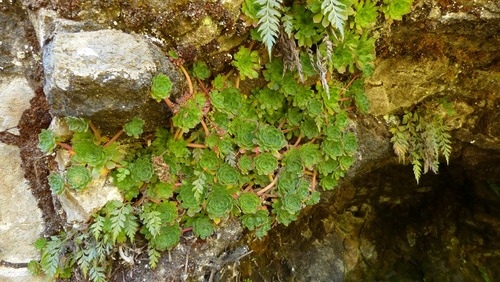
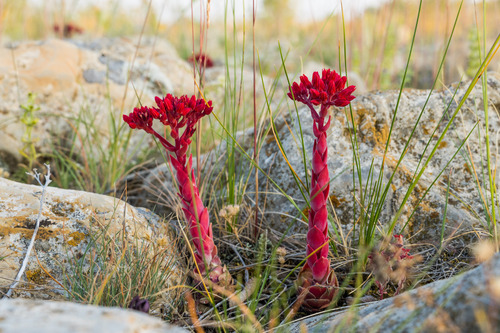
Dudleya lanceolata - (Nutt.)Britton.&Rose.
(Nutt.)Britton.&Rose.
Lanceleaf Liveforever
gbif· cc-by-nc
Boaz Benaiah Solorio
gbif· cc-by-nc
Aaron Echols
gbif· cc-by-nc
E. Merkt
Description
Dudleya lanceolata is an evergreen Perennial growing to 0.3 m (1ft) by 0.5 m (1ft 8in) at a medium rate. See above for USDA hardiness. It is hardy to UK zone 9 and is frost tender. The species is hermaphrodite (has both male and female organs) and is pollinated by Bees, insects. It is noted for attracting wildlife. Suitable for: light (sandy) and medium (loamy) soils and can grow in nutritionally poor soil. Suitable pH: mildly acid, neutral and basic (mildly alkaline) soils. It cannot grow in the shade. It prefers dry or moist soil and can tolerate drought.
Edible Uses
The edible part is the leaf. Lanceleaf rock lettuce tastes virtually identical to Panamint rock lettuce. That implies a succulent leafy food with variable astringency, often better in older leaves than in younger ones. Edible Uses & Rating: Lanceleaf rock lettuce ranks as a modest edible succulent rather than a major food plant. It is most useful where it grows naturally and where little else succulent and safe is available. Because it is often habitat-restricted and may be legally protected or ecologically sensitive, its modern foraging value is usually lower than its theoretical edibility might suggest. Taste, Processing & Kitchen Notes: If it follows Panamint rock lettuce closely, the leaves are likely best assessed by age. Younger leaves may be more astringent and less satisfying, while older leaves may become milder and more lettuce-like. Bitterness and low-level peppery or acrid overtones are likely possible, though probably lower than in many other Crassulaceae. In practical use, the leaves are best eaten fresh when mild, or lightly cooked if the astringency is strong. Seasonality (Phenology): Lanceleaf rock lettuce blooms from about April to July. Like many succulent perennials, its leaves persist beyond the flowering period, though condition and palatability may vary with drought intensity and age. Safety & Cautions (Food Use): The chief caution is conservation. Many Dudleya species are protected, habitat-restricted, or under collection pressure. Wild collection may be prohibited or unethical in many places. The plant should not be harvested except in genuine survival situations or where lawful, sustainable management clearly allows it. Harvest & Processing Workflow: If leaves are legally and ethically taken, the least damaging method is to remove only a few mature outer leaves from each rosette. They should be cleaned of dust and grit, then eaten fresh or briefly cooked if any harshness is noticeable. Cultivar/Selection Notes: Lanceleaf Dudleya is cultivated ornamentally in native plant and succulent circles, and horticultural selection usually favors attractive rosettes, clean foliage, and good flowering performance rather than edible quality. Look-Alikes & Confusion Risks: This species is very close to Panamint rock lettuce and Gila rock lettuce, differing mainly in size and distribution. It may also resemble other yellow-flowered California dudleyas. Species-level separation often depends on habitat, size, and floral or regional details rather than on a single dramatic trait. Traditional/Indigenous Use Summary: We place lanceleaf rock lettuce within the edible-leaved rock lettuces of southern California and Baja California, though it does not provide the same degree of specific cultural detail as mission lettuce or Panamint rock lettuce. Leaves - raw. Tender.
Medicinal Uses
Dudleya lanceolata (lanceleaf liveforever) has traditional medicinal uses, with some preliminary research indicating potential antioxidant and anti-inflammatory properties. Historically, some Dudleya species have been used for skin care or as a poultice, but specific, documented medicinal applications for D. lanceolata are limited. Key Points: Traditional Medicine: Some Dudleya species are used in traditional practices, and researchers are studying the genus for its potential to treat infections, inflammation, and injuries. Potential Health Benefits: Preliminary lab studies on Dudleya extracts suggest antioxidant and anti-inflammatory properties. Caution: Dudleya species are protected in some regions. Many species, including Dudleya lanceolata, are sensitive to overharvesting, which can harm them and their habitats.
Known Hazards
The chief caution is conservation. Many Dudleya species are protected, habitat-restricted, or under collection pressure. Wild collection may be prohibited or unethical in many places. The plant should not be harvested except in genuine survival situations or where lawful, sustainable management clearly allows it.
Distribution
South-western N. America.
Where It Grows
NORTHERN AMERICA: Mexico (Baja California (Norte))
Cultivation
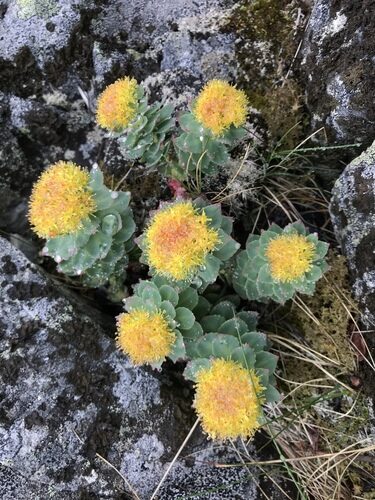
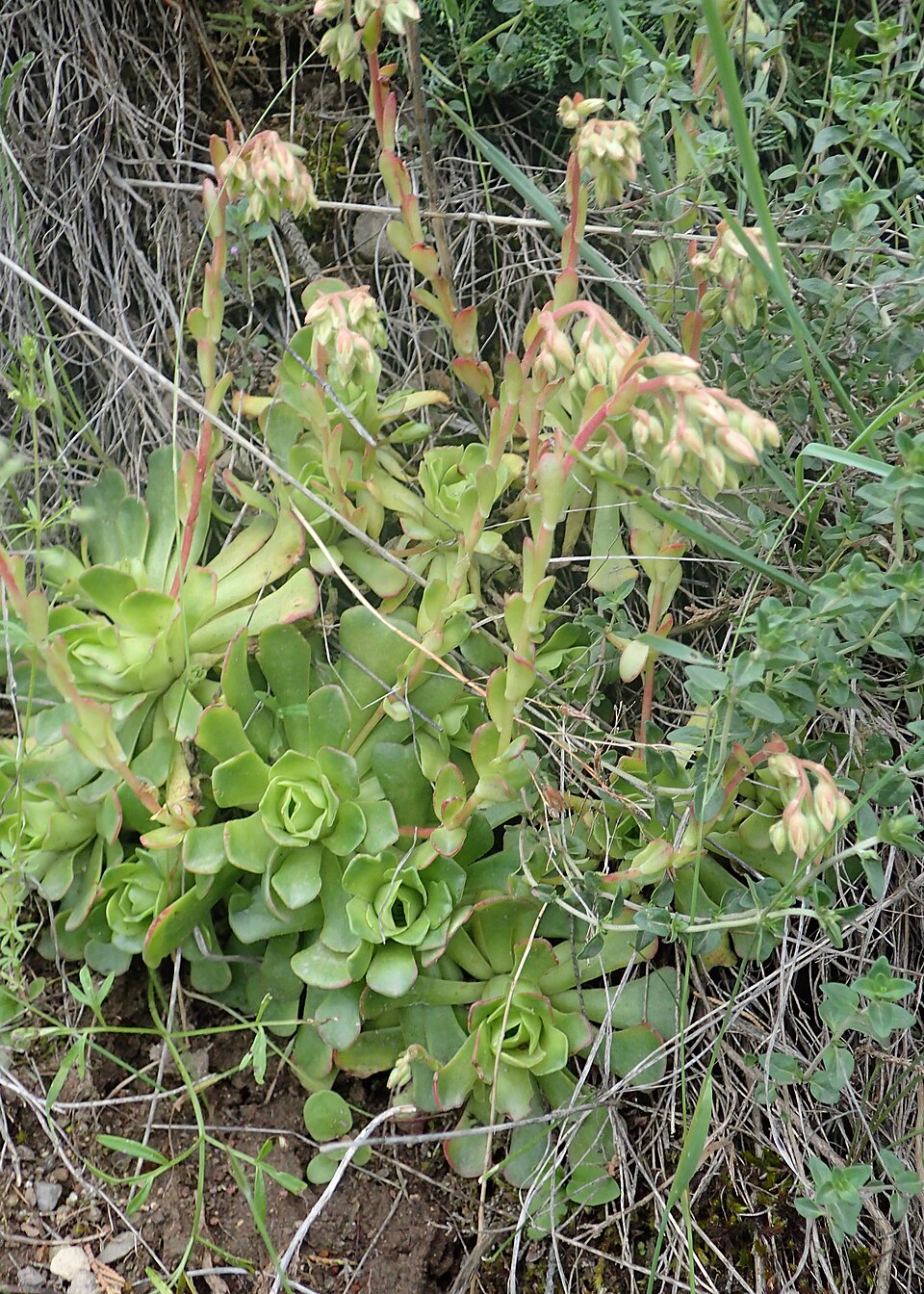
Lanceleaf rock lettuce is a useful but regionally limited edible succulent. Its greatest importance today may be as a native plant of high ornamental and ecological value, with food use remaining secondary and highly situational. Growing Conditions: It prefers rocky hillsides, excellent drainage, full sun near the coast or partial protection in hotter inland sites, and lean mineral soils. It performs best where winter moisture drains quickly, and summer watering is restrained. Habitat & Range: This species occurs on rocky hillsides in southern California and extends south into Baja California. It is strongly associated with dry, rocky slopes and outcrops. Size & Landscape Performance: It forms attractive star-like rosettes and sends up tall flowering stalks with yellow blossoms. In the landscape, it performs as a sculptural rock-garden succulent with strong seasonal floral interest. Cultivation (Horticulture): It is well-suited to rock gardens, crevice gardens, and native succulent plantings, provided overwatering is avoided. Inland heat may require a little protection from the harshest reflected summer sun. Pests & Problems: Rot from poor drainage is the principal threat. Snails, slugs, and crown moisture can also cause damage in cultivation. Identification & Habit: Lanceleaf rock lettuce is a hairless, fleshy perennial with thick lance-shaped basal leaves, reduced upper leaves on the stem, and one-sided cymes or panicles of yellow flowers. Pollinators: The yellow flowers are likely visited by small native bees, flies, and other generalist insect pollinators typical of open succulent blooms. Lanceleaf rock lettuce, accepted as Dudleya lanceolata, belongs to the stonecrop family (Crassulaceae) and the genus Dudleya. Common names include lanceleaf rock lettuce, lanceleaf dudleya, and lanceleaf liveforever. It is a perennial succulent native to southern California and northern Baja California. In cultivation it generally suits USDA Zones about 8–10, sometimes a bit warmer in wetter climates. Mature plants commonly form basal rosettes about 10–30 cm tall and 20–50 cm across, with flowering stalks substantially taller. This species is not very hardy outdoors and usually requires some protection from the frost.
Propagation
Propagation is mainly by seed and, where possible, by carefully handling offsets or divisions in cultivation.
Other Uses
Its greatest importance today may be as a native plant of high ornamental and ecological value, with food use remaining secondary and highly situational. Lanceleaf Dudleya is cultivated ornamentally in native plant and succulent circles, and horticultural selection usually favors attractive rosettes, clean foliage, and good flowering performance rather than edible quality. It forms attractive star-like rosettes and sends up tall flowering stalks with yellow blossoms. In the landscape it performs as a sculptural rock-garden succulent with strong seasonal floral interest. It is well suited to rock gardens, crevice gardens, and native succulent plantings. It occupies rocky drought-prone niches and provides seasonal nectar resources to insects. Its rosettes also stabilize tiny pockets of soil on slopes and outcrops.
Synonyms
Also Known As
Lanceleaf Rock Lettuce (Dudleya lanceolata).