Erythrococca bongensis
Pax
Hariadho
gbif· cc-by-sa
Susan Brown
gbif· cc-by-sa
Achamm
gbif· cc-by-sa
Susan Brown
Description
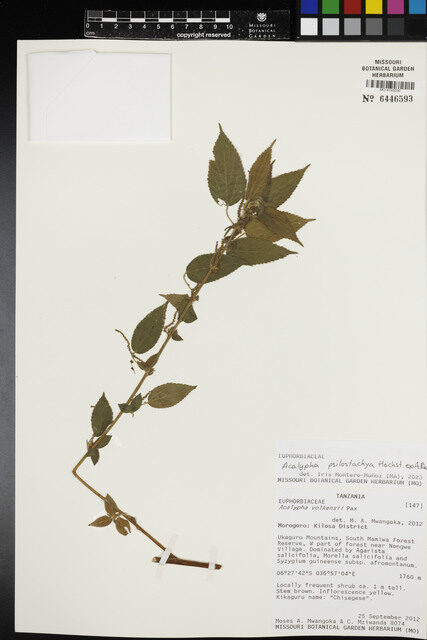
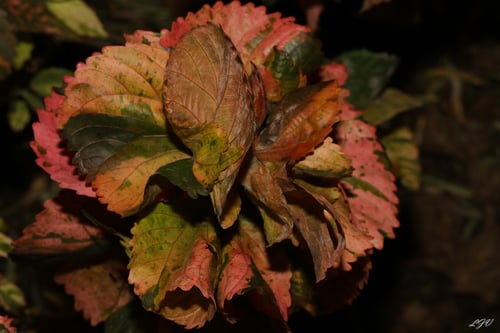
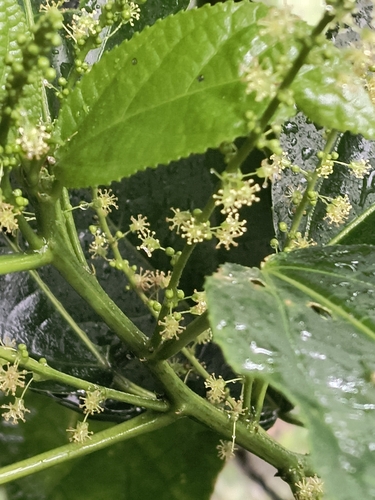
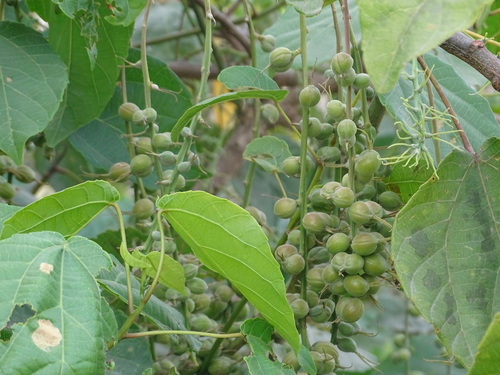
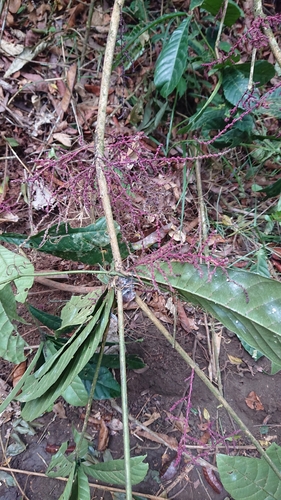
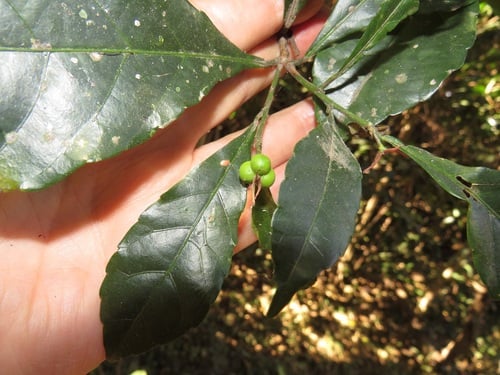
A shrub or small tree. It can be erect or laying over. It grows 3.5 m tall. The bark is pale grey and flaking. They young branches are grey-green and hairy when young. The leaves are simple and alternate. The leaf blades are oval and 3-8 cm long by 1-3 cm wide. Tress are separately male or female. The flowers are in a head. The fruit have 3 separate sections. These are about 4 mm across. They can be green or purple. There is one seed in each section.
Edible Uses
The leaves are eaten as a vegetable and used in sauces.
Traditional Uses
The leaves are eaten as a vegetable. They are also used in a sauce.
This uses section is brief — help expand it
Medicinal Uses
The leaves are anthelmintic, antitussive, stomachic and tonic. The sap is diluted with water and drunk, or the leaves are mixed with butter and eaten, as a treatment against cough. The leaves are eaten as a treatment for stomach complaints and to expel tapeworms. A decoction of the leaves is used as a fortifier for children, as a treatment for diarrhoea and, when salt is added, is used as a treatment for dehydration. A leaf decoction is used as a wash, or vapour bath, against diarrhoea. The leaves and stems are applied as an enema against haemorrhoids. A decoction of the leaves. combined with several other plants, is taken orally or is applied as an enema against diarrhoea. An infusioncombined with several other plants is applied as an enema against various skin infections. A decoction of the leaves, again combined with several other plants, is given as a drink to women whose foetus does not move. The leaf powder is sniffed as a preventative of vomiting. An infusion of the leaves is used as a wash to treat skin problems, while a decoction of leafy twigs is applied as a wash to treat rectal prolapse. A decoction of leaves and roots, sometimes combined with Hibiscus fuscus, is drunk to expel intestinal parasites. The root or leaf powder is taken in milk to treat tonsillitis. An infusion of the root is given as an enema against stomach-ache and indigestion. In veterinary medicine, the leaf sap is given to facilitate parturition. A decoction of the leaves is given in serious cases of anthrax and East Coast fever.
Distribution
A tropical plant. It grows on the edge of forest and along rivers and streams. It grows between 200-2,450 m altitude. Brisbane Botanical Gardens.
Where It Grows
Africa, Australia, Burundi, Central Africa, Congo DR, East Africa, Ethiopia, Kenya, Sudan, Tanzania, Uganda,
Cultivation
A dioecious species, both male and female forms need to be grown if fruit and seed are required.
Other Uses
The branches are used to make arrow shafts and walking sticks.
Nutrition
| Part | Moisture | kJ | kcal | Protein | Vit A | Vit C | Iron | Zinc |
|---|---|---|---|---|---|---|---|---|
| Leaves raw | 68 | 443 | 106 | 7.2 | — | — | — | — |
| Leaves | 90 | — | — | — | — | 8.3 | 2.6 | — |
Synonyms
Also Known As
Acululu
References (10)
- Anywar, G., et al, 2014, Wild Plants Used as Nutraceuticals from Nebbi District, Uganda. European Journal of medicinal Plants. 4(6):641-660
- Anymar, G., et al, 2017, Proximate Nutrient Composition of some Wild Edible Medicinal Plants from Uganda. Afr. J. Food gric. Nutr. Dev. 2017; 17(3): 12215-12226
- Bussman, R. W., et al., 2006, Plant Use of the Maasai of Sekenani Valley, Maasai Mara, Kenya. Journal of Ethnobiology and Ethnomedicine. 2:22
- East African Herbarium records, 1981,
- Food Composition Tables for use in Africa FAO http://www.fao.org/infoods/directory No. 629
Show all 10 references Hide references
- Johns, T., and Kokwaro, J.O., 1991, Food Plants of the Luo of Siayo District, Kenya. Economic Botany 45(1), pp 103-113
- Nzigidahera, B., 2006, Assessment of Socio-cultural, Economic Charasteristics and Livelihood of Riparian Population of the Kibira National Park. UNDP
- Oyen, L.P.A., 2008. Erythrococca bongensis Pax. [Internet] Record from Protabase. Schmelzer, G.H. & Gurib-Fakim, A. (Editors). PROTA (Plant Resources of Tropical Africa), Wageningen, Netherlands. < http://database.prota.org/search.htm>. Accessed 16 October 2009.
- Peters, C. R., O'Brien, E. M., and Drummond, R.B., 1992, Edible Wild plants of Sub-saharan Africa. Kew. p 110
- World Checklist of Useful Plant Species 2020. Royal Botanic Gardens, Kew