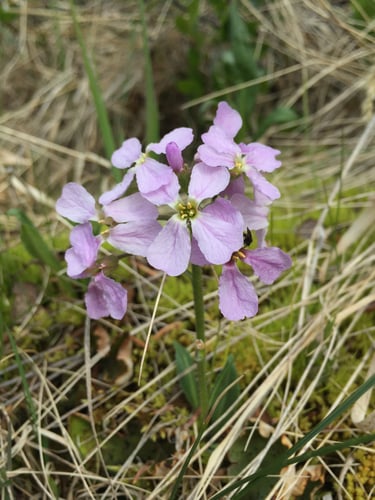
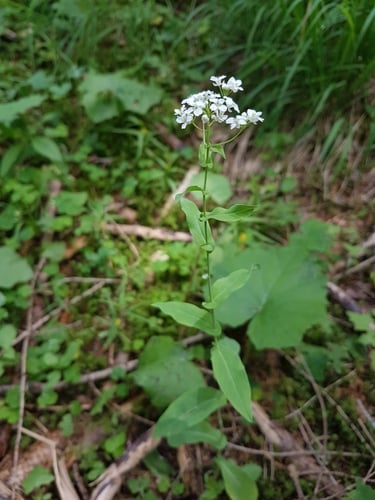
Alyssum alyssoides - (L.) L.
(L.) L.
Pale Madwort
gbif· cc-by-nc
Martin A. Prinz
gbif· cc-by-nc
Izan Lopez Vergel
gbif· cc-by-nc
Izan Lopez Vergel
Description
Alyssum alyssoides is a ANNUAL growing to 0.2 m (0ft 8in) by 0.2 m (0ft 8in) at a fast rate. See above for USDA hardiness. It is hardy to UK zone 5 and is not frost tender. The flowers are pollinated by Insects. It is noted for attracting wildlife. Suitable for: light (sandy) and medium (loamy) soils, prefers well-drained soil and can grow in nutritionally poor soil. Suitable pH: mildly acid, neutral and basic (mildly alkaline) soils. It can grow in semi-shade (light woodland) or no shade. It prefers dry or moist soil and can tolerate drought.
Edible Uses
Leaves – edible fresh or cooked. Flavor is reportedly mild, though stellate (star-like) hairs cover the surfaces and may be unpleasant. Cooking does not remove the hairs. Leaves could serve as a minor green vegetable if eaten in moderation. Seeds – not well documented for this species, but related species (A. desertorum) have mild-tasting seeds with soft texture when raw, toasted, or boiled. Seeds are winged and fall easily from pods. Further safety evaluation is needed. Other parts are not reported as edible. Caution: The genus is poorly studied for edibility. Safety is not well established, so use sparingly until more is known. Edibility Rating: 2/5 – Mild leaves edible, seeds possible but undocumented. Limited value due to hairs, small size, and lack of thorough safety information.
Known Hazards
The genus is poorly studied for edibility. Safety is not well established, so use sparingly until more is known.
Distribution
Native to Eurasia; naturalized in much of North America.
Where It Grows
Afghanistan, Albania, Austria, Baltic States, Belarus, Belgium, Bulgaria, Central European Russia, Corse, Cyprus, Czechia-Slovakia, East European Russia, France, Germany, Greece, Hungary, Iran, Italy, Kazakhstan, Kirgizstan, Krym, Lebanon-Syria, Morocco, Netherlands, North Caucasus, NW. Balkan Pen., Poland, Portugal, Romania, Sardegna, South European Russia, Spain, Switzerland, Tadzhikistan, Transcaucasus, Turkmenistan, Türkey, Türkey-in-Europe, Ukraine, Uzbekistan.
Cultivation
A small, short-lived annual, usually about 5–20 cm tall, sometimes to ~25 cm, forming loose, low mounds or patches roughly 10–30 cm across, depending on density and crowding. Survives in a wide range of climates. Growing Conditions: Sun: Prefers full sun; tolerates partial sun. Soil: Adaptable to sandy, rocky, or disturbed soils; tolerates poor fertility. Moisture: Prefers dry to moderately moist soils, often found in semi-arid regions. Tolerance: Thrives in disturbed ground and open habitats, but is not shade-tolerant. Best suited for zones 4–8, although it may also occur outside these zones where winters are not extreme. An annual plant that grows primarily in the temperate biome. Native to Eurasia; naturalized in much of North America. Common in sagebrush valleys, bluffs, disturbed fields, pastures, and mountains up to 2,000 m. Blooms May–June; seeds ripen in summer. It’s primarily insect-pollinated: the small yellowish flowers attract tiny solitary bees, hoverflies, other flies, and small beetles, and it’s also capable of some self-pollination when visits are scarce.
Propagation
Seed.
Synonyms
Also Known As
Pale madwort, lesser madwort, yellow alyssum (Alyssum alyssoides (L.) L.).