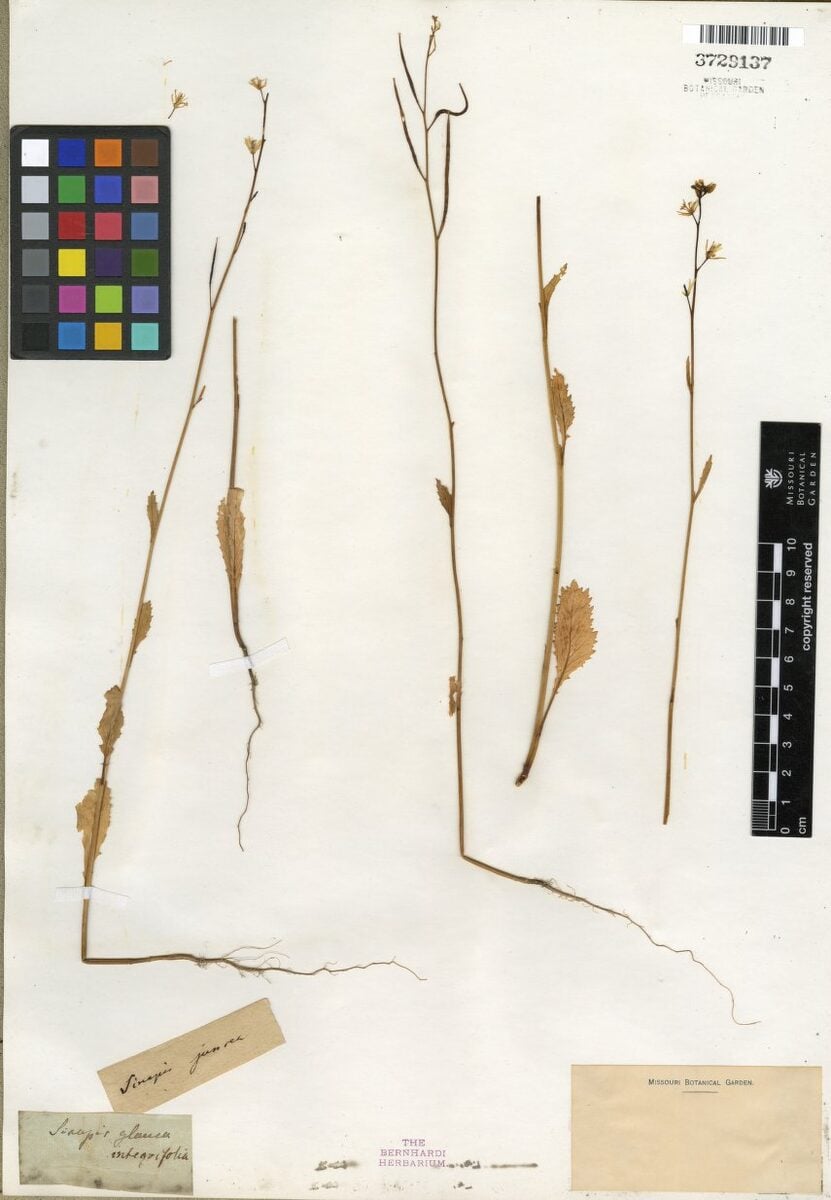
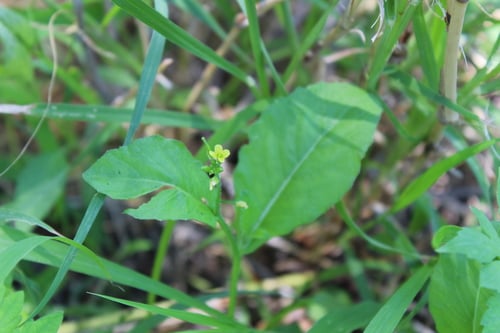
Crambe hispanica
L.
Spanish seakale
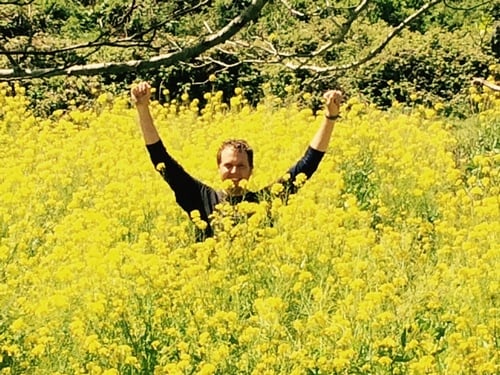
iNaturalist· cc-by-nc
(c) faluke, some rights reserved (CC BY-NC), uploaded by faluke
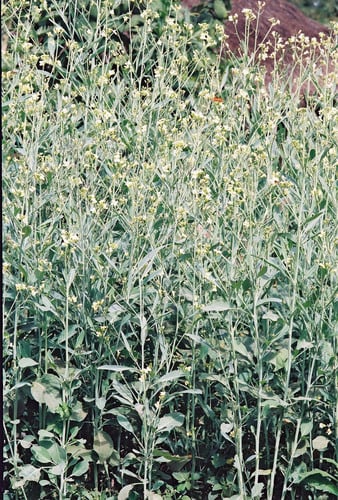
iNaturalist· cc-by-nc
(c) Sandro Bogdanović, some rights reserved (CC BY-NC)
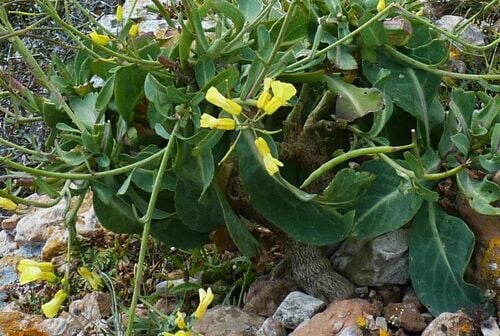
iNaturalist· cc-by-nc
(c) Sandro Bogdanović, some rights reserved (CC BY-NC)
Description
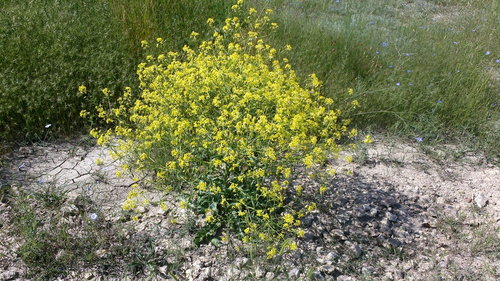
A cabbage family herb. It is a slender erect annual plant. It has bristles and grows 1 m tall. The lower leaves are large and kidney shaped or rounded with teeth around the edge. The flowers are white and 3-4 mm across. The petals can be tinged with purple at the base. The flowers are in a large branched panicle. The pod is 2-4 mm long. It has one seed.
Edible Uses
There are records from the 18th century of local people along the beaches of Kent, Sussex and Hampshire digging out and harvesting the emerging shoots as a vegetable from naturally occurring root crowns in the early springtime. This custom was first reported by Phillip Miller in his 1731 Gardener's Dictionary as practised among the people of Sussex, and it was seen once in the 18th century being sold as food at the Chichester market in 1753. John Martyn was the first to publish some practical notes on cultivating the plant in a late edition of Miller's work, but William Curtis was the first to publish a tract about his experiments of growing the plant as a vegetable crop in London in 1799, just before his death, with John Maher giving a reading before the Horticultural Society of London in 1805 which elaborated slightly on the work of Curtis. Both Curtis and Maher recommended growing the plant as a forced, blanched vegetable, growing the root crown in a ceramic cylinder which could be capped with a closed blanching pot. Over and about this pot fresh manure would be heaped a few feet deep, the heat produced when this dung rotted would be sufficient to force the plant to bolt as early as December, although later in the winter was recommended. For those without the financial means to purchase expensive blanching pots, Maher suggests covering the plants in a mat covered by a thick layer of gravel, and Curtis mentions simply hoeing a foot of soil over the crown, or piling sea sand, pebbles or coal ash over it, although both agree this will produce a much inferior crop. An area of roughly five square feet could hold a single root crown consisting of three plants, which after growing out from seed for three years could be forced at least twice a season to yield four to six shoots of up to twelve inches, although usually much less. Thomas Jefferson grew sea kale at Monticello between 1820 and 1825. It was served at the Royal Pavilion in Brighton, when Prince Regent George IV of the United Kingdom (1762–1830) used it as a seaside retreat. By the Victorian Era sea kale had become "in very general use" as a vegetable in Britain, according to the popular cookbook Mrs Beeton's Book of Household Management, in which it is called a type of asparagus, although at nine pennies for a basket of sprouts, it was one of the most expensive vegetables to be had. Its cultivation is discussed in older books on vegetable growing. Wild stocks were severely reduced in Britain by forcing in situ and collecting for food until the practice was banned in the early 20th century. Sea kale fell out of favour, but in the early 21st century, British chefs made it fashionable again. It is commercially grown by a number of farmers in Britain. A tiny experimental plot of sea kale is cultivated on Texel, a North Sea island in the Netherlands. It is irrigated with adulterated seawater. Maher mentions that he personally considered blanched sea kale a delicacy. Curtis says that as a food, boiled twenty minutes and covered in melted butter, it resembled most asparagus, although with hints of cabbage. He reports most he served it to found it agreeable; although some found it no better than cabbage, others found it superior even to asparagus. Although Curtis had never tried to do so himself, he mentions someone once made a decent stew of it and also theorizes that perhaps it might be well suited to be pickled.
Distribution
It grows in tropical and warm temperate places. It grows on coastal and inland areas often on rocky land. It can grow in arid places.
Where It Grows
Africa, Australia, Central Africa, Congo, Cyprus, East Africa, Ethiopia, Europe, Greece, Iran, Israel, Italy, Jordan, Kenya, Lebanon, Mediterranean, Middle East, Morocco, Nigeria, North Africa, Portugal, Rwanda, Somalia, South America, Spain, Syria, Tanzania, Turkey, Türkiye, Uganda, Venezuela, West Africa, Yugoslavia, Zimbabwe,
Notes
There are about 20 Crambe species.
Synonyms
Also Known As
Woppa
References (9)
- Blamey, M and Grey-Wilson, C., 2005, Wild flowers of the Mediterranean. A & C Black London. p 69
- Glover, et al, 1966b, (As Crambe abyssinica)
- Grubben, G. J. H. and Denton, O. A. (eds), 2004, Plant Resources of Tropical Africa 2. Vegetables. PROTA, Wageningen, Netherlands. p 560
- Kidane, B., et al, 2014, Wild and semi-wild leafy vegetables used by the Maale and Ari ethnic communities in southern Ethiopia. Genetic Resour Crop Evol. Springer. p 8
- Peters, C. R., O'Brien, E. M., and Drummond, R.B., 1992, Edible Wild plants of Sub-saharan Africa. Kew. p 97
Show all 9 references Hide references
- Royal Botanic Gardens, Kew (1999). Survey of Economic Plants for Arid and Semi-Arid Lands (SEPASAL) database. Published on the Internet; http://www.rbgkew.org.uk/ceb/sepasal/internet [Accessed 15th April 2011]
- Sp. pl. 2:671. 1753
- USDA, ARS, National Genetic Resources Program. Germplasm Resources Information Network - (GRIN). [Online Database] National Germplasm Resources Laboratory, Beltsville, Maryland. Available: www.ars-grin.gov/cgi-bin/npgs/html/econ.pl (10 April 2000)
- World Checklist of Useful Plant Species 2020. Royal Botanic Gardens, Kew