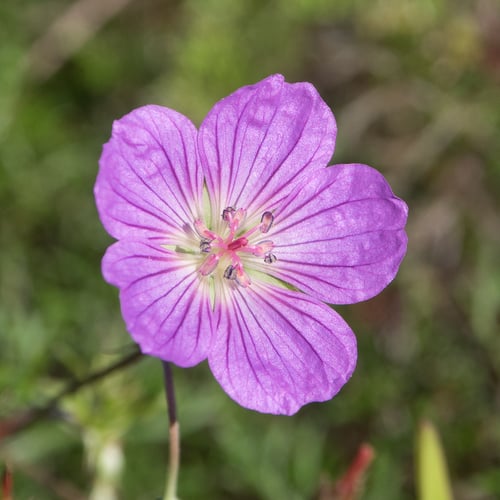
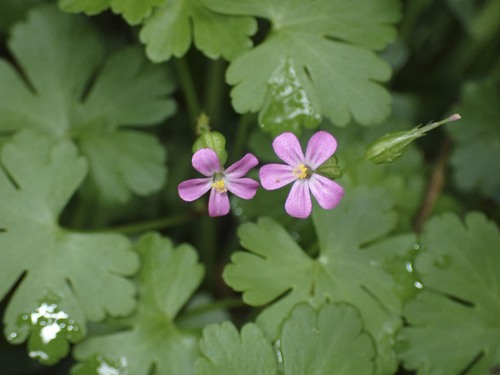
Erodium cicutarium
(L.) L’ Herit ex Aiton
Common Storksbill, Red-stem Filaree
iNaturalist· cc-by-nc
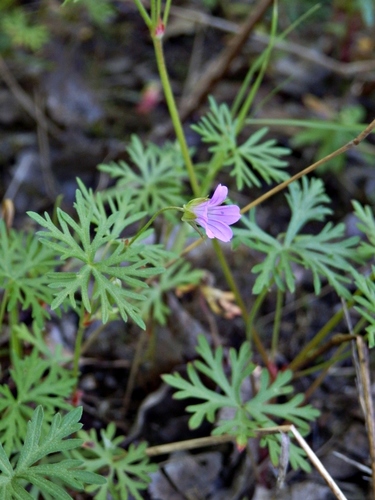
(c) Bryan, some rights reserved (CC BY-NC), uploaded by Bryan
iNaturalist· cc-by-nc
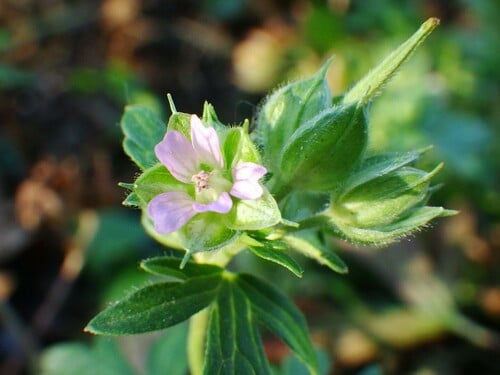
(c) Valentin Hamon, some rights reserved (CC BY-NC)
iNaturalist· cc-by
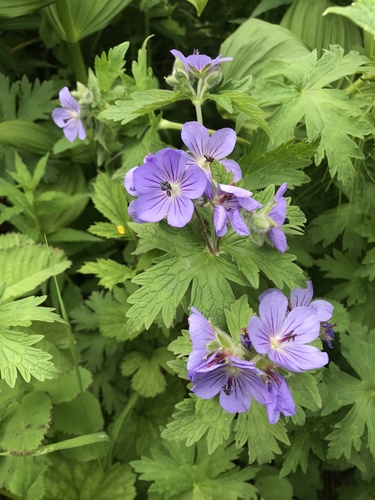
(c) Michael J. Papay, some rights reserved (CC BY), uploaded by Michael J. Papay
Summary
Source: WikipediaErodium cicutarium, also known as common stork's-bill, redstem filaree, redstem stork's bill or pinweed, is a herbaceous annual – or in warm climates, biennial – member of the family Geraniaceae of flowering plants. It is native to Macaronesia, temperate Eurasia and north and northeast Africa, and was introduced to North America in the eighteenth century, where it has since become naturalized, particularly in the deserts and arid grasslands of the southwestern United States.
Description
An annual herb. The stems are creeping or can curve upwards. They are 20-30 cm long. The leaves are deeply divided and 10 cm long. They are feather-like. The flowers are pink. They occur in clusters of 1-9 on the ends of branches. The fruit have long slender beaks. It is a very variable plant.
Edible Uses
Young leaves, harvested in spring before the plant flowers, are tasty and nutritious eaten raw or cooked as a potherb. They work well in salads, sandwiches, and soups, and can substitute for beet, plantain, sow thistle, or amaranth leaves in recipes. Young stems can be eaten raw. Children have traditionally chewed the root as a gum.
Traditional Uses
The young plant is cooked and eaten or also eaten raw. They can be added to salads, sauces, omelettes, sandwiches, or soups. The bottom of the young fruit is chewed.
Medicinal Uses
The whole plant is astringent and haemostatic, and has been used to treat uterine and other bleeding. The root and leaves have been eaten by nursing mothers to increase milk flow. Externally, the plant has been used as a wash for animal bites and skin infections. A poultice of the chewed root can be applied to sores and rashes. A tea made from the leaves is diaphoretic and diuretic, and an infusion has been used to treat typhoid fever. The leaves are soaked in bath water to treat rheumatism. The seeds contain vitamin K, and a poultice made from them is applied to gouty typhus.
Distribution
It is a temperate plant. It grows in grassland. In temperate China it grows on flood plains between 700-2,200 m above sea level. Tasmania Herbarium.
Where It Grows
Afghanistan, Africa, Albania, Algeria, Arabia, Argentina, Armenia, Australia, Austria, Azores, Balkans, Belarus, Belgium, Bolivia, Bosnia, Brazil, Britain, Bulgaria, Canada, Canary Islands, Caucasus, Central America, Central Asia, Chile, China, Crete, Croatia, Cyprus, Czech Republic, Denmark, Ecuador, Egypt, Estonia, Europe*, Falklands, Finland, France, Georgia, Germany, Greece, Guatemala, Hungary, India, Iran, Iraq, Ireland, Israel, Italy, Jordan, Kazakhstan, Korea, Kuwait, Kyrgyzstan, Latvia, Lebanon, Lesotho, Libya, Lithuania, Luxembourg, Macedonia, Mediterranean, Mexico, Middle East, Moldova, Morocco, Netherlands, New Zealand, North Africa, North America, Norway, Oman, Pakistan, Peru, Philippines, Poland, Romania, Russia, Saudi Arabia, Scandinavia, SE Asia, Siberia, Slovakia, Slovenia, South Africa, Southern Africa, South America, Spain, Switzerland, Syria, Taiwan, Tajikistan, Tasmania, Tunisia, Turkey, Türkiye, Turkmenistan, Ukraine, USA, Uzbekistan, Yemen, Yugoslavia,
Cultivation
Plants can be grown by seeds or by division of the roots.
Propagation
Sow seed in situ as soon as it is ripe in late summer, or alternatively in late spring. Germination usually takes place within 3 weeks.
Other Uses
A green dye obtained from the whole plant requires no mordant. The remnants of the styles are highly hygroscopic and can be used in hygrometers and as weather indicators. Dried plant powder has been mixed with watermelon seeds during storage and planting to help prevent watermelon disease.
Other Information
It is cultivated.
Notes
There are about 60 Erodium species.
Synonyms
Also Known As
Alfilaria, Alfileres, Alfilerillo, Cachu loica, Carota selvaggia, Derzidank, Derzikepire, Filaree, Iglica, Ignelik, Karga didagi, Kocakarı iğnesi, Mam darzila, Navadni čapljevec, Pin grass, Pirexalace, Pirxalack, Redstem filaree, Relojito, Sagdandan, Sahatoka, Savartskhela, Storksbill, Turnagagas, Wild musk
References (55)
- W. Aiton, Hort. kew. 2:414. 1789
- Ambasta, S.P. (Ed.), 2000, The Useful Plants of India. CSIR India. p 202
- Beckstrom-Sternberg, Stephen M., and James A. Duke. "The Foodplant Database." http://probe.nalusda.gov:8300/cgi-bin/browse/foodplantdb.(ACEDB version 4.0 - data version July 1994)
- Biscotti, N. et al, 2018, The traditional food use of wild vegetables in Apulia (Italy) in the light of Italian ethnobotanical literature. Italian Botanist 5:1-24
- Blamey, M and Grey-Wilson, C., 2005, Wild flowers of the Mediterranean. A & C Black London. p 114
Show all 55 references Hide references
- Bocek, B. R., 1984, Ethnobotany of Costanoan Indians, California, Based on Collections by John P. Harrington. Economic Botany 38(2): 240-255
- Bodkin, F., 1991, Encyclopedia Botanica. Cornstalk publishing, p 399
- Bussman, R. W., et al, 2021, Unity in diversity—food plants and fungi of Sakartvelo (Republic of Georgia), Caucasus. Journal of Ethnobiology and Ethnomedicine (2021) 17:72 p 9
- Cordero, S. E., Abello, L. A., & Galvez, F. L., 2017, Plantas silvestres comestibles y medicinales de Chile y otras partes del mundo. CORMA p 160
- Curtis, W.M., 1956, The Students Flora of Tasmania Vol 1 p 93
- Dashorst, G.R.M., and Jessop, J.P., 1998, Plants of the Adelaide Plains & Hills. Botanic Gardens of Adelaide and State Herbarium. p 92
- Demir, I. & Ayaz, N., 2022, Wild edible plants contributing to the traditional foods of Mardin (Turkey) Province. Indian Journal of Traditional Knowledge Vol 21(3), July 2022, pp 569-582
- Dogan, Y., 2012, Traditionally used wild edible greens in the Aegean Region of Turkey. Acta Societatis Botanicorum Poloniae 81(4): 329-342
- Dogan, Y. et al, 2013, Wild Edible Plants sold in the Local Markets of Izmir, Turkey. Pak. J. Bot. 45(S1): 177-184
- Duke, J.A., 1992, Handbook of Edible Weeds. CRC Press. p 96
- Elias, T.S. & Dykeman P.A., 1990, Edible Wild Plants. A North American Field guide. Sterling, New York p 109
- Ertug, F., 2000, An Ethnobotanical Study in Central Anatolia (Turkey). Economic Botany Vol. 54. No. 2. pp. 155-182
- Ertug, F., 2004, Wild Edible Plants of the Bodrum Area. (Mugla, Turkey). Turk. J. Bot. 28 (2004): 161-174
- Ertug, F, Yenen Bitkiler. Resimli Türkiye Florası -I- Flora of Turkey - Ethnobotany supplement
- Esperanca, M. J., 1988. Surviving in the wild. A glance at the wild plants and their uses. Vol. 2. p 260
- Facciola, S., 1998, Cornucopia 2: a Source Book of Edible Plants. Kampong Publications, p 117
- Flora of Pakistan. www.eFloras.org
- Galalaey, A. M. K., et al, 2021, Ethnobotanical study of some wild edible plants in Hujran Bason, Kurdistan Region of Iraq. ZANCO Journal of Pure and Applied Sciences. Salahaddin University-Erbil p 27
- Gonzalez, J. A., et al, 2011, The consumption of wild and semi-domesticated edible plants in the Arribes del Duero (Salamanca-Zamora, Spain): an ananalysis of traditional knowledge. Genetic. Resour Crop Evolution 58:991-1006
- Harris, S., Buchanan, A., Connolly, A., 2001, One Hundred Islands: The Flora of the Outer Furneaux. Tas Govt. p 152
- Hedrick, U.P., 1919, (Ed.), Sturtevant's edible plants of the world. p 293
- Hussey, B.M.J., Keighery, G.J., Cousens, R.D., Dodd, J., Lloyd, S.G., 1997, Western Weeds. A guide to the weeds of Western Australia. Plant Protection Society of Western Australia. p 166
- Hyde-Wyatt, B.H. & Morris D.I., 1975, Tasmanian Weed Handbook. Dept of Ag Tasmania. p 70
- Irving, M., 2009, The Forager Handbook, A Guide to the Edible Plants of Britain. Ebury Press p 184
- Kargioglu, M., et al, 2008, An Ethnobotanical Survey of Inner-West Anatolia, Turkey. Human Ecology 36:763-777
- Kargioglu, M. et al, 2010, Traditional Uses of Wild Plants in the Middle Aegean Region. Human Ecology 38:429-450
- Ladio, A. H. & Lozada, M., 2000, Edible Plant Use in a Mapuche Community of North-western Patagonia, Human Ecology. Vol. 28, No. 1. pp. 53-71
- Ladio, A. H., 2001, The Maintenance of Wild Edible Plant Gatherings in a Mapuche Community of Patagonia. Economic Botany, Vol. 55, No. 2, pp. 243-254
- Ladio, A. H. and Lozada, M., 2003, Comparison of wild edible plant diversity and foraging strategies in two aboriginal communities of northwestern Patagonia. Biodiversity and Conservation 12: 937–951
- Ladio, A. H. and Lozada, M., 2004, Patterns of use and knowledge of wild edible plants in distinct ecological environments: a case study of a Mapuche community from northwestern Patagonia. Biodiversity and Conservation 13:1153-1173
- Lamp, C & Collet F., 1989, Field Guide to Weeds in Australia. Inkata Press. p 120
- Lazarides, M. & Hince, B., 1993, Handbook of Economic Plants of Australia, CSIRO. p 95
- Luczaj et al, 2013, Wild vegetable mixes sold in the markets of Dalmatia (southern Croatia). Journal of Ethnobiology and Ethnomedicine. 8:2
- Luczaj, L. et al, 2013, Wild food plants used in the villages of the Lake Vrana Nature Park (northern Dalmatia, Croatia). Acta Societatis Botanicorum Poloniae, 82(4): 275-281
- Luczaj, L. et al, 2014, Wild Food Plants of Dalmatia (Croatia). in A. Pieroni, C. L. Quave (eds.), Ethnobotany and Biocultural Diversities in the Balkans, p 142
- MacKinnon, A., et al, 2009, Edible & Medicinal Plants of Canada. Lone Pine. p 221
- MacMahon, J.A., 1990, Deserts. Audubon Society Nature Guides. Knopf. p 364 Plate 57
- Moerman, D. F., 2010, Native American Ethnobotany. Timber Press. p 225
- Ozbucak, T. B. et al, 2006, The Contribution of Wild Edible Plants to Human Nutrition in the Black Sea Region of Turkey. Ethnobotanical Leaflets 10: 98-103
- Özdemir, E. and Kültür, S., 2017, Wild Edible Plants of Savaştepe District (Balıkesir, Turkey), Marmara Pharm J 21/3: 578-589
- Paczkowska, G. & Chapman, A.R., 2000, The Western Australian Flora. A Descriptive Catalogue. Western Australian Herbarium. p 252
- Plants for a Future database, The Field, Penpol, Lostwithiel, Cornwall, PL22 0NG, UK. http://www.scs.leeds.ac.uk/pfaf/ (Also as Erodium cicutarium var. bipinnatum)
- Senkardes, I & Tuzlaci, E., 2016, Wild Edible Plants of Southern Part of Nevsehir inTurkey. Marmara Pharmaceutical Journal 20:34-43
- Tasmanian Herbarium Vascular Plants list p 32
- Tardio, J., et al, Ethnobotanical review of wild edible plants in Spain. Botanical J. Linnean Soc. 152 (2006), 27-71
- Tareen, N. M., et al, 2016, Ethnomedicinal Utilization of Wild Edible Vegetables in District Harnai of Balochistan Province - Pakistan. Pakistan Journal of Botany 48(3): 1159-1171
- Upson, R., & Lewis R., 2014, Updated Vascular Plant Checklist and Atlas for the Falkland Islands. Falklands Conservation and Kew.
- Yesil, Y., et al, 2019, Wild edible plants in Yeşilli (Mardin-Turkey), a multicultural area. Journal of Ethnobiology and Ethnomedicine (2019) 15:52
- Yesil, Y., et al, 2019, Traditional knowledge of wild edible plants in Hasankeyf (Batman Province, Turkey). Acta Societatis Botanicorum Poloniae. 88(3):3633
- Zeven, A. C. & de West, J. M. J., 1982, Dictionary of cultivated plants and their regions of diversity. Wageningen. p 108