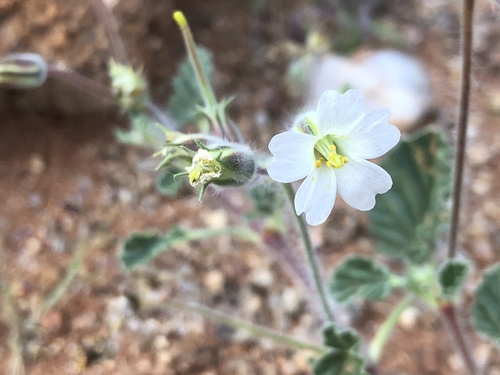
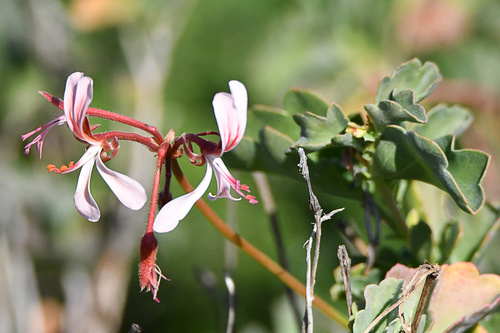
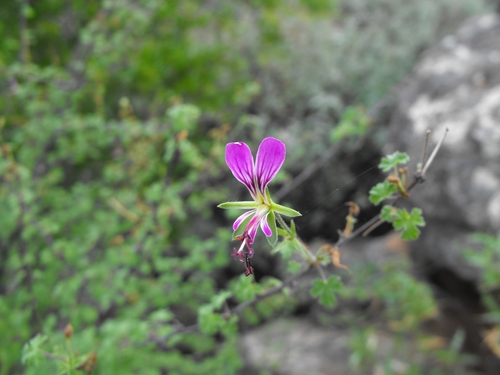
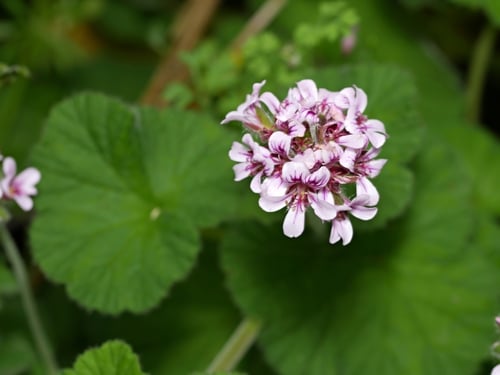
Geranium viscosissimum
Fisch. & C.A. Mey.
Sticky geranium, Sticky purple cranesbill
iNaturalist· cc-by-nc
(c) dnydick, some rights reserved (CC BY-NC), uploaded by dnydick
iNaturalist· cc0
no rights reserved, uploaded by Kallum McDonald
iNaturalist· cc-by-nc
(c) Kuxansum, some rights reserved (CC BY-NC)
Summary
Source: WikipediaGeranium viscosissimum, commonly known as the sticky purple geranium, is a perennial in the flowering plant family Geraniaceae. It is thought to be a protocarnivorous plant.
Description
A herb. It keeps growing from year to year. It has hairy glands. The stems are 60 cm tall. The leaves have 3-5 lobes. The leaf stalks are slender. The lobes have coarse teeth. The flowers are in clusters and are reddish-purple. The fruit is a dry capsule with a long beak.
Edible Uses
Flowers can be added to salads or used as a garnish. Leaves are edible raw or cooked, though they are not considered choice eating.
Traditional Uses
The flowers are eaten. They are added to salads.
This uses section is brief — help expand it
Medicinal Uses
The whole plant is astringent, salve-like, and styptic. An infusion of the leaves, combined with a steam or sweat bath using the leaves, is used to treat colds. The infusion also serves as a gargle for sore throats. A wash made from an infusion of the leaves or roots is applied to sore eyes. A poultice of the leaves or roots has been used on cuts and sores.
Distribution
It is a temperate plant. It grows in subalpine woodland meadows in the Rocky Mountains.
Where It Grows
Australia, Canada, North America, Tasmania, USA,
Cultivation
Succeeds in any good soil in sun or partial shade. Plants are hardy to about -25°c. Members of this genus are rarely if ever troubled by browsing deer or rabbits. This species is closely related to G. nervosum.
Propagation
Sow seed in spring in a cold frame. Once seedlings are large enough to handle, prick them out into individual pots and plant out during summer. Divide clumps in spring or autumn — larger clumps can go directly into permanent positions, but smaller ones are best potted up and grown on in a cold frame until well rooted, then planted out in spring.
Other Uses
None known
Notes
There are about 300-400 Geranium species. They are mostly temperate.
References (6)
- Cormack, R. G. H., 1967, Wild Flowers of Alberta. Commercial Printers Edmonton, Canada. p 190
- Facciola, S., 1998, Cornucopia 2: a Source Book of Edible Plants. Kampong Publications, p 118
- F. E. L. Fischer & J. L. E. Ave-Lallemant, Index sem. hort. petrop. 11(suppl.):18. 1846
- Hibbert, M., 2002, The Aussie Plant Finder 2002, Florilegium. p 110
- Plants for a Future database, The Field, Penpol, Lostwithiel, Cornwall, PL22 0NG, UK. http://www.scs.leeds.ac.uk/pfaf/
Show all 6 references Hide references
- Porsild, A.E., 1974, Rocky Mountain Wild Flowers. Natural History Series No. 2 National Museums of Canada. p 270