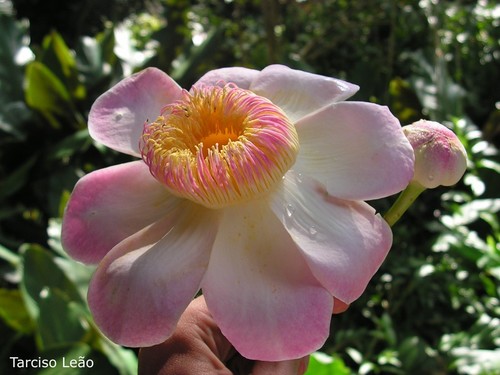
Lecythis pisonis
Cambess.
Paradise Nut. Brazilian Monkey Pot
iNaturalist· cc-by-nc
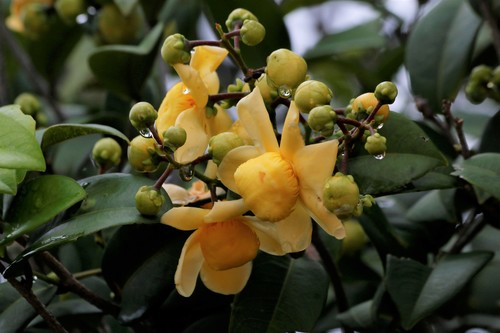
(c) Marinês Eiterer, some rights reserved (CC BY-NC), uploaded by Marinês Eiterer
iNaturalist· cc-by-nc
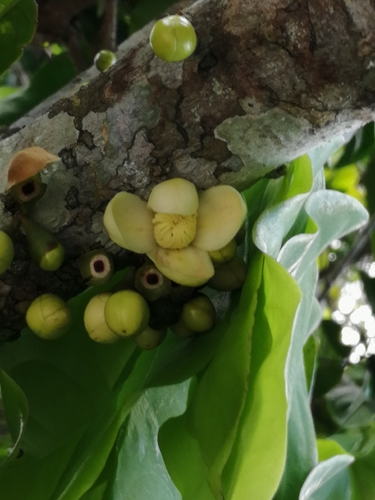
(c) Diego Monsores, some rights reserved (CC BY-NC), uploaded by Diego Monsores
iNaturalist· cc-by-nc
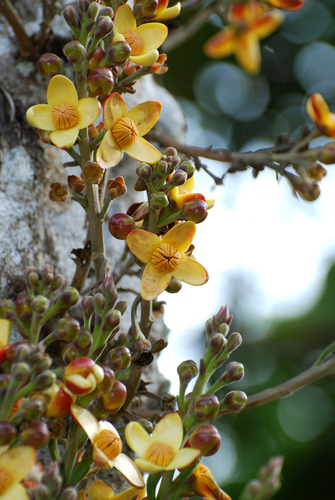
(c) Diego Monsores, some rights reserved (CC BY-NC), uploaded by Diego Monsores
Description
Lecythis pisonis is a deciduous Tree growing to 40 m (131ft) by 30 m (98ft) at a medium rate. See above for USDA hardiness. It is hardy to UK zone 10. The flowers are pollinated by Bees, insects. Suitable for: medium (loamy) and heavy (clay) soils. Suitable pH: mildly acid, neutral and basic (mildly alkaline) soils. It cannot grow in the shade. It prefers moist or wet soil.
Edible Uses
Oil. Seed - raw. Rich in oil, they are similar to the Brazil nut in size and shape. When ripe, the ivory-white kernels have a delicious flavour with a soft, almost creamy texture. The seeds are said to be sweeter than Brazil nuts, with a superior flavour and easier to digest. A very nutritious seed, containing about 63% oil or fat and 20% protein. Seeds are about 5cm long and 2.5cm thick. The shell is thin and easily broken, when quite fresh, however, this shell is said to contain a poisonous principle. An edible oil can be obtained from the seed. Pale yellow in colour, suggestive of almond oil in both taste and smell. The harmful seed coat must be removed before extraction of the oil.
Medicinal Uses
Infusions of the bark and pericarp are used in local medicine for treating liver complaints.
Known Hazards
The fresh, ripe seed shell is said to contain a poisonous principle. The seeds are likely to contain toxic quantities of selenium when grown on soils high in selenium.
Distribution
S. America - northern and eastern Brazil, Peru.
Where It Grows
SOUTHERN AMERICA: Brazil (Amazonas, Bahia, Espírito Santo, Maranhão, Minas Gerais, Pará, Pernambuco, Rio de Janeiro, Rondônia), Peru (Loreto)
Cultivation
Prefers a position in full sun or in dappled shade. Plants are probably not very fussy as to soil type. They can tolerate several months of waterlogging, as well as growing on the drier oxisols of terra firma. Unlike the related Brazil nut, which only produces its seeds towards the top of the tree, this species can fruit right down to the lower branches. The seeds take 18 months to mature after flowering. Initial growth of young trees is quite rapid, with 5 year old trees attaining a height of 4 metres. Trees have been known to produce their first crop in less than ten years from seed. Flowering is sporadic, some trees bearing every other year, others at 5 year intervals. Yields may be 12 - 20 fruits in the first fruiting year, with 81 fruits reported 2 years later. The average seed weight is 5.5 g, mature trees may yield around 80 kg of seeds annually. The average yield for mature trees on terra firma is less than 50 fruits per year, it is probably more for trees growing on the fertile flood plains. The fruits, which are suspended from the ends of branches, develop a perfectly fitting 'lid', which drops off as the nuts ripen, thus scattering the seeds. These fruits have been used as monkey traps. A bait is placed inside the empty fruit, which the monkey puts its hand inside to grab and then finds it cannot withdraw its hand (unless it releases the bait of course).
Propagation
Seed - it only has a short period of viability so should be sown as soon as it is ripe. Seed - best sown as soon as it is ripe in a partially shaded position in individual containers. A moderate germination rate can usually be expected, with the seed sprouting within 40 - 70 days. Seeds germinate within 7 - 10 days and initial growth is rapid, attaining 60 cm after 1 year.
Other Uses
Lighting Oil Soap WoodAn oil obtained from the seed is used for making soap and as an illuminant. The hard wooden 'fruits' that contain the seeds are put to various domestic or kitchen uses. By cutting them away slightly at the stalk end they can be made to stand upright. The tough and fibrous bark consists of a succession of thin layers which can be peeled off and used locally as cigarette wrappers. The heartwood is red-brown; it is clearly demarcated from the 2 - 10cm wide band of sapwood. The texture is medium; the grain straight or interlocked.The wood is heavy to very heavy; moderately hard to very hard; tough; elastic; very durable if not in the soil, being resistant to fungi, dry wood borers and termites. It seasons slowly, with only a slight risk of distortion, but a high risk of checking; once dry it is poorly stable in service. The wood has a high blunting effect and is difficult to work, stellite-tipped and tungsten carbide tools are recommended; nailing and screwing are good, but require pre-boring; gluing is correct. Because of its hardness, the wood is not extensively used traditionally, but is a very good heavy duty construction timber that is employed for outdoor purposes such as railway sleepers, roofing shingles, bridges, stakes, props etc, as well as for parquet floors, tool handles, construction and general carpentry[63 , 324 , 419 , 848 ].
Synonyms
Also Known As
Castana de monte, Cream nut, Cumbuca-de-macaco, Monkey pot, Pohon kacang kepayang, Sapucaia do amapa, Sapucaia, Sapucaiha