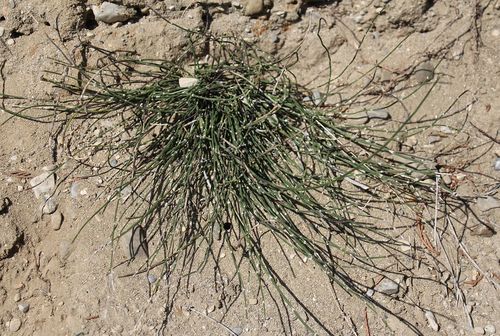
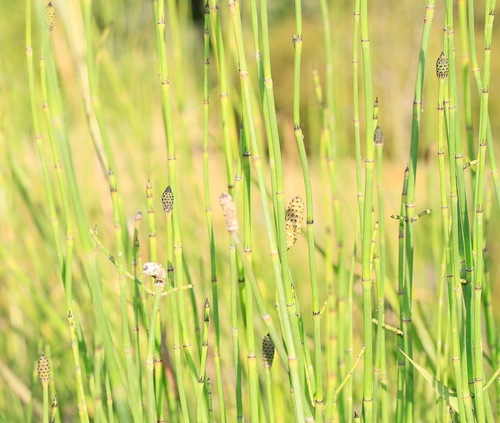
Equisetum hyemale
L.
Dutch rush, Scouring rush, Shave grass, Horsetail rush, Rough horsetail
iNaturalist· cc-by-nc
(c) Ihor Olshanskyi, some rights reserved (CC BY-NC), uploaded by Ihor Olshanskyi
iNaturalist· cc-by-nc
(c) Ihor Olshanskyi, some rights reserved (CC BY-NC), uploaded by Ihor Olshanskyi
iNaturalist· cc-by-nc
(c) Ihor Olshanskyi, some rights reserved (CC BY-NC), uploaded by Ihor Olshanskyi
Summary
Source: WikipediaEquisetum hyemale, commonly known as rough horsetail or scouring rush, is an evergreen perennial herbaceous pteridophyte in the horsetail family Equisetaceae native to Eurasia and Greenland. It was formerly widely treated in a broader sense including a subspecies (subsp. affine) in North America, but this is now treated as a separate species, Equisetum praealtum.
Description
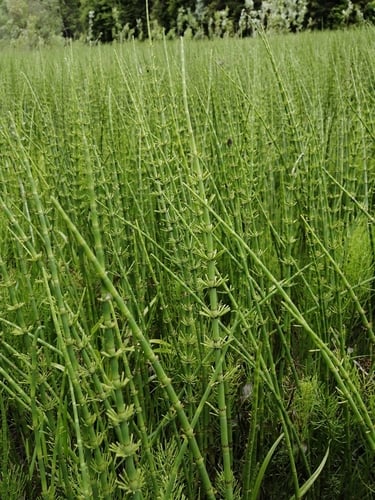
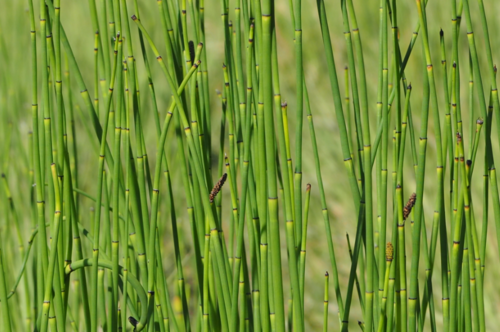
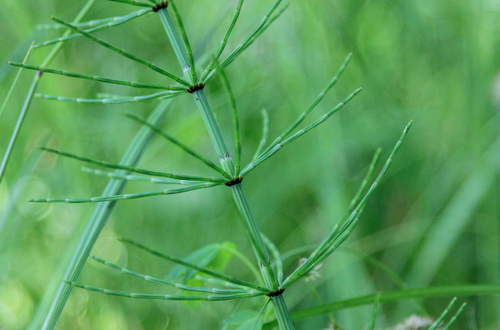
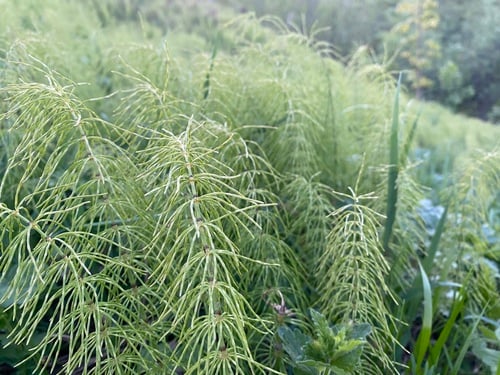
An evergreen rush. It grows 1.2 m high. The stems are hollow and do not have leaves. They have 14-40 ridges along them. There are cones at the tips. These are 1-2 cm long. These are pointed.
Edible Uses
The fertile shoots (strobili), harvested in spring, can be cooked as an asparagus substitute, though caution is advised regarding toxicity. The roots can be dried and then cooked as a source of starch, with the same caution regarding toxicity. One further report notes that Native Americans also ate the peeled stems, base of the plant, roots, and tubers raw, but cautions that this may be inadvisable.
Traditional Uses
CAUTION: It should not be used in large amounts nor used for long periods of time. The leaves are boiled to make a drink. The stalk tops are dried then mashed and mixed with other foods. The dried rootstocks are used as a famine food.
Medicinal Uses
Horsetails have an unusual chemistry compared to most other plants — they are rich in silica, contain several alkaloids including nicotine, and various minerals. The plant is anticancer, anti-inflammatory, antispasmodic, diaphoretic, diuretic, expectorant, febrifuge, haemostatic, hypotensive, and styptic, and also has an appetite-stimulating effect. The barren stems are used and are most active when fresh, though they can also be dried; sometimes the ashes of the plant are used. Taken internally it acts as a useful diuretic and is used in the treatment of kidney and bladder problems. A decoction applied externally will stop the bleeding of wounds and promote healing. The plant also contains polyphenolic flavonoids with bactericidal activity.
Known Hazards
Large quantities of the plant can be toxic. This is because it contains the enzyme thiaminase, a substance that can rob the body of the vitamin B complex. In small quantities this enzyme will do no harm to people eating an adequate diet that is rich in vitamin B, though large quantities can cause severe health problems. The enzyme is destroyed by heat or thorough drying, so cooking the plant will remove the thiaminase. The plant also contains equisetic acid - see the notes on medicinal uses for more information.
Distribution
It is a temperate plant. It grows in cool climates. It grows in moist soil and up to 20 cm of water. In N China it grows along the banks of streams between 100-3,000 m above sea level. It suits hardiness zones 3-10.
Where It Grows
Asia, Australia, Britain, Canada, China, Europe, Hawaii, Japan, Korea, Luxembourg, Mongolia, North America, Russia, Slovenia, Tasmania, Tibet, USA,
Cultivation
Prefers a moist soil with a pH between 6.5 and 7.5. Plants are hardy to about -30°c. The stems of this species were once exported to Britain in quantity from Holland so that they could be used as an abrasive for cleaning pots and pans. Plants have a deep and penetrating root system and can be invasive. If grown in the garden they are best kept in bounds by planting them in a large container which can be sunk into the ground. In garden design, as well as the above-ground architecture of a plant, root structure considerations help in choosing plants that work together for their optimal soil requirements including nutrients and water. Thick or swollen - fibrous or tap root.
Propagation
Spores should ideally be collected as soon as they ripen in spring and surface-sown immediately on sterile compost. Keep moist and pot up as soon as plants are large enough to handle. Germination is very difficult. Division is also possible; plants usually spread freely when well sited and rarely need assistance.
Other Uses
The stems are very rich in silica and are used for scouring and polishing metal and as a fine sandpaper — the stems are first bleached by repeated wetting and drying in the sun. They can also be used to polish wooden floors and furniture. An infusion of the stem is an effective fungicide against mildew, mint rust, and blackspot on roses, and makes a good liquid feed. Used as a hair rinse, it can eliminate fleas, lice, and mites. A light pink dye is obtained from the stem. The hollow stems have been used as whistles; one report also describes children pulling the stem joints apart to produce a whistling sound.
Other Information
It is a famine food.
Notes
There are about 25 Equisetum species. It can spread and become a problem. It is used in medicine.
Also Known As
Mhi-ke-ko-tsa, Zimska preslica
References (15)
- Brown, D., 2002, The Royal Horticultural Society encyclopedia of Herbs and their uses. DK Books. p 203
- Cundall, P., (ed.), 2004, Gardening Australia: flora: the gardener's bible. ABC Books. p 544
- Ding, X., 2021, Collection calendar: the diversity and local knowledge of wild edible plants used by Chenthang Sherpa people to treat seasonal food shortages in Tibet, China. Journal of Ethnobiology and Ethnomedicine 17:40
- Geng, Y., et al, 2016, Traditional knowledge and its transmission of wild edibles used by the Naxi in Baidi Village, northwest Yunnan province. Journal of Ethnobiology and Ethnomedicine. 12:10
- Hedrick, U.P., 1919, (Ed.), Sturtevant's edible plants of the world. p 292
Show all 15 references Hide references
- Hibbert, M., 2002, The Aussie Plant Finder 2002, Florilegium. p 93
- Kuhnlein, H. V. and Turner, N. J., 1991, Traditional Plant Foods of Canadian Indigenous Peoples. Food and Nutrition in History and Anthropology Volume 8. Gordon and Breach. p 30
- MacKinnon, A., et al, 2009, Edible & Medicinal Plants of Canada. Lone Pine. p 388
- Moerman, D. F., 2010, Native American Ethnobotany. Timber Press. p 214
- Plants for a Future database, The Field, Penpol, Lostwithiel, Cornwall, PL22 0NG, UK. http://www.scs.leeds.ac.uk/pfaf/
- Slocum, P.D. & Robinson, P., 1999, Water Gardening. Water Lilies and Lotuses. Timber Press. p 94
- Sp. pl. 2:1062. 1753
- Staples, G.W. and Herbst, D.R., 2005, A tropical Garden Flora. Bishop Museum Press, Honolulu, Hawaii. p 38
- Williams, D., 2017, Ainu Ethnobiology. Contributions in Ethnobiology. Society of Ethnobiology. p 127
- www.eFloras.org Flora of China