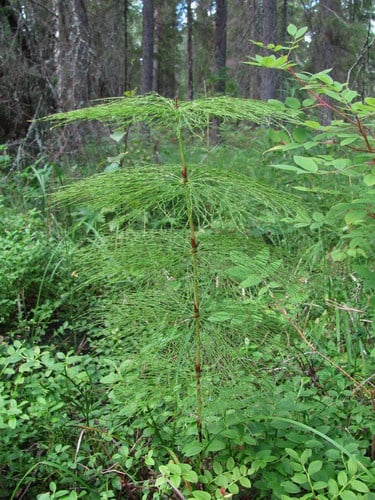
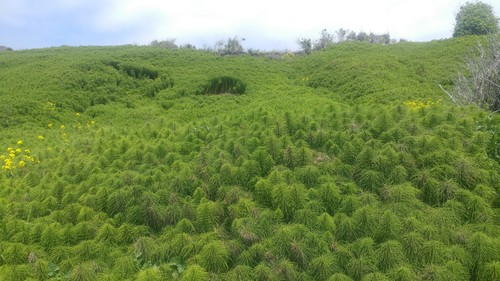
Equisetum arvense
L.
Field horsetail
iNaturalist· cc-by-nc
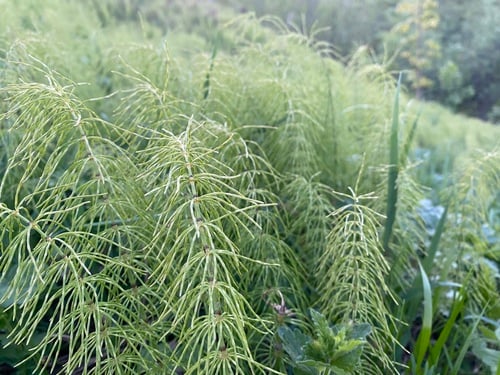
(c) gwenbezodis, some rights reserved (CC BY-NC)
iNaturalist· cc-by-nc
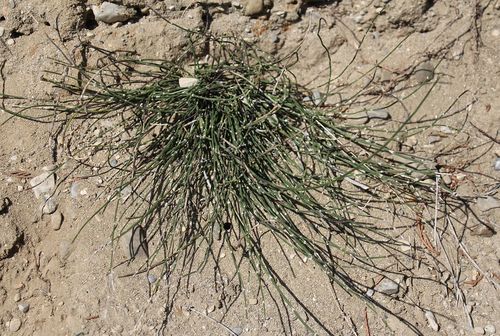
(c) Vladimir Bryukhov, some rights reserved (CC BY-NC), uploaded by Vladimir Bryukhov
iNaturalist· cc-by-nc
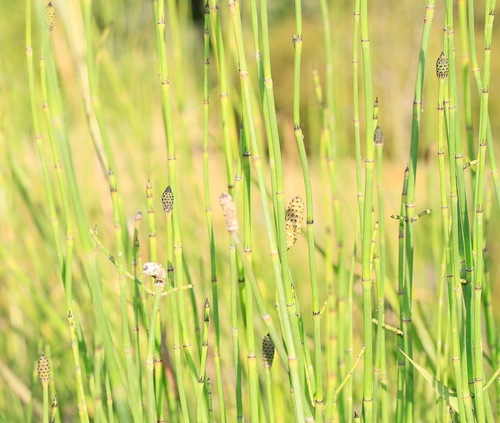
(c) rochelle77, some rights reserved (CC BY-NC)
Summary
Source: WikipediaEquisetum arvense, commonly known as field horsetail or common horsetail, is a species of vascular plant in the horsetail family Equisetaceae. Like all horsetails, it is a type of fern. It is native throughout the arctic and temperate regions of the Northern Hemisphere. It has two distinct growth forms, a fertile spore-bearing stem and a sterile green stem. It is sometimes confused with mare's tail, Hippuris vulgaris.
Description
A rush like plant. It keeps growing from year to year. It grows 40-60 cm high and spreads 30-45 cm wide. The stems are in rings which are tightly packed. They are 60 cm tall. They are slightly rough and have furrows along them. There are also branching stems which are short lived. The leaves are fine and feathery and light green.
Edible Uses
The fertile shoots (strobili), harvested in spring, can be cooked as an asparagus substitute. They should be used while young, and it is advisable to change the cooking water 3–4 times. One source notes they can be eaten raw — peeled with the shoot tip discarded — but describes this as a very tedious process, and they should not be consumed raw in any quantity given toxicity concerns. Some Native American peoples enjoyed the young vegetative shoots before they had branched out, sometimes collecting them in large quantities for feasts. They peeled off the leaf sheaths and ate the stems raw, describing them as being 'nothing but juice.' The roots are edible raw in spring, including the tuberous growths and black nodules on the rhizomes. Gathering these nodules takes considerable effort and was normally done only in times of need, though native peoples sometimes raided the underground caches of lemmings and other rodents to obtain them. One further report notes that Native Americans also ate the peeled stems, base of the plant, roots, and tubers raw, but cautions that this may be inadvisable.
Traditional Uses
CAUTION: It should probably only be used in small amounts or for short periods of time. The shoots have been eaten cooked as a vegetable and also used to make tea. It is the young spore bearing stems that are used. They can be preserved in oil. The shoots are used in soup. The side tubers are added to bread. The tubers are eaten fresh as a snack.
Medicinal Uses
Horsetails have an unusual chemistry compared to most other plants — they are rich in silica, contain several alkaloids including nicotine, and various minerals. Horsetail is very astringent and makes an excellent clotting agent, staunching wounds, stopping nosebleeds, and reducing the coughing up of blood. It helps speed the repair of damaged connective tissue, improving its strength and elasticity. The plant is anodyne, antihaemorrhagic, antiseptic, astringent, carminative, diaphoretic, diuretic, galactogogue, haemostatic, and vulnerary. The green infertile stems are used medicinally and are most active when fresh, though they can also be harvested in late summer and dried; sometimes the ashes of the plant are used. Taken internally, it acts as a useful diuretic and is used in the treatment of kidney and bladder problems, cystitis, urethritis, prostate disease, and internal bleeding, proving especially useful when there is bleeding in the urinary tract. A decoction applied externally stops the bleeding of wounds and promotes healing, and is especially effective for nosebleeds. A decoction added to a bath benefits slow-healing sprains and fractures, as well as irritable skin conditions such as eczema. The plant contains equisetic acid, thought to be identical to aconitic acid — a potent heart and nerve sedative that is a dangerous poison in high doses. The plant contains irritant substances and should only be used for short periods, and ideally under the supervision of a qualified practitioner. A homeopathic remedy is made from the fresh plant and used in the treatment of cystitis and other urinary complaints. The German Commission E Monographs approve Equisetum arvense for urinary tract infections, kidney and bladder stones, and wounds and burns.
Known Hazards
Equisetum arvense is toxic to livestock, particularly horses. It is difficult to control due to its extensive underground rhizomes, which can penetrate the soil up to 6 feet (1.8 m) deep. Fire, mowing, or slashing are ineffective since new stems quickly grow from the rhizomes. Some herbicides remove aerial growth but regrowth quickly occurs albeit with a reduction in frond density.
Distribution
It is a temperate plant. They grow in wet places. It is best in swampy clayey soils. It needs a protected location. It is resistant to frost and damaged by drought. They spread by branching rhizomes. In China it grows from sea level to 3,700 m above sea level. In the Himalayas it grows between 3,300-4,050 m above sea level. It suits hardiness zones 2-9.
Where It Grows
Alaska, Andorra, Armenia, Asia, Australia, Balkans, Bulgaria, Canada, Caucasus, Central America, Central Asia, China, Estonia, Europe, Falklands, Faroe Islands, Finland, France, Germany, Greece, Greenland, Guatemala, Haiti, Himalayas, Hungary, Iceland, India, Iraq, Italy, Japan, Kazakhstan, Korea, Kurdistan, Kyrgyzstan, Latvia, Lithuania, Luxembourg, Macedonia, Mediterranean, Mexico, Middle East, Mongolia, Nepal, North America, Norway, Pakistan, Panama, Poland, Portugal, Russia, Scandinavia, Sicily, Slovakia, Slovenia, Spain, Sweden, Switzerland, Tajikistan, Turkey, Türkiye, USA, Uzbekistan, West Indies,
Cultivation
Prefers poor dusty ground. This rather contradicts another report which says that the presence of this plant indicates underground water. Prefers a moist but well-drained fertile soil with a pH between 6.5 and 7.5. A very cold-hardy species tolerating temperatures down to about -30°c. Plants have a deep and penetrating root system and can be invasive. If grown in the garden they are best kept in bounds by planting them in a large container which can be sunk into the ground. In garden design, as well as the above-ground architecture of a plant, root structure considerations help in choosing plants that work together for their optimal soil requirements including nutrients and water. Thick or swollen - fibrous or tap root.
Propagation
Spores should ideally be collected as soon as they ripen in spring and surface-sown immediately on sterile compost. Keep moist and pot up as soon as plants are large enough to handle. Germination is very difficult. Division is also possible; plants usually spread freely when well sited and rarely need assistance.
Other Uses
The stems contain 10% silica and can be used for scouring metal and as a fine sandpaper, as well as for polishing brass, hardwood, and similar materials. An infusion of the stem acts as an effective fungicide against mildew, mint rust, and blackspot on roses, and also makes a good liquid feed. A light pink dye (described as yellow-gray in another source) is obtained from the stem. The plant has been used for making whistles. It is also noted as a dynamic accumulator.
Other Information
It is a commercially cultivated vegetable. It is sold in local markets.
Notes
There are about 29 Equisetum species. They grow in cool, damp places. It is used in medicine.
Nutrition
| Part | Moisture | kJ | kcal | Protein | Vit A | Vit C | Iron | Zinc |
|---|---|---|---|---|---|---|---|---|
| Leaves | 93.7 | 84 | 20 | 1 | — | — | 4.4 | — |
Synonyms
Also Known As
Akersnelle, Ashvavar, Common horsetail, Darhabro, Dziadzet, Kaweta, Kesatilgad, Khovoshch, Kitsenisad, Kjerringrokk, Matti, Mezei zsurlo, Piibusk, Polski kvosht, Savipahklid, Seatilk, Shave Brush, Soetteugi, Stolbiki, Sugina, Tiruma kosa
References (48)
- Abbet, C., et al, 2014, Ethnobotanical survey on wild alpine food plants in Lower and Central Valais (Switzerland). Journal of Ethnopharmacology 151 (2014) 624–634
- Ambasta, S.P. (Ed.), 2000, The Useful Plants of India. CSIR India. p 197
- Blamey, M and Grey-Wilson, C., 2005, Wild flowers of the Mediterranean. A & C Black London. p 531
- Bodkin, F., 1991, Encyclopedia Botanica. Cornstalk publishing, p 386
- Bremness, L., 1994, Herbs. Collins Eyewitness Handbooks. Harper Collins. p 288
Show all 48 references Hide references
- Brown, D., 2002, The Royal Horticultural Society encyclopedia of Herbs and their uses. DK Books. p 201
- Bowser, M., 2017, Handout on Edible Plants of the Kenai Peninsula. USFWS Kenai National Wildlife Refuge p 8
- Cerne, M., 1992, Wild Plants from Slovenia used as Vegetables. Acta Horticulturae 318.
- Chen, B. & Qiu, Z., Consumer's Attitudes towards Edible Wild Plants, Ishikawa Prefecture, Japan. p 23 www.hindawi.com/journals/ijfr/aip/872413.pdf
- Cundall, P., (ed.), 2004, Gardening Australia: flora: the gardener's bible. ABC Books. p 543
- Denes, A., et al, 2012, Wild plants used for food by Hungarian ethnic groups living in the Carpathian Basin. Acta Societatis Botanicorum Poloniae 81 (4): 381-396
- Dobriyal, M. J. R. & Dobriyal, R., 2014, Non Wood Forest Produce an Option for Ethnic Food and Nutritional Security in India. Int. J. of Usuf. Mngt. 15(1):17-37
- Facciola, S., 1998, Cornucopia 2: a Source Book of Edible Plants. Kampong Publications, p 94
- Food Composition Tables for use in East Asia FAO http://www.fao.org/infoods/directory No. 550
- Girard, N. J., 2020, Sustainable Foraging of Wild Edible Plants in Norway. A Biocultural Approach. M. Sc. thesis Norwegian University. p 130
- Hwang, HS, et al, 2014, Distribution characteristics of plant in the Ungseokbong Mountain, Gyeongsangnam-do, Korea. Journal of Asia-Pacific Biodiversity. 7(2014) e164-e178
- Jones, A., 2010, Plants that we eat. University of Alaska Press. p 150
- Kalle, R. & Soukand, R., 2012, Historical ethnobotanical review of wild edible plants of Estonia (1770s-1960s) Acta Societatis Botanicorum Poloniae 81(4):271-281
- Kays, S. J., and Dias, J. C. S., 1995, Common Names of Commercially Cultivated Vegetables of the World in 15 languages. Economic Botany, Vol. 49, No. 2, pp. 115-152
- Khan, A. H., et al, 2023, Traditional foraging for ecological transition? Wild food ethnobotany among three ethnic groups in the highlands of the eastern Hindukush, North Pakistan. Journal of Ethnobiology and Ethnomedicine 19:9
- Kim, H. & Song, M., 2013, Ethnobotanical analysis for traditional knowledge of wild edible plants in North Jeolla Province (Korea). Genetic. Resour. Crop Evol. (2013) 60:1571-1585
- Kiple, K.F. & Ornelas, K.C., (eds), 2000, The Cambridge World History of Food. CUP p 1787
- Kolosova, V., et al, 2020, Foraging in Boreal Forest: Wild Food Plants of the Republic of Karelia, NW Russia. Foods 2020, 9, 1015; p 9
- Kuhnlein, H. V. and Turner, N. J., 1991, Traditional Plant Foods of Canadian Indigenous Peoples. Food and Nutrition in History and Anthropology Volume 8. Gordon and Breach. p 30
- Licata, M., et al, 2016, A survey of wild plant species for food use in Sicily (Italy) – results of a 3-year study in four Regional Parks. Journal of Ethnobiology and Ethnomedicine 12:12
- Luczaj, L., 2012, Ethnobotanical review of wild edible plants of Slovakia. Acta Societatis Botanicorum Poloniae 81(4):245-255
- Luczaj, L. et al, 2012, Wild food plant use in 21st century Europe: the disappearance of old traditions and the search for new cuisines involving wild edibles. Acta Soc Bot Pol 81(4):359–370
- MacKinnon, A., et al, 2009, Edible & Medicinal Plants of Canada. Lone Pine. p 388
- Moerman, D. F., 2010, Native American Ethnobotany. Timber Press. p 213
- Nanagulyan, S., et al, 2020, Wild plants and fungi sold in the markets of Yerevan (Armenia). Journal of Ethnobiology and Ethnomedicine 16:26
- Nedelcheva A., 2013, An ethnobotanical study of wild edible plants in Bulgaria. EurAsian Journal of BioSciences 7, 77-94
- Plants for a Future database, The Field, Penpol, Lostwithiel, Cornwall, PL22 0NG, UK. http://www.scs.leeds.ac.uk/pfaf/
- Pruse, B., et al, 2021, Active Wild Food Practices among Culturally Diverse Groups in the 21st Century across Latgale, Latvia. Biology 2021, 10, 551.
- Sansanelli, S., et al, 2017, Ethnobotanical survey of wild food plants traditionally collected and consumed in the Middle Agri Valley (Basilicata region, southern Italy). Journal of Ethnobiology and Ethnomedicine (2017) 13:50
- Shikov, A. N. et al, 2017, Traditional and Current Food Use of Wild Plants Listed in the Russian Pharmacopoeia. Frontiers in Pharmacology. Vol. 8 Article 841
- Sp. pl. 2:1061. 1753
- Svanberg, I., et al, 2012, Edible wild plant use in the Faroe Islands and Iceland. Acta Societatis Botanicorum Poloniae 81(4): 233-238
- Svanberg, I., 2012, The use of wild plants as food in pre-industrial Sweden. Acta Societatis Botanicorum Poloniae 81(4): 317-327
- Tanaka,
- Toupal, R. S. & Hollenback, K., 2009, An Ethnobotany of Indiana Dunes National Lakeshore: Plant Uses of the Ojibwa People. Bureau of Applied Research in Anthropology. University of Arizona
- Turner, N., 1995, Food Plants of Coastal First Peoples. Royal BC Museum Handbook p 23
- Turner, N. J. et al, 2011, Edible and Tended Wild Plants, Traditional Ecological Knowledge and Agroecology. Critical Reviews in Plant Sciences, 30:198-225
- Uphof,
- Upson, R., & Lewis R., 2014, Updated Vascular Plant Checklist and Atlas for the Falkland Islands. Falklands Conservation and Kew.
- Urgamal, M., et al, 2014, Conspectus of the Vascular Plants of Mongolia. Mongolia Academy of Sciences Institute of Botany and National University of Mongolia Department of Biology. p 30
- Wild edible plants of Himachal Pradesh
- World Checklist of Useful Plant Species 2020. Royal Botanic Gardens, Kew
- www.ediblewildfood.com