Dryandra fraseri
R. Br.
Orange honey pot
wikimedia· cc-by-sa
Wikimedia Commons - Melburnian
wikimedia· cc-by
Wikimedia Commons - Jean and Fred from Perth, Australia
Description
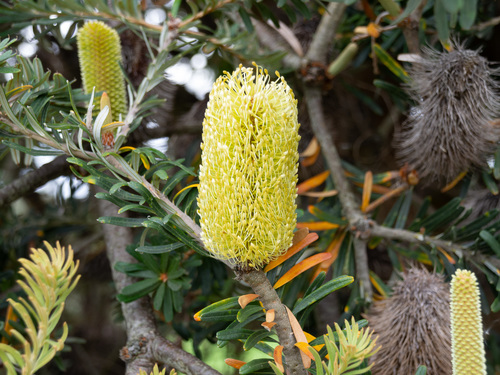
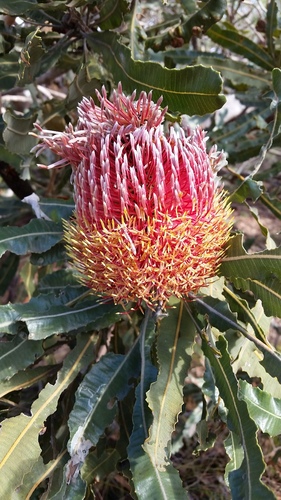
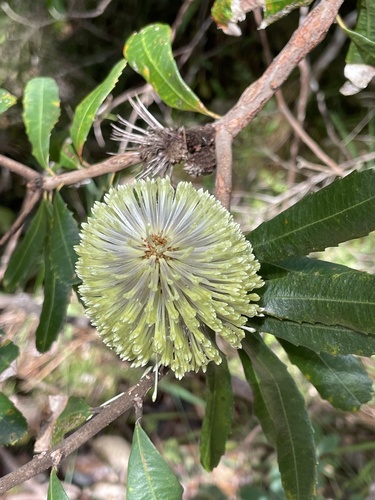
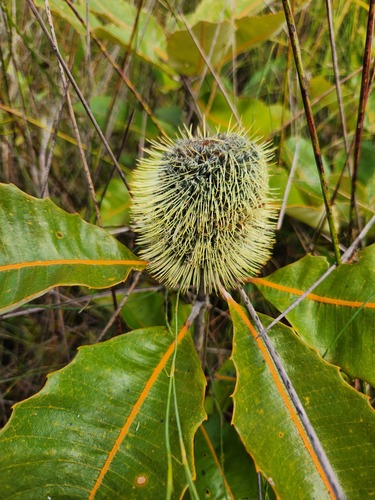
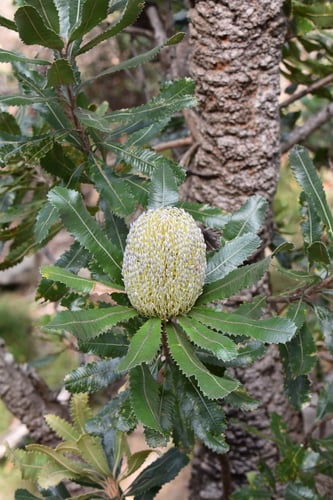
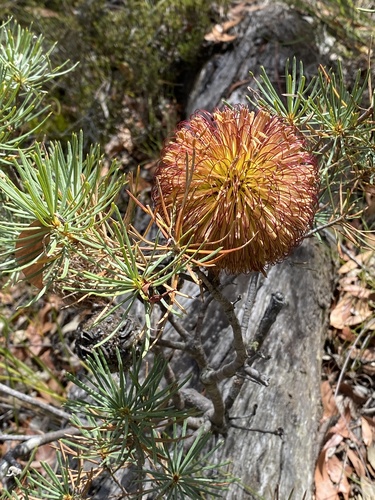
A small spreading shrub. It grows 0.1-1 m high and spreads 1-2 m wide. The branches are hairy when young. The leaves are 5-10 cm long by 1 cm wide. They are divided down to the midrib and often curve backwards. The lobes are narrow and prickly. They are whitish underneath. The flower heads are 4.5-6.5 cm across. The can be pale or bright yellow. The bracts are small.
Edible Uses
The nectar is consumed.
Distribution
It grows in Western Australia. It needs well drained soil. It can tolerate frost. It can stand some drought and exposure near the coast.
Where It Grows
Australia*, Britain, Europe,
Cultivation
Plants are grown from seed or cuttings.
Notes
There are 50-60 Dryandra species.
Synonyms
References (7)
- Bindon, P., 1996, Useful Bush Plants. Western Australian Museum. p 106.
- Bodkin, F., 1991, Encyclopedia Botanica. Cornstalk publishing, p 363
- Elliot, W.R., & Jones, D.L., 1984, Encyclopedia of Australian Plants suitable for cultivation. Vol 3. Lothian. p 359
- Lazarides, M. & Hince, B., 1993, Handbook of Economic Plants of Australia, CSIRO. p 84
- Lord, E.E., & Willis, J.H., 1999, Shrubs and Trees for Australian gardens. Lothian. p 162
Show all 7 references Hide references
- Mast, A. R. and Thiele, K., 2007, The transfer of Dryandra R. Br. to Banksia L. f. (Proteaceae). Australian Systematic Botany 20:63-71
- Paczkowska, G . & Chapman, A.R., 2000, The Western Australian Flora. A Descriptive Calatogue. Western Australian Herbarium. p 474