Banksia oblongifolia
Cav.
Fern-leaved Banksia
iNaturalist· cc-by-nc
(c) jen_w1, some rights reserved (CC BY-NC)
iNaturalist· cc-by-nc
(c) Adrian Gale, some rights reserved (CC BY-NC), uploaded by Adrian Gale
iNaturalist· cc-by-nc
(c) Geoffrey Sinclair, some rights reserved (CC BY-NC), uploaded by Geoffrey Sinclair
Summary
Source: WikipediaBanksia oblongifolia, commonly known as the fern-leaved, dwarf or rusty banksia, is a species in the plant genus Banksia. Found along the eastern coast of Australia from Wollongong, New South Wales, in the south to Rockhampton, Queensland, in the north, it generally grows in sandy soils in heath, open forest or swamp margins and wet areas. A many-stemmed shrub up to 3 m (9.8 ft) high, it has leathery serrated leaves and rusty-coloured new growth. The yellow flower spikes, known as inflorescences, most commonly appear in autumn and early winter. Up to 80 follicles, or seed pods, develop on the spikes after flowering. Banksia oblongifolia resprouts from its woody lignotuber after bushfires, and the seed pods open and release seed when burnt, the seed germinating and growing on burnt ground. Some plants grow between fires from seed shed spontaneously. Spanish botanist Antonio José Cavanilles described B. oblongifolia in 1800, though it was known as Banksia aspleniifolia in New South Wales for many years. However, the latter name, originally coined by Richard Anthony Salisbury, proved invalid, and Banksia oblongifolia has been universally adopted as the correct scientific name since 1981. Two varieties were recognised in 1987, but these have not been generally accepted. A wide array of mammals, birds, and invertebrates visit the inflorescences. Though easily grown as a garden plant, it is not commonly seen in horticulture.
Description
A small shrub. It grows 0.6-3 m high. It spreads 1.5-3 m wide. The leaves are stiff and dark. They are oblong and with small teeth along the edge. The new growth is rust coloured and woolly. The flowers are pale yellow. The buds are blue-grey.
Edible Uses
The nectar is sucked from the flowers or used to make a sweet water drink.
Traditional Uses
The nectar is sucked from the flower or used to make a sweet water drink.
This uses section is brief — help expand it
Distribution
It will grow from tropical to temperate regions. It needs moist well drained soil. It can only stand light frosts. It suits hardiness zones 9-11. Coffs Harbour Botanical Gardens.
Where It Grows
Australia*, Tasmania,
Cultivation
Plants can be grown by seed or cuttings.
Notes
There are about 75 Banksia species. They are mostly in Australia.
Synonyms
References (7)
- Edible and Useful Native Plants (off internet)
- Etherington, K., & Imwold, D., (Eds), 2001, Botanica's Trees & Shrubs. The illustrated A-Z of over 8500 trees and shrubs. Random House, Australia. p 116
- Greig, D., 1996, Flowering Natives for Home Gardens. Angus & Robertson. p 68
- Haslam, S., 2004, Noosa's Native Plants. Noosa Integrated Catchment Assn. Inc. p 72
- Hibbert, M., 2002, The Aussie Plant Finder 2002, Florilegium. p 38
Show all 7 references Hide references
- Leiper, G & Houser, J., Mutooroo. Plant Use by Australian Aboriginal People. Assembly press, Queensland.
- Molyneux, B & Forrester, S., 1997, The Austraflora A-Z of Australian Plants. Reed. p 51
More from Proteaceae
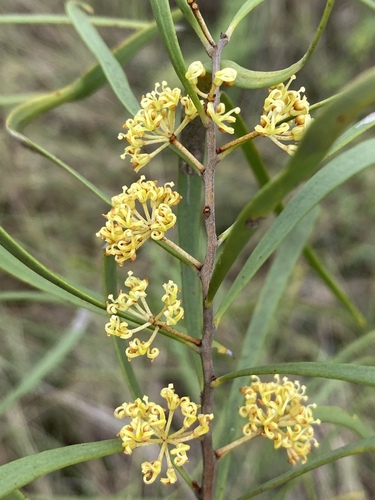
Hakea arborescens
Yellow Hakea, Tree Hakea, Common Hakea
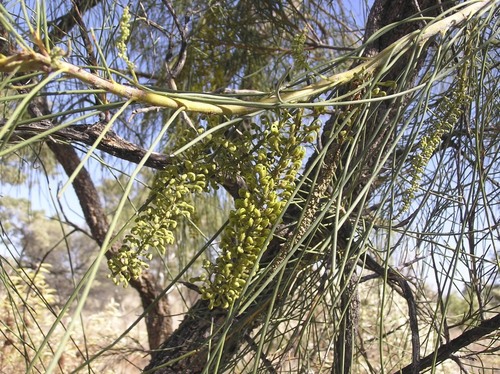
Hakea chordophylla
Northern Corkwood, Bootlace oak, Bull Oak
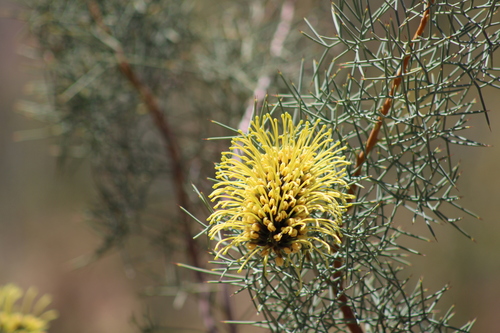
Hakea divaricata
Fork-leafed Corkwood, Corkbark, Needlewood
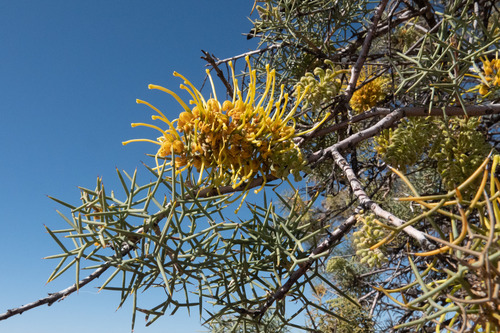
Hakea eyreana
Four-leaved Corkwood, Straggly Corkwood, Corkbark, Untjiya
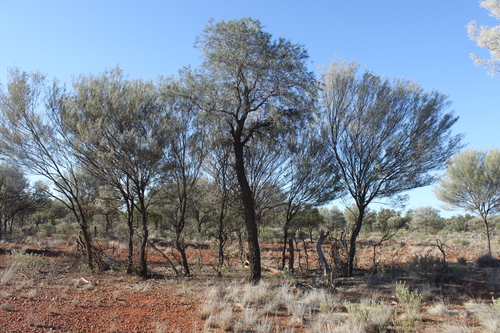
Hakea ivoryi
Corkbark Tree, Corkwood, Ivory's Hakea
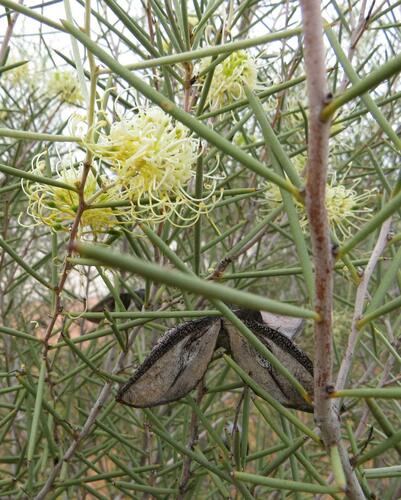
Hakea leucoptera
Needlebush, Silver Needlewood