Banksia marginata
Cav.
Silver Banksia
iNaturalist· cc-by
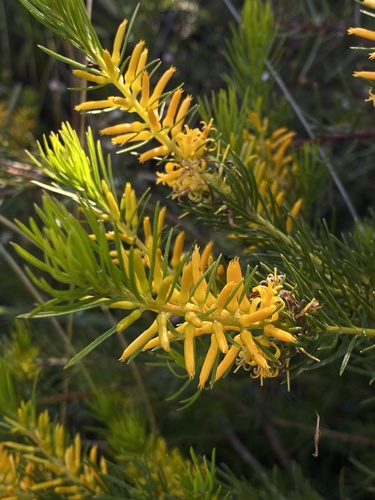
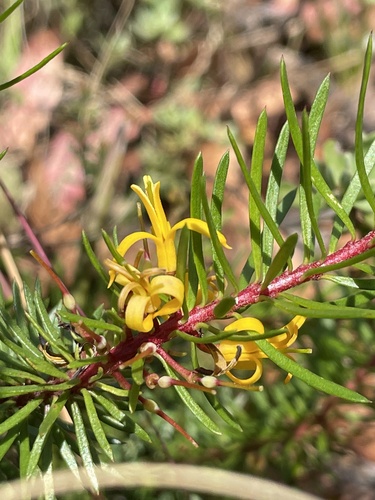
(c) Terra Occ, some rights reserved (CC BY), uploaded by Terra Occ
iNaturalist· cc-by-nc
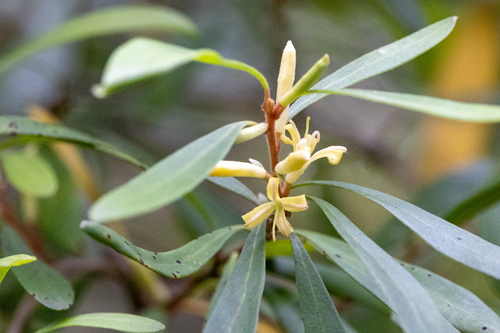
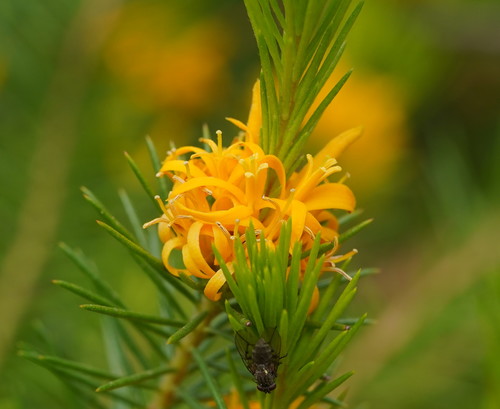
(c) David, some rights reserved (CC BY-NC), uploaded by David
iNaturalist· cc-by-nc-sa
(c) Nathan Johnson, some rights reserved (CC BY-NC-SA)
Summary
Source: WikipediaBanksia marginata, commonly known as the silver banksia, is a species of tree or shrub in the family Proteaceae found throughout much of southeastern Australia. It ranges from the Eyre Peninsula in South Australia to north of Armidale, New South Wales, and across Tasmania and the islands of Bass Strait. It grows in various habitats, including Eucalyptus forest, scrub, heathland and moorland. Banksia marginata varies widely in habit, ranging from a 20-centimetre (7.9 in) shrub to a 12-metre (40 ft) tree. The narrow leaves are linear and the yellow inflorescences occur from late summer to early winter. These flower spikes fade to brown and then grey and develop woody follicles bearing the winged seeds. Originally described by Antonio José Cavanilles in 1800, further collections of B. marginata were designated as several separate species by Robert Brown in 1810. However, all were reclassified as a single species by George Bentham in 1870. No distinct subspecies have been recognised by Banksia expert Alex George, who nonetheless concedes that further work is needed. Many species of bird, in particular honeyeaters, forage at the flower spikes, as do native and European honeybees. The response to bushfire varies. Some populations are serotinous: they are killed by fire and regenerate from large stores of seed, which have been held in cones in the plant canopy and are released after a fire. Others regenerate from underground lignotubers or suckers from lateral roots. Although it has been used for timber, Banksia marginata is most commonly seen as a garden plant, with dwarf forms being commercially propagated and sold.
Description
A dense bushy shrub or small tree. It can grow 1-9 m high. The bark is smooth and greyish brown. The leaves are 3-10 cm long and narrow. They are oblong and silvery underneath. The edges of the leaves can have teeth on younger leaves. The edges of older leaves can be rolled under. The flowers are small. They are yellow. They are crowded into dense spikes 10 cm long and 4 cm across. Cones turn grey with age. The fertile sections form hard brown bulges on the side of cones. The seeds have wings.
Edible Uses
Edible Parts: Nectar Edible Uses: Drink The flowers are filled with a sweet nectar which can be sucked directly or washed out with water to make a refreshing beverage.
Traditional Uses
The nectar is sucked from the flowers. It can be washed out into water and used to make a drink.
This uses section is brief — help expand it
Medicinal Uses
None known
Distribution
A temperate plant. It grows in heath and light forests. It can tolerate frosts. It is resistant to salt spray. It needs good drainage. It can tolerate some shade. Hobart Botanical Gardens. It suits hardiness zones 8-10. Tasmania Herbarium. Arboretum Tasmania.
Where It Grows
Australia*, Tasmania*,
Cultivation
Requires a well-drained lime-free soil and a sunny position. Thrives in acid sandy loams. Prefers a pH between 6.3 and 6.5. Plants are tolerant of damp soils and sea winds. If this species is to be successfully cultivated, the soil should be low in nutrients, especially in nitrates and phosphates. This species is not very cold-hardy, possibly tolerating temperatures down to around -5°c. Plants require greenhouse protection in most parts of Britain but high-altitude forms could succeed outdoors in the mildest areas of the country. This species hybridizes in the wild with B. integrifolia and B. conferta penicillata. A good bee plant.
Propagation
Seed - surface sow in an ericaceous compost as soon as the seed is ripe or as soon as it is obtained and do not exclude light. Seal the pot in a plastic bag until germination takes place, which can take 1 - 3 months or more at 20°c. When they are large enough to handle, prick the seedlings out into individual pots and grow them on in the greenhouse for at least their first winter. Plant them out into their permanent positions in late spring or early summer, after the last expected frosts. Cuttings of half-ripe wood, July/August in sand in a frame.
Other Uses
The bark contains 10% tannin. This species has been used as a rootstock for propagating other members of the genus. Wood - soft, easily worked, pinkish with a prominent grain. It is highly decorative but the plants tend to be gnarled and irregular thus limiting its use. Used for veneers, furniture etc. Special Uses
Notes
There are about 75 Banksia species. They are mostly in Australia.
Also Known As
Berre, Honey suckle
References (33)
- Anales Hist. Nat. 1:227. 1799
- Bodkin, F., 1991, Encyclopedia Botanica. Cornstalk publishing, p 130
- Boomsma, C.D., 1972, Native Tree of South Australia. Woods & Forests Department South Australia, Bulletin No.19. p 55
- Cameron, M., (Ed.) 1981, A Guide to Flowers & Plants of Tasmania. Reed p 56
- Clarke,P. A., 2013, The Aboriginal Ethnobotany of the Adelaide Region, South Australia. Transactions of the Royal Society of South Australia. (2013), 137(1): 97-126
Show all 33 references Hide references
- Cronin, L., 1989, The Concise Australian Flora. Reed. p 154
- Cundall, P., (ed.), 2004, Gardening Australia: flora: the gardener's bible. ABC Books. p 218
- Curtis, W.M., 1993, The Student's Flora of Tasmania. Part 3 St David's Park Publishing, Tasmania, p 615
- Dashorst, G.R.M., and Jessop, J.P., 1998, Plants of the Adelaide Plains & Hills. Botanic Gardens of Adelaide and State Herbarium. p 48
- Elliot, W.R., & Jones, D.L., 1982, Encyclopedia of Australian Plants suitable for cultivation. Vol 2. Lothian. p 296
- Etherington, K., & Imwold, D., (Eds), 2001, Botanica's Trees & Shrubs. The illustrated A-Z of over 8500 trees and shrubs. Random House, Australia. p 116
- Facciola, S., 1998, Cornucopia 2: a Source Book of Edible Plants. Kampong Publications, p 188
- Gilfedder, L et al, 2003, The Nature of the Midlands. Midlands Bushweb. PO Box 156 Longford, Tasmania. p 95
- Gott, B & Conran, J., 1991, Victorian Koorie Plants. PO Box 666 Hamilton, Victoria 3300, Australia. p 42
- Greig, D., 1996, Flowering Natives for Home Gardens. Angus & Robertson. p 67
- Grieg, D., 2002, A photographic guide to Wildflowers of South-eastern Australia. New Holland. p 103
- Hall, N. et al, 1972, The Use of Trees and Shrubs in the Dry Country of Australia, AGPS, Canberra. p 533
- Harris, S., Buchanan, A., Connolly, A., 2001, One Hundred Islands: The Flora of the Outer Furneaux. Tas Govt. p 116
- Hastings Advance Community College, 2017, Uses for Native Plants of the Mornington Peninsula. 86pp. p 23
- Hibbert, M., 2002, The Aussie Plant Finder 2002, Florilegium. p 38
- IRVINE
- Isaacs, J., 1987, Bush Food, Aboriginal Food and Herbal Medicine. Weldons. p 136
- Kirkpatrick, J.B. & Backhouse, S., 1985, Native Trees of Tasmania. p 54
- Kirkpatrick, J., 1997, Alpine Tasmania, An Illustrated guide to the flora and vegetation. Oxford, p
- Lazarides, M. & Hince, B., 1993, Handbook of Economic Plants of Australia, CSIRO. p 31
- Lord, E.E., & Willis, J.H., 1999, Shrubs and Trees for Australian gardens. Lothian. p 150
- Molyneux, B & Forrester, S., 1997, The Austraflora A-Z of Australian Plants. Reed. p 50
- Tanaka,
- Tasmanian Herbarium Vascular Plants list p 46
- Whiting, J. et al, 2004, Tasmania's Natural Flora. Tasmania's Natural Flora Editorial Committee PO Box 194, Ulverstone, Tasmania, Australia 7315 p 261
- Williams A. & Sides, T., 2008, Wiradjuri Plant Use in the Murrumbidgee Catchment. Murrumbidgee Catchment Management Authority. Wagga Wagga, p 44
- Woolmore, E et al, 2002, King Island Flora: A Field Guide. p 66
- Young, J., (Ed.), 2001, Botanica's Pocket Trees and Shrubs. Random House. p 127