Banksia integrifolia
L.f.
Coast Banksia, White Honeysuckle Banksia
iNaturalist· cc-by-nc-sa
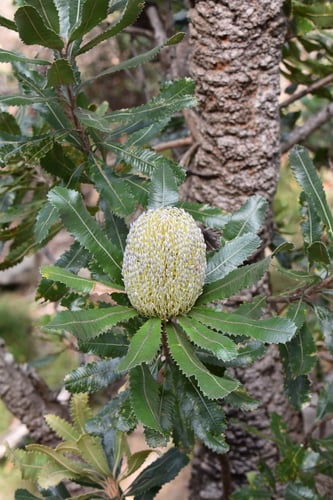
(c) Nick Lambert, some rights reserved (CC BY-NC-SA), uploaded by Nick Lambert
iNaturalist· cc-by-nc
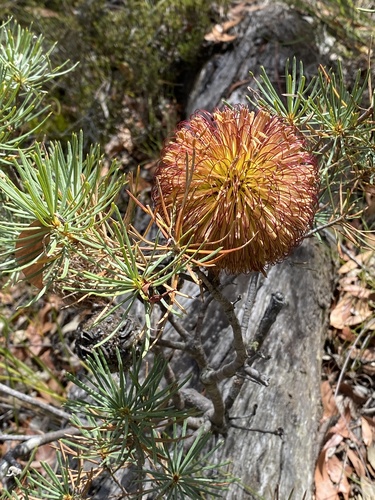
(c) Mononymous, some rights reserved (CC BY-NC), uploaded by Mononymous
iNaturalist· cc-by
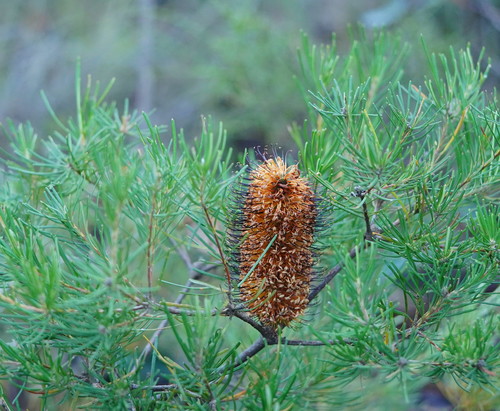
(c) 呂一起(Lu i-chi), some rights reserved (CC BY), uploaded by 呂一起(Lu i-chi)
Summary
Source: WikipediaBanksia integrifolia, commonly known as the coast banksia, is a species of tree that grows along the east coast of Australia. One of the most widely distributed Banksia species, it occurs between Victoria and Central Queensland in a broad range of habitats, from coastal dunes to mountains. It is highly variable in form, but is most often encountered as a tree up to 25 metres (82 ft) in height. Its leaves have dark green upper surfaces and white undersides, a contrast that can be striking on windy days. It is one of the four original Banksia species collected by Sir Joseph Banks in 1770, and one of four species published in 1782 as part of Carolus Linnaeus the Younger's original description of the genus. It has had a complicated taxonomic history, with numerous species and varieties ascribed to it, only to be rejected or promoted to separate species. Modern taxonomy recognises three subspecies: B. integrifolia subsp. integrifolia, B. integrifolia subsp. compar and B. integrifolia subsp. monticola. A hardy and versatile garden plant, B. integrifolia is widely planted in Australian gardens. It is a popular choice for parks and streetscapes, and has been used for bush revegetation and stabilisation of dunes. Its hardiness has prompted research into its suitability for use as a rootstock in the cut flower trade, but has also caused concerns about its potential to become a weed outside its natural habitat.
Description
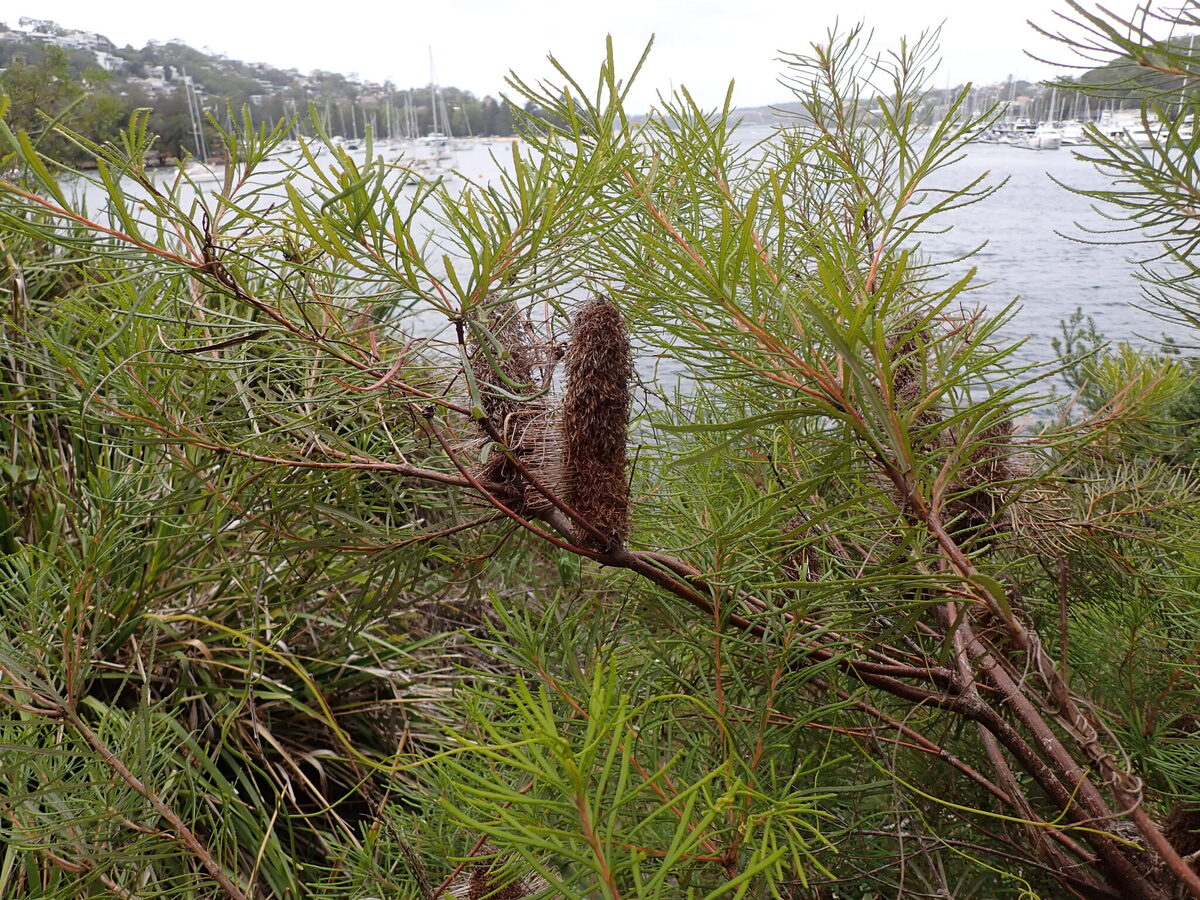
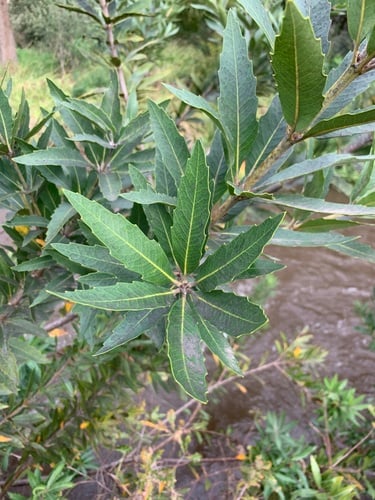
A medium sized tree. It grows to about 15-25 m tall. It spreads 2-10 m wide. The leaves are dull green above and silvery below. They can be 20 cm long. The young leaves have teeth along the edge while older leaves have smooth edges. The flowers are pale yellow on flower heads up to 15 cm long. Several different varieties of this plant occur. The fruit are silvery-grey cones with seed sacs which stick out the side.
Edible Uses
Edible Parts: Nectar Edible Uses: The flowers are rich in nectar and this is sometimes harvested as a food. It is best harvested in the morning before birds and evaporation deplete the yields. The flowers can be sucked or soaked in water in order to obtain the nectar.
Traditional Uses
The flowers are soaked in water to make a drink from the nectar.
This uses section is brief — help expand it
Medicinal Uses
None known
Distribution
It is a warm temperate to subtropical plant. It grows along the coast. It grows on sand dunes. It is hardy and resistant to salt spray. It can grow from tropical to temperate climates. It needs moist well drained soil or dry soil. It can tolerate light frosts. It suits hardiness zones 8-11. Melbourne Botanical Gardens. Tasmania Herbarium. Arboretum Tasmania.
Where It Grows
Australia*, Tasmania,
Cultivation
Succeeds in most soils. Requires a lime-free soil. Thrives in acid sandy loams. Prefers a pH between 6.3 and 6.5. If this species is to be successfully cultivated, the soil should be low in nutrients, especially in nitrates and phosphates. Quite resistant to wind and salt spray, it grows well by the coast. Plants growing in exposed positions have entire leaves whilst those in sheltered positions have serrated leaves. Plants require greenhouse protection in most parts of Britain but they succeed outdoors on a sheltered wall in the mildest areas of the country. Plants in Australian gardens tolerate temperatures down to at least -7°c, but this cannot be translated directly to British gardens due to our cooler summers and longer colder and wetter winters. A polymorphic species, there are many named varieties selected for their ornamental value. A good bee plant.
Propagation
Seed - surface sow in an ericaceous compost as soon as the seed is ripe or as soon as it is obtained and do not exclude light. Seal the pot in a plastic bag until germination takes place, which can take 1 - 3 months or more at 20°c. When they are large enough to handle, prick the seedlings out into individual pots and grow them on in the greenhouse for at least their first winter. Plant them out into their permanent positions in late spring or early summer, after the last expected frosts. Cuttings of half-ripe wood, July/August in sand in a frame.
Other Uses
Rootstock Tannin Wood The bark contains about 10% tannin. Used as a rootstock for other members of this genus. Wood - soft, easily worked, pinkish with a prominent grain. It is highly decorative but the plants tend to be gnarled and irregular thus limiting its use. Used for veneers, furniture etc. Special Uses Attracts Wildlife
Notes
There are about 75 Banksia species. They are mostly in Australia.
Synonyms
Also Known As
Dhiinaa
References (37)
- Bodkin, F., 1991, Encyclopedia Botanica. Cornstalk publishing, p 129
- Breidahl H., 1997, Australian Southern Shores. Lothian. p 80
- Brickell, C. (Ed.), 1999, The Royal Horticultural Society A-Z Encyclopedia of Garden Plants. Convent Garden Books. p 160
- Caton, J.M. & Hardwick, R. J., 2016, Field Guide to Useful Native Plants from Temperate Australia. Harbour Publishing House. p 44
- Cronin, L., 1989, The Concise Australian Flora. Reed. p 134
Show all 37 references Hide references
- Cundall, P., (ed.), 2004, Gardening Australia: flora: the gardener's bible. ABC Books. p 218
- Curtis, W.M., 1993, The Student's Flora of Tasmania. Part 3 St David's Park Publishing, Tasmania, p 615
- Doran, J.C., & Turnbull, J.W. (Eds), 1997, Australian Trees and Shrubs: species for land rehabilitation and farm plantings in the tropics. ACIAR Monograph No 24. p 252
- Edible and Useful Native Plants (off internet)
- Elliot, W.R., & Jones, D.L., 1982, Encyclopedia of Australian Plants suitable for cultivation. Vol 2. Lothian. p 294
- Etherington, K., & Imwold, D., (Eds), 2001, Botanica's Trees & Shrubs. The illustrated A-Z of over 8500 trees and shrubs. Random House, Australia. p 116
- Greig, D., 1996, Flowering Natives for Home Gardens. Angus & Robertson. p 67
- Grieg, D., 2002, A photographic guide to Wildflowers of South-eastern Australia. New Holland. p 103
- Haslam, S., 2004, Noosa's Native Plants. Noosa Integrated Catchment Assn. Inc. p 18
- Hastings Advance Community College, 2017, Uses for Native Plants of the Mornington Peninsula. 86pp. p 22
- Hibbert, M., 2002, The Aussie Plant Finder 2002, Florilegium. p 38
- Holliday, I., 1989, A Field Guide to Australian Trees. Hamlyn. p 72
- Kirkpatrick, J.B. & Backhouse, S., 1985, Native Trees of Tasmania. p 53
- Lazarides, M. & Hince, B., 1993, Handbook of Economic Plants of Australia, CSIRO. p 31
- Leiper, G & Houser, J., Mutooroo. Plant Use by Australian Aboriginal People. Assembly press, Queensland.
- Llamas, K.A., 2003, Tropical Flowering Plants. Timber Press. p 321
- Low, T., 1991, Wild Food Plants of Australia. Australian Nature FieldGuide, Angus & Robertson. p 142
- Low, T., 1992, Bush Tucker. Australia’s Wild Food Harvest. Angus & Robertson. p 170
- McKerney, M. & White, H., 2011, Bush Tucker, Boomerangs & Bandages. Border River-Gwyder Catchment Management Authority p 67
- Melzer, R. & Plumb, J., 2011, Plants of Capricornia. Belgamba, Rockhampton. p 277
- Molyneux, B & Forrester, S., 1997, The Austraflora A-Z of Australian Plants. Reed. p 50
- Nicholson, N & H., 2000, Australian Rainforest Plants, V. Terania Rainforest Publishing. NSW. p 12
- Pearson, S. & A., 1992, Rainforest Plants of Eastern Australia. Kangaroo Press p 40
- Ryan, M. (Ed.), 2003, Wild Plants of Greater Brisbane. Queensland Museum. p 26
- Self, M., 199, Phoenix Seeds catalogue. p 14
- Smith, K & I., 1999, Grow your own bushfoods. New Holland. Australia. p 105
- Steenbeeke, Greg as part of the Plants Directory project. List of plant species from northern NSW that may be used as food plants p 11
- Suppl. pl. 127. 1782 ("1781")
- Tasmanian Herbarium Vascular Plants list p 46
- Townsend, K., 1994, Across the Top. Gardening with Australian Plants in the tropics. Society for Growing Australian Plants, Townsville Branch Inc. p 97
- Young, J., (Ed.), 2001, Botanica's Pocket Trees and Shrubs. Random House. p 126
- Zola, N., & Gott, B., 1992, Koorie Plants Koorie People. Koorie Heritage Trust. p 22