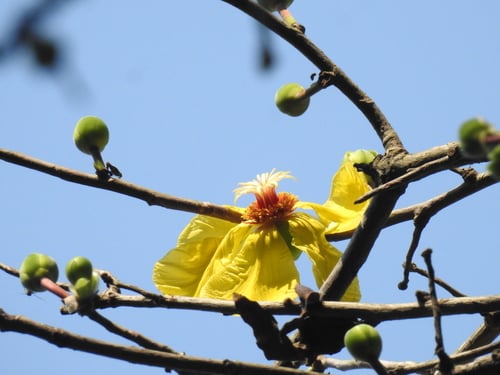
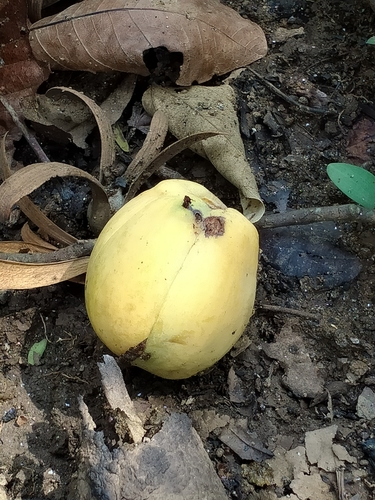
Dillenia pentagyna
Roxb.
Lesser-flowered dillenia, Nepal elephant apple
iNaturalist· cc0
no rights reserved, uploaded by S.MORE
iNaturalist· cc-by
(c) Siddarth Machado, some rights reserved (CC BY)
Summary
Source: WikipediaDillenia pentagyna, the dog teak or Nepali elephant apple, is a small tree with tortuous twigs. It is a member of the family Dilleniaceae, and is found from Sulawesi to South-Central China to India and Sri Lanka.
Description
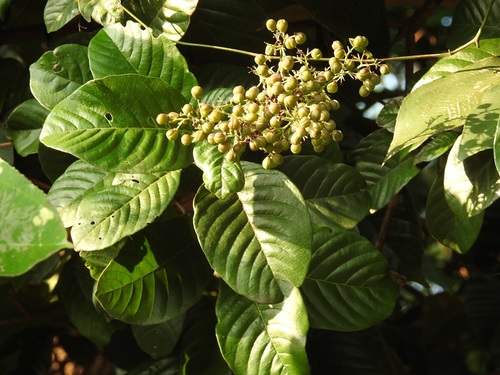
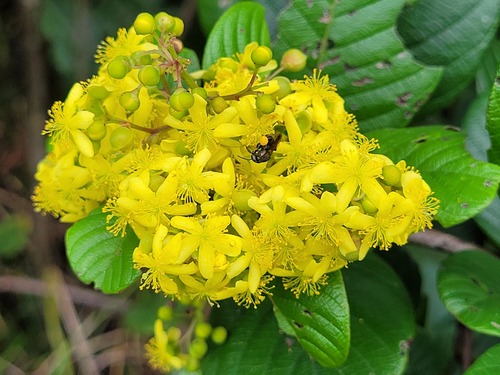
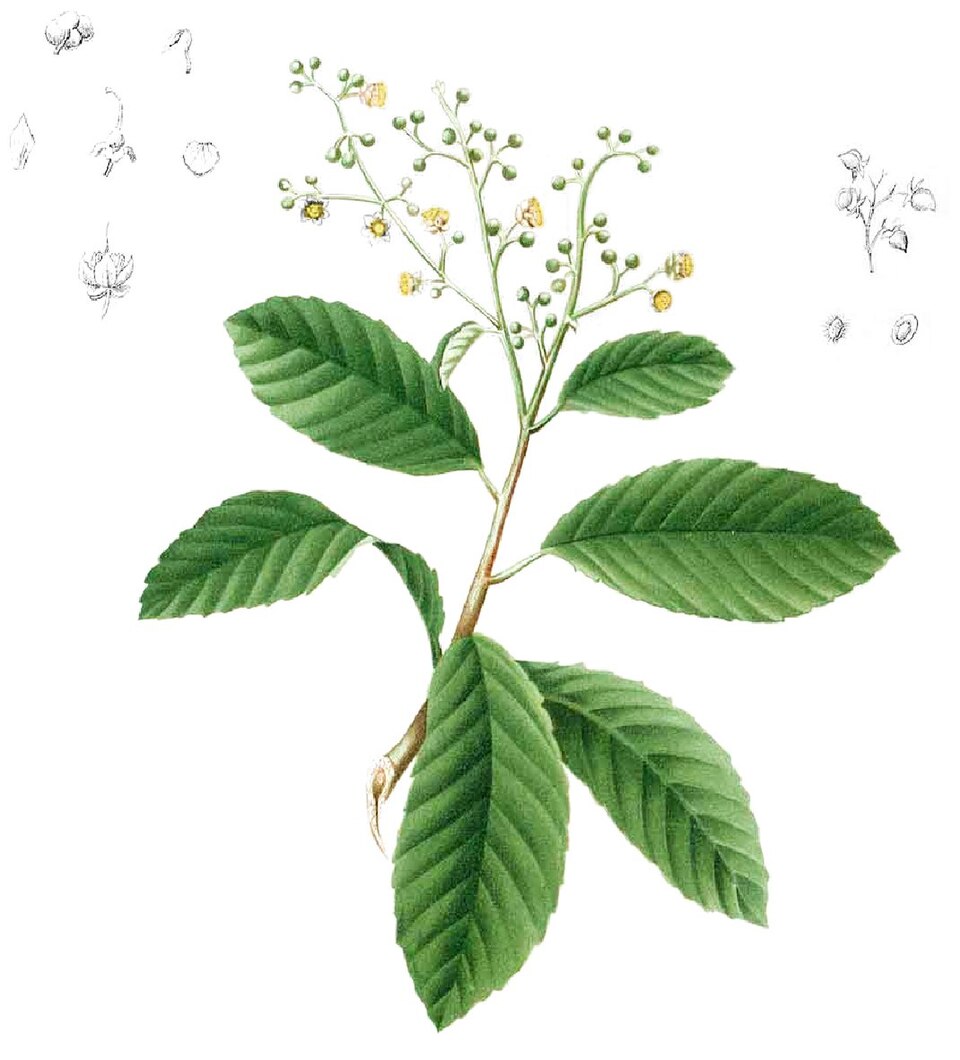
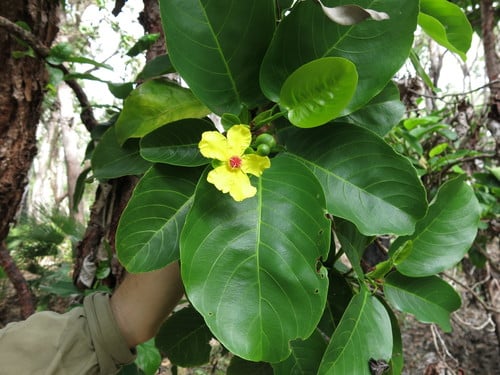
A tree. It grows 6-17 m tall. The twigs are twisted. The bark is grey and smooth. The leaves are large and 35-53 cm long by 12-30 cm wide. They fall off during the year. The leaves narrow to the base and have teeth along the edge. The flowers appear before the leaves. The flowers are yellow. The fruit are round. The fruit is succulent.
Edible Uses
Ripe fruits are eaten with salt and chili, made into jam, or pickled; flower buds and young fruits are eaten raw or pickled and can be stored for 20 days; flowers are fried.
Traditional Uses
The ripe fruit are edible but not greatly appreciated. They are eaten with salt and chili. They are used for jam. They can be pickled. The flower buds and young fruit are eaten raw or pickled. They can be stored for 20 days. The flowers are fried.
Medicinal Uses
The tree is used as a source of fruit, traditional medicine, timber and charcoal. Amongst the Tetun speaking practitioners of the ai tahan traditional medicine, in Belu Regency, Timor Barat, Indonesia, the bark is used to treat headaches and migraines. In Cambodia, the fruit is eaten, but is not generally appreciated, it also provides a component for a remedy against cough. The timber is used to make humidity resistant boards and beams. Small knick-knacks are made from the wood, which makes excellent charcoal as well. The Bunong people of Mondulkiri Province, northeastern Cambodia, drink a decoction of the bark and wood of both this tree and Oroxylum indicum to treat cold and fever. Amongst Kuy- and Khmer-speaking people living in the same villages in Stung Treng and Preah Vihear provinces of north-central Cambodia, the tree is used as source of medicine, fuel and food. In various areas of India, parts of the plant are used in ethnomedicine. The Koch-Rajbanshi people of western Assam use the seed and bark against cancer. In the Konkan region of Maharashtra, village people use a paste of water and bark to treat wounds. In Deogarh district, Tribal people use a decoction of the fruit and Zingiber montanum for "blood dysentery". To treat diabetes, ripe fruit is taken regularly. The unripe fruit is consumed as a vegetable.
Distribution
A tropical plant. In Nepal it grows up to 1200 m altitude. It grows in open places in the foothills. It grows in drier areas. In southern China it grows in rainforests below 400 m above sea level. In Sikkim it grows between 150-1,500 m above sea level. In Yunnan.
Where It Grows
Andamans, Asia, Bangladesh, Bhutan, Cambodia, China, East Timor, Himalayas, India, Indochina, Indonesia, Laos, Malaysia, Myanmar, Nepal, Northeastern India, Philippines, SE Asia, Sikkim, Sri Lanka, Thailand, Timor-Leste, Vietnam,
Cultivation
Plants are grown from seed. They can also be grown by cuttings.
Other Uses
The old leaves contain an abundance of silica and are used as a sand paper. The bark contains about 6% tannins. A fibre obtained from the inner bark is used for cordage. The leaves are used as a mulch. The wood is used for planking, house posts and furniture. The wood, though of rather good quality, is rarely used because of its crookedness. A rather good quality charcoal is made from the wood.
Production
In India fruit are produced March to May.
Notes
There are about 60 Dillenia species.
Nutrition
| Part | Moisture | kJ | kcal | Protein | Vit A | Vit C | Iron | Zinc |
|---|---|---|---|---|---|---|---|---|
| Flowers | 89.5 | — | 344 | 0.7 | — | — | 16.2 | — |
Synonyms
Also Known As
Agachi, Agaie, Aggai, Aggai kallai, Akshi, Banchalta, Chalta, Cherimpi, Chinnakalinga, Chirimpi, Chota-karmal, Dieng-soh-bar, Dog teak tree, Graw-grawp, Hargaza, Kadu-kanigala, Kallai, Kalot, Kanigala, Karaola, Karkotta, Karmal, Kaulong, Khwaw, Kodapunna, Kurkut, Larong, Lve, Mai-mak-san, Mai-masan, Mekur kendi, Mingmechet, Naytekku, Niupang, Okshi, Panchphal, Pohon janti, Pohon sempur karmal, Punna, Rai, Ran-kel, Ravundana, Reavadi, Rovey, Sahad, Sahn-chang, Shukni-kung, Tanatri, Tantari, Tatar, Tatri, Tentri, Thing-se-lei, Zin byun
References (51)
- Ambasta, S.P. (Ed.), 2000, The Useful Plants of India. CSIR India. p 173
- Anderson, E. F., 1993, Plants and people of the Golden Triangle. Dioscorides Press. p 209
- Baishya, S. Kr., et al, 2013, Survey of Wild Edible Fruits of Dhubri District, Assam, India. Plant Archives Vol 13 (1): 155-158
- BARC, 2016, State of Biodiversity for Food and Agriculture in Bangladesh. Bangladesh Agricultural Research Council.
- Baro, D., Baruah, S. and Borthukar, S. K. 2015, Documentation on wild vegetables of Baksa district, BTAD (Assam). Scholars Research Library. Archives of Applied Science Research, 2015, 7 (9):19-27
Show all 51 references Hide references
- Cengel, D. J. & Dany, C., (Eds), 2016, Integrating Forest Biodiversity Resource Management and Sustainable Community Livelihood Development in the Preah Vihear Protected Forest. International Tropical Timber Organization p 120
- Chakraborty, S. & Chaturbedi, H. P., 2014, Some Wild Edible Fruits of Tripura- A Survey. Indian Journal of Applied research. (4) 9
- Chandrakumar, P., et al, 2015, Ethnobotanical studies of wild edible plants of Gond, Halba and Kawar tribes of Salekasa Taluka, Gondia District, Maharashtra State, India. International Research Journal of Pharmacy 6(8)
- Cowie, I, 2006, A Survey of Flora and vegetation of the proposed Jaco-Tutuala-Lore National Park. Timor-Lests (East Timor) www.territorystories.nt/gov.au p 46
- Dangol, D. R., 2002, Economic uses of forest plant resources in western Chitwan, Nepal. Banko Janakari, 12(2): 56-64
- Dangol, D. R. et al, 2017, Wild Edible Plants in Nepal. Proceedings of 2nd National Workshop on CUAOGR, 2017.
- Dobriyal, M. J. R. & Dobriyal, R., 2014, Non Wood Forest Produce an Option for Ethnic Food and Nutritional Security in India. Int. J. of Usuf. Mngt. 15(1):17-37
- Dutta, U., 2012, Wild Vegetables collected by the local communities from the Churang reserve of BTD, Assam. International Journal of Science and Advanced Technology. Vol. 2(4) p 121
- Ethnobotany of Karbis. Chapter 4 in p 104
- GAMMIE,
- Gardner, S., et al, 2000, A Field Guide to Forest Trees of Northern Thailand, Kobfai Publishing Project. p 31
- Gautam, R. S., et al, 2020, Wild Edible Fruits of Nepal. Int. J. Appl. Sci. Biotechnol. Vol 8(3): 289-304
- Gautam, R. S., et al, 2022, Ethnobotanical Review of Wild Edible Plants of Nepal. Journal of Natural History Museum Volume 32, 2021-22 p 111
- Hedrick, U.P., 1919, (Ed.), Sturtevant's edible plants of the world. p 271
- Hu, Shiu-ying, 2005, Food Plants of China. The Chinese University Press. p 548
- Jadhav, R., et al, 2015, Forest Foods of Northern Western Ghats: Mode of Consumption, Nutrition and Availability. Asian Agri-History Vol. 19, No. 4: 293-317
- Kala, C. P., 2009, Aboriginal uses and management of ethnobotanical species in deciduous forests of Chhattisgarh state in India. Journal of Ethnobiology and Ethnomedicine. 5:32
- Kar, A., et al, 2013, Wild Edible Plant Resources used by the Mizos of Mizoram, India. Kathmandu University Journal of Science, Engineering and Technology. Vol. 9, No. 1, July, 2013, 106-126
- Manandhar, N.P., 2002, Plants and People of Nepal. Timber Press. Portland, Oregon. p 202
- Meitei, L. R., et al, 2022, An ethnobotanical study on the wild edible plants used by forest dwellers in Yangoupokpi Lokchao Wildlife Sanctuary, Manipur, India. Ethnobotany Research and Application 23:15
- Misra S. & Misra M., 2016, Ethnobotanical and Nutritional Evaluation of Some Edible Fruit Plants of Southern Odisha, India. International Journal of Advances in Agricultural Science and Technology, Vol.3 Issue.1, March- 2016, pg. 1-30
- Mozhui, R., et al, 2011, Wild edible fruits used by the tribals of Dimapur district of Nagaland, India. Pleione 5(1): 56 - 64.
- Partha, P., 2014, Ethnobotany of the Laleng (Patra) Community in Bangladesh. Journal of Pharmacognosy and Phytochemistry. 2(6):173-184
- Pasha, M. K. & Uddin, S. B., 2019, Minor Edible Fruits of Bangladesh. Bangladesh J. Plant Taxon. 26(2): 299–313
- Patiri, B. & Borah, A., 2007, Wild Edible Plants of Assam. Geethaki Publishers.
- Pham-Hoang Ho, 1999, An Illustrated Flora of Vietnam. Nha Xuat Ban Tre. p 406
- Phangchopi, U., et al, 2015, Diversity of wild edible plants in Marat Longri Wildlife Sanctuary, Assam. Indian Journal of Natural Products and Resources Vol. 6(4), December 2015 pp. 305-313
- Phon, P., 2000, Plants used in Cambodia. © Pauline Dy Phon, Phnom Penh, Cambodia. p 233
- Pl. Corom. 1: 21. T. 20. 1795
- Ramakrishna, N. & Singh, DSR, R., 2020, Ethno-Botanical Studies of Edible Plants Used by Tribal Women in Nirmal District. IJSRSET p 309
- Reddy, K. N. et al, 2007, Traditional knowledge on wild food plants in Andhra Pradesh. Indian Journal of Traditional Knowledge. Vol. 6(1): 223-229
- Savita, et al, 2006, Studies on wild edible plants of ethnic people in east Sikkim. Asian J. of Bio Sci. (2006) Vol. 1 No. 2 : 117-125
- Sarma, H., et al, 2010, Updated Estimates of Wild Edible and Threatened Plants of Assam: A Meta-analysis. International Journal of Botany 6(4): 414-423
- Sawian, J. T., et al, 2007, Wild edible plants of Meghalaya, North-east India. Natural Product Radiance Vol. 6(5): p 415
- Seal, T., 2012, Evaluation of Nutritional Potential of Wild Edible Plants, Traditionally Used by the Tribal People of Meghalaya. American Journal of Plant Nutrition and FertilizationTechnology 2(1): 19-26
- Setiya, A. V., et al, 2016, Exploration and documentation of some wild edible plants used by the aboriginals from Gadchiroli District (M.S.) India. International Advanced Research Journal in Science, Engineering and Technology. 3(7)
- Singh, H.B., Arora R.K.,1978, Wild edible Plants of India. Indian Council of Agricultural Research, New Delhi. p 54
- Singh, V. B., et al, (Ed.) Horticulture for Sustainable Income and Environmental Protection. Vol. 1 p 215
- Sukarya, D. G., (Ed.) 2013, 3,500 Plant Species of the Botanic Gardens of Indonesia. LIPI p 231
- Sundriyal, M., et al, 2004, Dietary Use of Wild Plant Resources in the Sikkim Himalaya, India. Economic Botany 58(4) pp 626-638
- Teron, R. & Borthakur, S. K., 2016, Edible Medicines: An Exploration of Medicinal Plants in Dietary Practices of Karbi Tribal Population of Assam, Northeast India. In Mondal, N. & Sen, J.(Ed.) Nutrition and Health among tribal populations of India. p 151
- Turreira Garcia, N., et al, 2017, Ethnobotanical knowledgeof the Kuy and Khmer people in Prey Lang, Cambodia. Cambodian Journal of Natural History 2017 (1): 76-101
- Uprety, Y., et al, 2012, Diversity of use and local knowledge of wild edible plant resources in Nepal. Journal of Ethnobotany and Ethnomedicine 8:16
- Uprety, Y., et al, 2016, Traditional use and management of NTFPs in Kangchenjunga Landscape: implications for conservation and livelihoods. Journal of Ethnobiology and Ethnomedicine (2016) 12:19
- Wild edible plants of Himachal Pradesh
- World Checklist of Useful Plant Species 2020. Royal Botanic Gardens, Kew