Dillenia indica
L.
Elephant apple
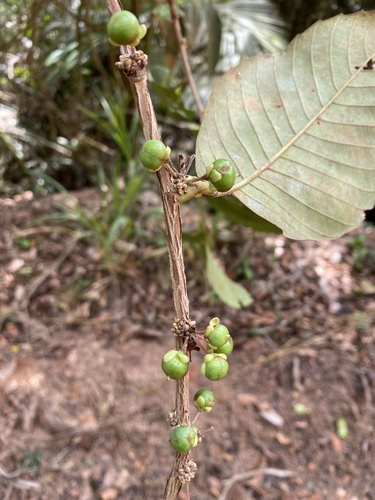
iNaturalist· cc-by-nc
(c) scott.zona, some rights reserved (CC BY-NC)
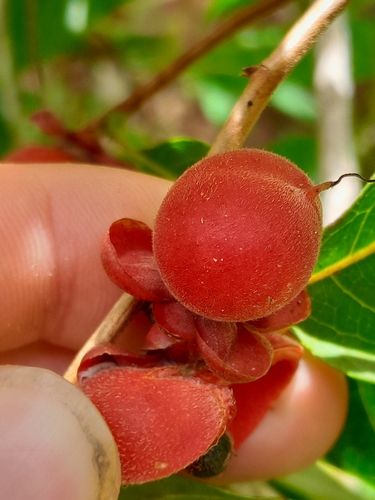
iNaturalist· cc-by-nc
(c) Leticia Sehn, some rights reserved (CC BY-NC), uploaded by Leticia Sehn
iNaturalist· cc-by-nc
(c) Diego Monsores, some rights reserved (CC BY-NC), uploaded by Diego Monsores
Summary
Source: WikipediaDillenia indica, commonly known as elephant apple or ou tenga, is a species of Dillenia (Family Dilleniaceae) native to China, India, and tropical Asia. It is found in stony river banks. This species was one of the many first described by Linnaeus in the 10th edition of his Systema Naturae in 1759.
Description
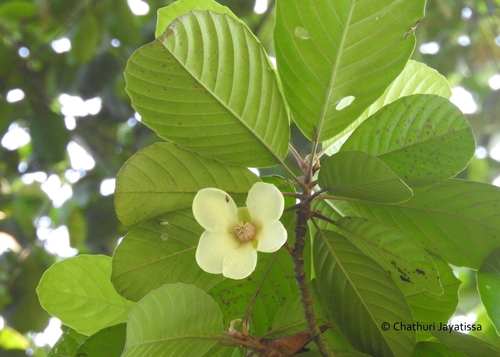
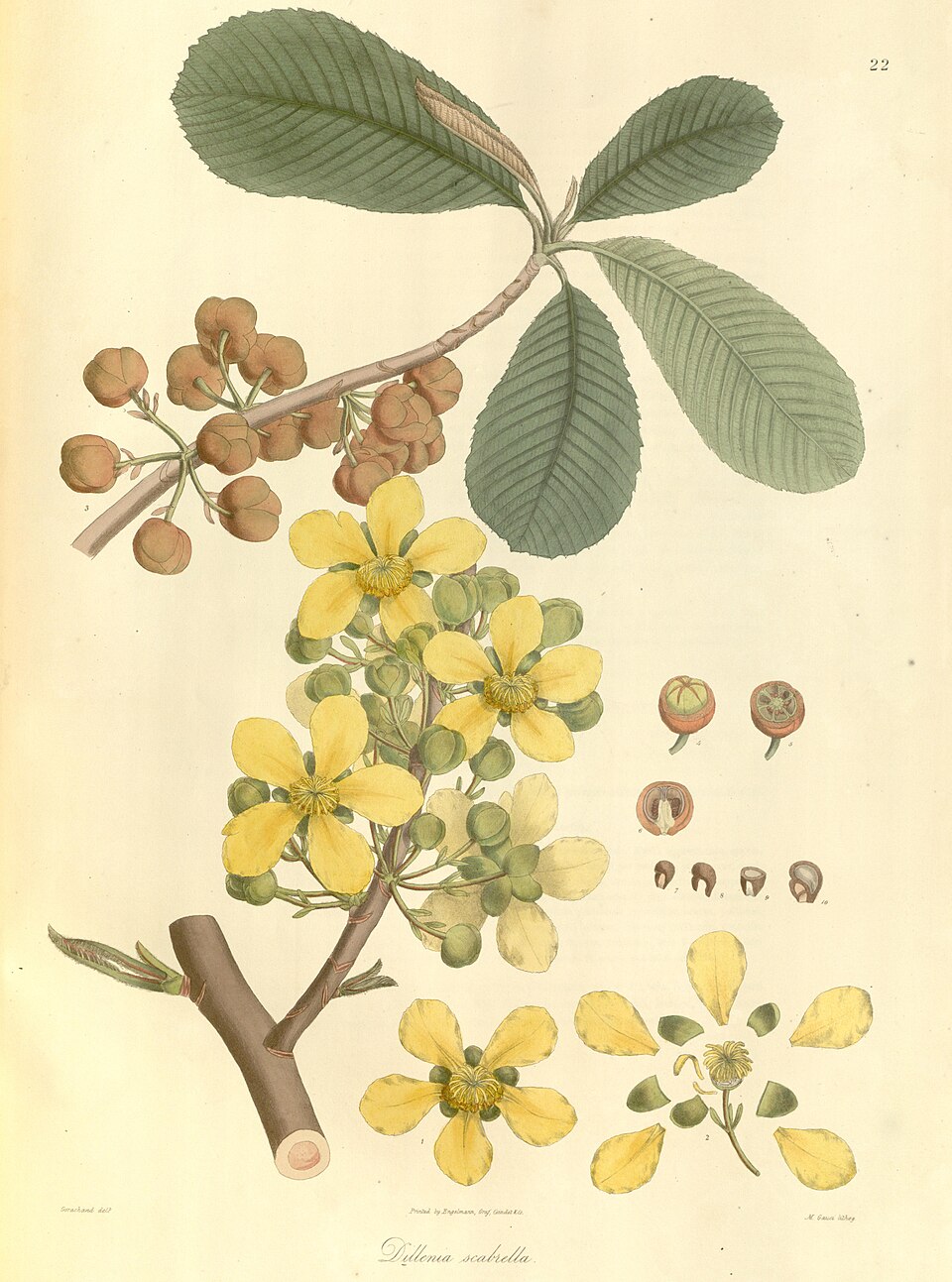
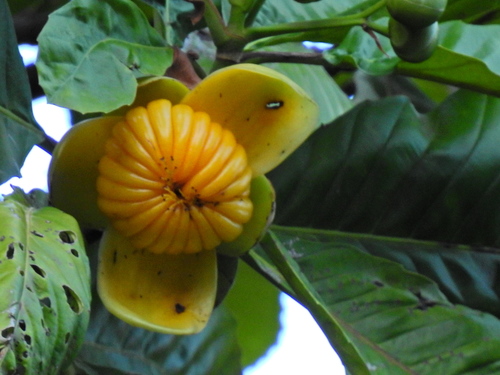
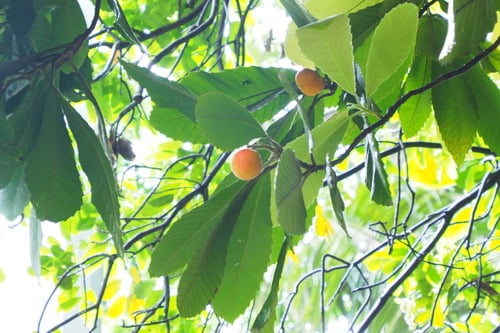
An evergreen tree with a short trunk. It grows to 10-15-30 m high and spreads to 4-10 m across. The bark is rough. It has a dense round crown. The branches are straggling and droop at the end. The leaves are at the ends of branches. The leaves are deeply ribbed. They have teeth around the edge. The leaves are bright dark green. They are 15-25 cm long and 5-10 cm wide, but can be twice that size. The leaves have a bold pattern of sunken veins. The leaf stalk is 2-5 cm long. The flower buds are large and round and look like fruit. The flowers are large and white and 20 cm across. They are cup shaped. The flowers are produced in the upper leaf axils. The flower sepals thicken and cover the fruit to make a round green fruit up to 12 cm across. The seeds are kidney shaped with hairy edges. They are embedded in a glutinous pulp.
Edible Uses
The fruit pulp is sour and used in Indian cuisine in curries, jam (ouu khatta), and jellies. Because it is a main source of food for elephants, monkeys and deer, collection of fruit from the core areas of the forest is prohibited. Commercial sale of the fruit is also prohibited, in an effort to help keep the food-chain system of the forest from dismantling totally. Its branches are used to make good firewood.
Traditional Uses
The fruit can be used for jellies, curries and drinks. It is the fleshy sepals around the fruit that are eaten. They can be pickled. The fruit can be eaten raw. More commonly they are used in curries, especially prawn curries. They can be cooked with lentils. They can be made into jam. They are used for chutney. The sweetened fruit juice makes a cooling drink. The fleshy calyx can be stored for 20 days. The young leaves are eaten.
Medicinal Uses
The fruit is tonic and laxative. It is used in the treatment of abdominal disorders, and is mixed with sugar to be used against coughs. The bark and leaves are astringent. The bark is used as a mouthwash to treat thrush.
Distribution
It is a tropical plant. It suits the tropical lowlands. It prefers rich moist soils. It needs a protected partly shaded position. It is drought and frost tender. They need a temperature above 15°C to grow. It grows in moist evergreen forest. In Papua New Guinea it is an introduced species and grows in coastal areas below about 600 m altitude. In Yunnan in China it grows between 600-1100 m altitude. In XTBG Yunnan. In the Cairns Botanical Gardens. It suits hardiness zones 10-12.
Where It Grows
Africa, Andamans, Asia, Australia, Bangladesh, Bhutan, Cambodia, Cameroon, Central Africa, China, Colombia, Cuba, Dominican Republic, East Africa, Ghana, Guyana, Haiti, Hawaii, Himalayas, India, Indochina, Indonesia, Laos, Malaysia, Mozambique, Myanmar, Nepal, Nigeria, Northeastern India, Pacific, Pakistan, Papua New Guinea, PNG, Philippines, Pohnpei, Sao Tome and Principe, SE Asia, Sierra Leone, Sikkim, Singapore, South America, Sri Lanka, Suriname, Thailand, USA, Vietnam, West Africa, West Indies,
Cultivation
Plants are normally grown from seed. They can be grown from cuttings and by air layering.
Propagation
Seed - Semi-ripe cuttings
Other Uses
The fruits can be rubbed in water to make a soap. The pulp is used as a hair wash. The leaf juice is applied to the scalp to prevent baldness. The dried leaves are used to polish ivory. The wood ash is added to clay bricks to increase their fire resistance. The light brown sapwood is slightly soft. It is little used. The wood, which is moderately hard and has a durability under water of around 3 years, is sometimes used for house-building or gunstocks.
Production
In NE India fruit are available September to December.
Other Information
Trees are only occasionally seen in coastal areas of Papua New Guinea and they are rarely used for food. The fruit are sold in markets in India. It is a cultivated food plant.
Notes
There are about 60 Dillenia species.
Nutrition
| Part | Moisture | kJ | kcal | Protein | Vit A | Vit C | Iron | Zinc |
|---|---|---|---|---|---|---|---|---|
| Fruit | 84.5 | — | — | — | — | 2.2 | — | — |
Synonyms
Also Known As
Aitrang, Betta kanigala, Bharija, Bia huo biu, Chalba, Chalita, Chalom, Chalta, Chata, Chatla, Chilta, Chimpuh, Chulta, Dak chan, Girnar, Heigree, Heigri, Hondapara Tree, Indian Dillenia, Ithlang, Jampa, Karambal, Karambel, Karmal, Katmon, Kawr-thin-deng, Kosar, Malampunna, Mandi, Ma-tad, Masan, Masangsi, Ma taad, Mataat, Matad, Matat, Mota-karmal, Olifant, Outenga, Pach-phaley, Panchphal, Peddakalinga, Phamsikol, Phlul vieng, Plou, Plum-plam, Pohon sempur air, Ramphal, Red Beach, Saan-cha-waa, Salam, San, Satikhoi, Sempur chay, Sepulahau, Simpoh, Simpol, Simpor, Simpur, Si pi luo me, So, Soh-kyrbam, Sompa, Taigir, Thabyu, Thaidi, Thaigir, Thapru, Thaudi chi, Uva, Xi shi a di
References (115)
- Abbiw, D.K., 1990, Useful Plants of Ghana. West African uses of wild and cultivated plants. Intermediate Technology Publications and the Royal Botanic Gardens, Kew. p 46
- Ambasta, S.P. (Ed.), 2000, The Useful Plants of India. CSIR India. p 173
- Anderson, E. F., 1993, Plants and people of the Golden Triangle. Dioscorides Press. p 209
- Arora, R. K., 2014, Diversity in Underutilized Plant Species - An Asia-Pacific Perspective. Bioversity International. p 66
- Baishya, S. Kr., et al, 2013, Survey of Wild Edible Fruits of Dhubri District, Assam, India. Plant Archives Vol 13 (1): 155-158
Show all 115 references Hide references
- Balkrishna, A., et al, 2022, Indigenous Uses of Plants among Forest-dependent Communities of Seijosa, Arunachal Pradesh. International Journal of Economic Plants 2022, 9(1):064-080
- Bandyopadhyay, S. et al, 2009, Wild edible plants of Koch Bihar district, West Bengal. Natural Products Radiance 8(1) 64-72
- Bandyopadhyay, S., et al, 2012, A Census of Wild Edible Plants from Howrah District, West Bengal, India. Proceedings of UGC sponsored National Seminar 2012
- Banerjee, A., et al, 2013, Ethnobotanical Documentation of Some Wild Edible Plants in Bankura District, West Bengal, India. The Journal of Ethnobiology and Traditional Medicine. Photon 120 (2013) 585-590
- BARC, 2016, State of Biodiversity for Food and Agriculture in Bangladesh. Bangladesh Agricultural Research Council.
- Baro, D., Baruah, S. and Borthukar, S. K. 2015, Documentation on wild vegetables of Baksa district, BTAD (Assam). Scholars Research Library. Archives of Applied Science Research, 2015, 7 (9):19-27
- Barwick, M., 2004, Tropical and Subtropical Trees. A Worldwide Encyclopedic Guide. Thames and Hudson p 144
- Bodkin, F., 1991, Encyclopedia Botanica. Cornstalk publishing, p 343
- Bole, P.V., & Yaghani, Y., 1985, Field Guide to the Common Trees of India. OUP p 39
- Brahma, S., et al, 2013, Wild edible fruits of Kokrajhar district of Assam, North-East India, Asian Journal of Plant Science and Research 3(6):95-100
- Bremness, L., 1994, Herbs. Collins Eyewitness Handbooks. Harper Collins. p 52
- Brickell, C. (Ed.), 1999, The Royal Horticultural Society A-Z Encyclopedia of Garden Plants. Convent Garden Books. p 368
- Burkill, I.H., 1966, A Dictionary of the Economic Products of the Malay Peninsula. Ministry of Agriculture and Cooperatives, Kuala Lumpur, Malaysia. Vol 1 (A-H) p 822
- Cao, Y., et al, 2020, Ethnobotanical study on wild edible plants used by three trans-boundary ethnic groups in Jiangcheng County, Pu’er, Southwest China. Journal of Ethnobiology and Ethnomedicine (2020) 16:66
- Chakraborty, S. & Chaturbedi, H. P., 2014, Some Wild Edible Fruits of Tripura- A Survey. Indian Journal of Applied research. (4) 9
- Chowdery, T., et al, 2014, Wild edible plants of Uttar Dinajpur District, West Bengal. Life Science Leaflets. 47:pp 20-36 http://lifesciencesleaflets.ning.com
- Chowdhury, M. & Mukherjee, R., 2012, Wild Edible Plants Consumed by Local Communities of Maldah of West Bengal, India. Indian J.Sci.Res.3(2) : 163-170
- Cundall, P., (ed.), 2004, Gardening Australia: flora: the gardener's bible. ABC Books. p 501
- Dangol, D. R. et al, 2017, Wild Edible Plants in Nepal. Proceedings of 2nd National Workshop on CUAOGR, 2017.
- Darley, J.J., 1993, Know and Enjoy Tropical Fruit. P & S Publishers. p 119
- Das, T. & Das, A. K., 2005, Inventorying plant biodiversity in homegardens: A case study in Barak Valley, Assam, North East India. CURRENT SCIENCE, VOL. 89, NO. 1, 10 JULY 2005
- Devi, O.S., P. Komor & D. Das, 2010, A checklist of traditional edible bio-resources from Ima markets of Imphal Valley, Manipur, India. Journal of Threatened Taxa 2(11): 1291-1296
- Dobriyal, M. J. R. & Dobriyal, R., 2014, Non Wood Forest Produce an Option for Ethnic Food and Nutritional Security in India. Int. J. of Usuf. Mngt. 15(1):17-37
- Dutta, U., 2012, Wild Vegetables collected by the local communities from the Churang reserve of BTD, Assam. International Journal of Science and Advanced Technology. Vol. 2(4) p 121
- Eiadthong, W., et al, 2010, Management of the Emerald Triangle Protected Forests Complex. Botanical Consultant Technical Report. p 48
- Engel, D.H., & Phummai, S., 2000, A Field Guide to Tropical Plants of Asia. Timber Press. p 78, 100
- Etherington, K., & Imwold, D., (Eds), 2001, Botanica's Trees & Shrubs. The illustrated A-Z of over 8500 trees and shrubs. Random House, Australia. p 262
- Ethnobotany of Karbis. Chapter 4 in p 104
- Facciola, S., 1998, Cornucopia 2: a Source Book of Edible Plants. Kampong Publications, p 91
- Flora of China. Vol. 12, p 332 and Flora of China. www.eFloras.org
- Flora of Pakistan. www.eFloras.org
- French, B.R., 1986, Food Plants of Papua New Guinea, A Compendium. Asia Pacific Science Foundation p 294
- Gardner, S., et al, 2000, A Field Guide to Forest Trees of Northern Thailand, Kobfai Publishing Project. p 32
- Gautam, R. S., et al, 2020, Wild Edible Fruits of Nepal. Int. J. Appl. Sci. Biotechnol. Vol 8(3): 289-304
- Gautam, R. S., et al, 2022, Ethnobotanical Review of Wild Edible Plants of Nepal. Journal of Natural History Museum Volume 32, 2021-22 p 111
- GUPTA,
- Hazarika, B. et al. (2020). An overview of the unexplored underutilized fruit crops of Assam, India. Journal of Applied and Natural Science, 12(3): 442 - 453
- Hearne, D.A., & Rance, S.J., 1975, Trees for Darwin and Northern Australia. AGPS, Canberra p 52, Pl 13
- Hedrick, U.P., 1919, (Ed.), Sturtevant's edible plants of the world. p 271
- Heywood, V.H., Brummitt, R.K., Culham, A., and Seberg, O. 2007, Flowering Plant Families of the World. Royal Botanical Gardens, Kew. p 128
- Hibbert, M., 2002, The Aussie Plant Finder 2002, Florilegium. p 87
- Hu, Shiu-ying, 2005, Food Plants of China. The Chinese University Press. p 548
- Jadhav, R., et al, 2015, Forest Foods of Northern Western Ghats: Mode of Consumption, Nutrition and Availability. Asian Agri-History Vol. 19, No. 4: 293-317
- Japanese International Research Centre for Agricultural Science www.jircas.affrc.go.jp/project/value_addition/Vegetables
- Jeeva, S., 2009, Horticultural potential of wild edible fruits used by the Khasi tribes of Meghalaya. Journal or Horticulture and Forestry Vol. 1(9) pp. 182-192
- Jin, Chen et al, 1999, Ethnobotanical studies on Wild Edible Fruits in Southern Yunnan: Folk Names: Nutritional Value and Uses. Economic Botany 53(1) pp 2-14
- Joshi, N., et al, 2007, Traditional neglected vegetables of Nepal: Their sustainable utilization for meeting human needs. Tropentag 2007. Conference on International Agricultural Research for Development.
- Kar, A., et al, 2013, Wild Edible Plant Resources used by the Mizos of Mizoram, India. Kathmandu University Journal of Science, Engineering and Technology. Vol. 9, No. 1, July, 2013, 106-126
- Khan, D. & Shaukat, S.S., 2006, The Fruits of Pakistan: Diversity, Distribution, Trends of Production and Use. Int. J. Biol. Biotech., 3(3):463-499
- Krishen P., 2006, Trees of Delhi, A Field Guide. DK Books. p 146
- Llamas, K.A., 2003, Tropical Flowering Plants. Timber Press. p 184
- Lord, E.E., & Willis, J.H., 1999, Shrubs and Trees for Australian gardens. Lothian. p 53
- Lungphi, P., Wangpan, T. & Tangjang, S., 2018, Wild edible plants and their additional uses by the Tangsa community living in the Changlang district of Arunachal Pradesh, India. Pleione 12(2): 151 - 164. 2018.
- Luo, B., et al, 2019, Wild edible plants collected by Hani from terraced rice paddy agroecosystem in Honghe Prefecture, Yunnan, China. Journal of Ethnobiology and Ethnomedicine 15:56
- Macmillan, H.F. (Revised Barlow, H.S., et al) 1991, Tropical Planting and Gardening. Sixth edition. Malayan Nature Society. Kuala Lumpur. p 298
- Maikhuri, R, K, and Gangwar, A. K., 1993, Ethnobiological Notes on the Khasi and Garo Tribes of Meghalaya, Northeast India, Economic Botany, Vol. 47, No. 4, pp. 345-357
- Majumdar, K and Datta, N., 2009, Traditional wild edible fruits for the forest dwellers of Tripura, India. Pleione 3(2) 167-178
- Manandhar, N.P., 2002, Plants and People of Nepal. Timber Press. Portland, Oregon. p 203
- McMakin, P.D., 2000, Flowering Plants of Thailand. A Field Guide. White Lotus. p 15
- Medhi, P. & Borthakur, S. K., 2012, Phytoresources from North Cachur Hills of Assam -3: Edible plants sold at Hflong market. Indian Journal or Natural Products and Resources. 3(1) pp 84-109
- Medhi, P. & Borthakur, S. K., 2013, Wild edible plants sold by the Zeme Nagas at the makeshift market of Mahur, Dima Hasao district of Assam. Pleione 7(1): 84 - 93. 2013
- Medhi, P., Sarma, A and Borthakur, S. K., 2014, Wild edible plants from the Dima Hasao district of Assam, India. Pleione 8(1): 133-148
- Meitei, L. R., et al, 2022, An ethnobotanical study on the wild edible plants used by forest dwellers in Yangoupokpi Lokchao Wildlife Sanctuary, Manipur, India. Ethnobotany Research and Application 23:15
- Miguel, E., et al, 1989, A checklist of the cultivated plants of Cuba. Kulturpflanze 37. 1989, 211-357
- Morley, B. & Everard, B., 1970, Wild Flowers of the World. Ebury press. Plate 112
- Mot So Rau Dai an Duoc O Vietnam. Wild edible Vegetables. Ha Noi 1994, p 216
- Mozhui, R., et al, 2011, Wild edible fruits used by the tribals of Dimapur district of Nagaland, India. Pleione 5(1): 56 - 64.
- Mukhia, P.K., et al, 2013, Wild plants as Non Wood Forest Products used by the rural community of Dagana, a southern foothill district of Bhutan, SAARC Journal, 27 pages
- Murtem, G. & Chaudhrey, P., 2016, An ethnobotanical note on wild edible plants of Upper Eastern Himalaya, India. Brazilian Journal of Biological Sciences, 2016, v. 3, no. 5, p. 63-81
- Narayanan Ratheesh, M. K. et al, 2011, Wild edible plants used by the Kattunaikka, Paniya and Kuruma tribes of Wayanad District, Kerala, India. Journal of Medicinal Plants Research Vol. 5(15), pp. 3520-3529
- Narzary, H., et al, 2013, Wild Edible Vegetables Consumed by Bodo tribe of Kokrajhar District (Assam), North-East India. Archives of Applied Science Research, 5(5): 182-190
- Omawale, 1973, Guyana's edible plants. Guyana University, Georgetown p 13
- Paul, A., 2013, Minor and uncultivated fruits of Eastern India, 2nd International Symposium on Minor Fruits and Medicinal Plants
- Partha, P., 2014, Ethnobotany of the Laleng (Patra) Community in Bangladesh. Journal of Pharmacognosy and Phytochemistry. 2(6):173-184
- Pasha, M. K. & Uddin, S. B., 2019, Minor Edible Fruits of Bangladesh. Bangladesh J. Plant Taxon. 26(2): 299–313
- Patiri, B. & Borah, A., 2007, Wild Edible Plants of Assam. Geethaki Publishers.
- Pegu, R., et al, 2013, Ethnobotanical study of Wild Edible Plants in Poba Reserved Forest, Assam, India. Research Journal of Agriculture and Forestry Sciences 1(3):1-10
- Pham-Hoang Ho, 1999, An Illustrated Flora of Vietnam. Nha Xuat Ban Tre. p 405
- Phangchopi, U., et al, 2015, Diversity of wild edible plants in Marat Longri Wildlife Sanctuary, Assam. Indian Journal of Natural Products and Resources Vol. 6(4), December 2015 pp. 305-313
- Phon, P., 2000, Plants used in Cambodia. © Pauline Dy Phon, Phnom Penh, Cambodia. p 232
- Plants of Haiti Smithsonian Institute http://botany.si.edu/antilles/West Indies
- Rahmatullah, M., et al, 2009, A survey of medicinal plants in two areas of Dinajpur district, Bangladesh including plants which can be used as functional foods. American-Eurasian Journal of Sustainable Agriculture, 3(4): 862-876
- Ramakrishna, N. & Singh, DSR, R., 2020, Ethno-Botanical Studies of Edible Plants Used by Tribal Women in Nirmal District. IJSRSET p 309
- Rashid, H. E., 1977, Geography of Bangladesh. Westview. p 349
- Recher, P, 2001, Fruit Spirit Botanical Gardens Plant Index. www.nrg.com.au/~recher/ seedlist.html p 2
- Sahni, K.C., 2000, The Book of Indian Trees. Bombay Natural History Society. Oxford. p 16
- Saikia, M., 2015, Wild edible vegetables consumed by Assamese people of Dhemaji District of Assam, NE India and their medicinal values. Archives of Applied Science Research, 2015, 7 (5):102-109
- Sarma, H., et al, 2010, Updated Estimates of Wild Edible and Threatened Plants of Assam: A Meta-analysis. International Journal of Botany 6(4): 414-423
- Savita, et al, 2006, Studies on wild edible plants of ethnic people in east Sikkim. Asian J. of Bio Sci. (2006) Vol. 1 No. 2 : 117-125
- Sawian, J. T., et al, 2007, Wild edible plants of Meghalaya, North-east India. Natural Product Radiance Vol. 6(5): p 415
- Seidemann J., 2005, World Spice Plants. Economic Usage, Botany, Taxonomy. Springer. p 136
- Singh, H.B., Arora R.K.,1978, Wild edible Plants of India. Indian Council of Agricultural Research, New Delhi. p 54
- Singh, V. B., et al, (Ed.) Horticulture for Sustainable Income and Environmental Protection. Vol. 1 p 215
- Slik, F., www.asianplant.net
- Sp. pl. 1:535. 1753
- Srivastava, R. C., 2010, Traditional knowledge of Nyishi (Daffla) tribe of Arunachal Pradesh. Indian Journal of Traditional Knowledge. 9(1):26-37
- Staples, G.W. and Herbst, D.R., 2005, A tropical Garden Flora. Bishop Museum Press, Honolulu, Hawaii. p 270
- Sukarya, D. G., (Ed.) 2013, 3,500 Plant Species of the Botanic Gardens of Indonesia. LIPI p 229
- Sundriyal, M., et al, 2004, Dietary Use of Wild Plant Resources in the Sikkim Himalaya, India. Economic Botany 58(4) pp 626-638
- Suwardi, A. B., et al, 2020, Ethnobotany and conservation of indigenous edible fruit plants in South Aceh, Indonesia. Biodiversitas Vol. 21, No. 5, pp 1850-1860
- Swaminathan, M.S., and Kochnar, S.L., 2007, An Atlas of Major Flowering Trees in India. Macmillan. p 19
- Teron, R. & Borthakur, S. K., 2016, Edible Medicines: An Exploration of Medicinal Plants in Dietary Practices of Karbi Tribal Population of Assam, Northeast India. In Mondal, N. & Sen, J.(Ed.) Nutrition and Health among tribal populations of India. p 151
- Thorng, R., et al, 2015, Roles of Wild Food Plants in Ethnic Group Communities in Mondulkiri Province, Northeastern Cambodia. Journal of Mekong Societies Vol.11 No.2 May-August 2015 pp. 1-17
- Tsering, J., et al, 2017, Ethnobotanical appraisal on wild edible plants used by the Monpa community of Arunchal Pradesh. Indian Journal of Traditional Knowledge. Vol 16(4), October 2017, pp 626-637
- Turreira Garcia, N., et al, 2017, Ethnobotanical knowledgeof the Kuy and Khmer people in Prey Lang, Cambodia. Cambodian Journal of Natural History 2017 (1): 76-101
- Van Sam, H. et al, 2008, Uses and Conservation of Plant Species in a National Park. A case study of Ben En, Vietnam. Economic Botany 62:574-593
- WATT,
- Wiersema, J. H. & Leon, B., 2013, World Economic Plants. A Standard Reference CRC Press. 2nd Ed. p 246
- Wild edible plants of Himachal Pradesh
- World Checklist of Useful Plant Species 2020. Royal Botanic Gardens, Kew