Akebia trifoliata
(Thunb.) Koidz.
Three Leaf Akebia
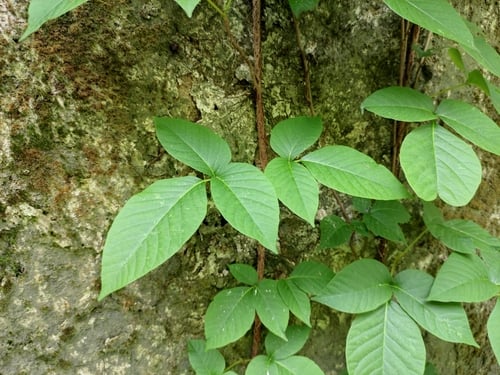
iNaturalist· cc-by-nc
(c) 空猫 T. N, some rights reserved (CC BY-NC), uploaded by 空猫 T. N
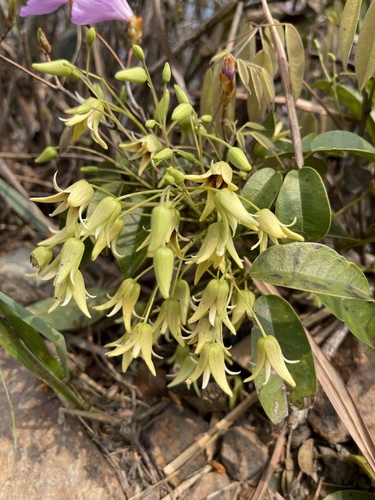
iNaturalist· cc-by-nc
(c) onidiras-iNaturalist, some rights reserved (CC BY-NC), uploaded by onidiras-iNaturalist
iNaturalist· cc-by-nc
(c) 空猫 T. N, some rights reserved (CC BY-NC), uploaded by 空猫 T. N
Summary
Source: WikipediaAkebia trifoliata also known as chocolate vine, three leaf chocolate vine or three leaf akebia, is a species of flowering plant. It is a close relative of the more commonly known Akebia quinata.
Description
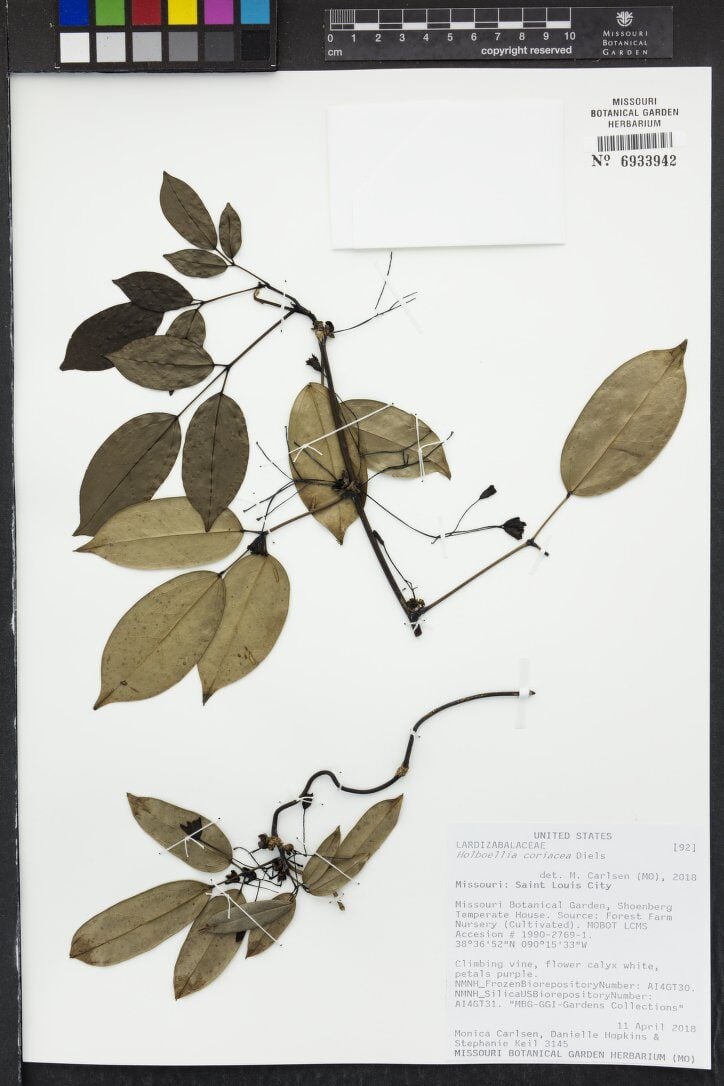
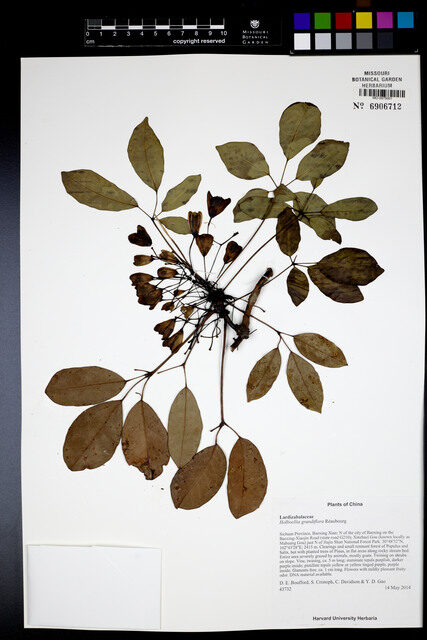
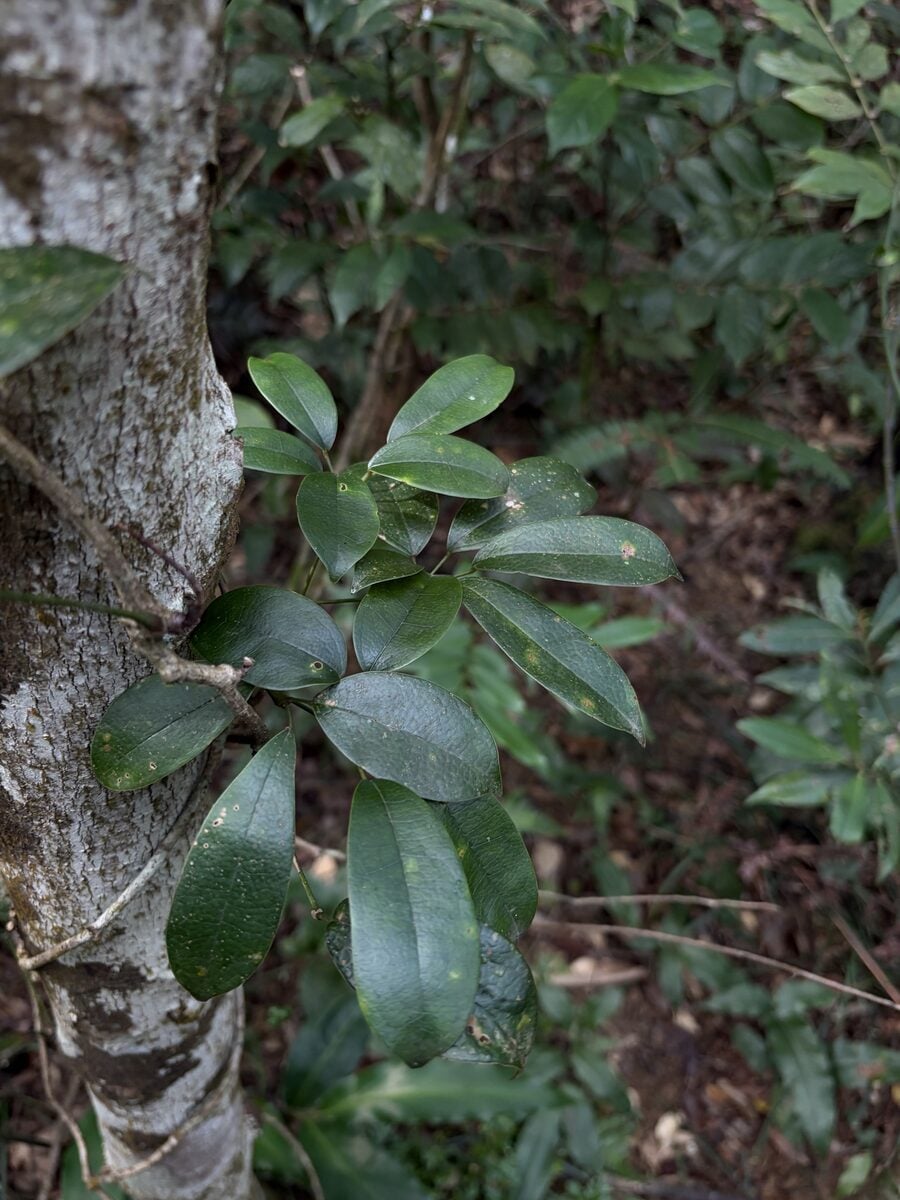
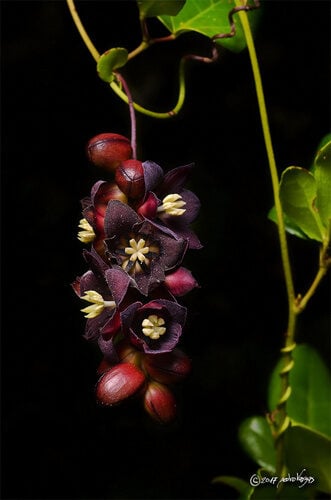
A climbing plant. It is woody. It grows up to 9 m long. In colder places it looses its leaves. The leaves have 3 leaflets. Young leaves are bronze red then turn green. It loses its leaves during the year. The flowers are purple. The flowers have a sweet scent. The fruit looks somewhat like a deep-purple coloured sausage. The fruit is 7 - 13 cm long.
Edible Uses
The fruit is eaten raw. Though sweet, it tends toward the insipid side, with a delicate flavour and soft, juicy texture. A squeeze of lemon juice helps bring out the flavour. The fruit is something of a novelty, resembling a deep-purple sausage and measuring 7–13cm in length. Dried young leaves make a reasonable tea substitute.
Traditional Uses
The ripe fruit is eaten raw. It can also be used for drinks. The dried young leaves are used as a herbal tea.
This uses section is brief — help expand it
Medicinal Uses
The stems are analgesic, antibacterial, antifungal, anti-inflammatory, antitumor, blood tonic, cardiotonic, diuretic, emmenagogue, and galactogogue. Taken internally, they help control gram-positive bacterial and fungal infections and are used to treat urinary tract infections, absent menstruation, and poor lactation, among other conditions. Stems are harvested in autumn and dried for later use.
Distribution
Plants grow naturally in rocky places in woods and thickets to 1800 metres in China, Japan and Korea. It needs well drained moist soil. It can grow in acid or alkaline soils. Dormant plants can withstand heavy frosts but plants with shoots are damaged. It can stand temperatures down to -10°C. In mild climates plants do not lose their leaves. It can grow in shade but does better in the sun. It grows in Sichuan and Yunnan.
Where It Grows
Africa, Asia, Australia, Britain, Burkina Faso, China*, Central Africa, Central African Republic, CAR, China, Côte d'Ivoire, Europe, Gabon, Ghana, Ivory Coast, Japan, Korea, Taiwan, West Africa,
Cultivation
Plants can be grown from seed. If possible use fresh seed or for stored seed give it one months cold treatment. Seed should be sown on the surface of the soil. The seed usually germinates in 1 - 3 months at 15°C. Plants do not transplant easily. Plants do not transplant easily. Plants do well climbing on deciduous trees. Hand pollination helps fruit bearing. As plants are probably self sterile 2 plants from different sources should be grown together. Plants can be grown from cuttings of the vine or root. Plants can also be grown by layering.
Propagation
Sow seed in a cold frame as soon as it ripens, surface-sowing in a light position. Germination typically takes 1–3 months at 15°C. Stored seed requires 1 month of cold stratification and can be difficult to germinate. Prick seedlings into individual pots once large enough to handle and grow on in light shade in the greenhouse through at least their first winter. Plant out in late spring or early summer after the last frost. Half-ripe cuttings can be taken in July/August in a frame, though they may be slow to root. Softwood cuttings are also possible in spring. Root cuttings can be taken in December in a warm greenhouse. Layering works well in early spring — plants often self-layer, so rooted sections can simply be dug up and transplanted directly to their permanent positions.
Other Uses
The peeled stems are highly pliable, can be bleached, and are well suited to basket making. The flowers are purple and sweetly scented. Landscape uses include arbors. Noted for use in food forests and as a scented plant.
Production
Plants are fast growing. In China plants flower in April and May and fruit in June to September.
Other Information
Fruit are sold in markets in Japan.
Notes
There are about 4-5 Akebia species.
Synonyms
Also Known As
Bayuegua, Bayuezha, Mitsuba-akebi
References (21)
- Bircher, A. G. & Bircher, W. H., 2000, Encyclopedia of Fruit Trees and Edible Flowering Plants in Egypt and the Subtropics. AUC Press. p 15 (As Akebia lobata)
- Bodkin, F., 1991, Encyclopedia Botanica. Cornstalk publishing, p 63
- Bot. Mag. (Tokyo) 39:310. 1925
- Brickell, C. (Ed.), 1999, The Royal Horticultural Society A-Z Encyclopedia of Garden Plants. Convent Garden Books. p 92
- Brown, D., 2002, The Royal Horticultural Society encyclopedia of Herbs and their uses. DK Books. p 109
Show all 21 references Hide references
- Facciola, S., 1998, Cornucopia 2: a Source Book of Edible Plants. Kampong Publications, p 138
- Flowerdew, B., 2000, Complete Fruit Book. Kyle Cathie Ltd., London. p 188
- Hedrick, U.P., 1919, (Ed.), Sturtevant's edible plants of the world. p 31 (As Akebia lobata)
- Hu, Shiu-ying, 2005, Food Plants of China. The Chinese University Press. p 391 (var. australis)
- John, L., & Stevenson, V., 1979, The Complete Book of Fruit. Angus & Robertson p 46 (As Akebia lobata)
- Kang, Y., et al, 2012, Wild food plants and wild edible fungi in two valleys on the Qinling Mountains (Shaanxi, central China) Journal of Ethnobiology and Ethnomedicine; 9:26
- Kang, Y., et al, 2012, Wild food plants and wild edible fungi of Heihe valley (Qinling Mountains, Shaanxi, central China): Herbophilia and indifference to fruits and mushrooms. Acta Societas Botanicorum Poloniae 81(4):4-5-413
- Kang, Y., et al, 2014, Wild food plants used by the Tibetans of Gongba Valley (Zouqu country, Gansu, China) Journal of Ethnobiology and Ethnomedicine 10:20
- Lamberton, K (Ed.), 2004, The Australian gardening encyclodepia. Murdoch Books, NSW Australia. p 154 (As Akebia trifoliata)
- Lord, E.E., & Willis, J.H., 1999, Shrubs and Trees for Australian gardens. Lothian. p 326
- Luo, B., et al, 2019, Wild edible plants collected by Hani from terraced rice paddy agroecosystem in Honghe Prefecture, Yunnan, China. Journal of Ethnobiology and Ethnomedicine 15:56
- Lyle, S., 2006, Discovering fruit and nuts. Land Links. p 54, 56
- Plants for a Future database, The Field, Penpol, Lostwithiel, Cornwall, PL22 0NG, UK. http://www.scs.leeds.ac.uk/pfaf/
- Reis, S. V. and Lipp, F. L., 1982, New Plant Sources for Drugs and Foods from the New York Botanical Garden herbarium. Harvard. p 62
- Wang, J. et al, 2013, A Study on the Utilization of Wild Plants for Food in Liangshan Yi Autonomous Prefecture. Plant Diversity and Resources. 35(4): 416-471
- Wang, J., et al, 2020, An ethnobotanical survey of wild edible plants used by the Yi people of Liangshan Prefecture, Sichuan Province, China. Journal of Ethnobiology and Ethnomedicine 16:10 p 7