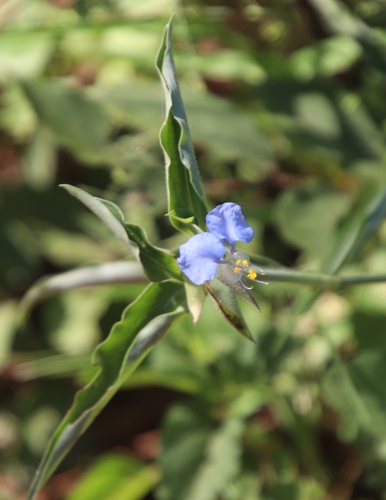
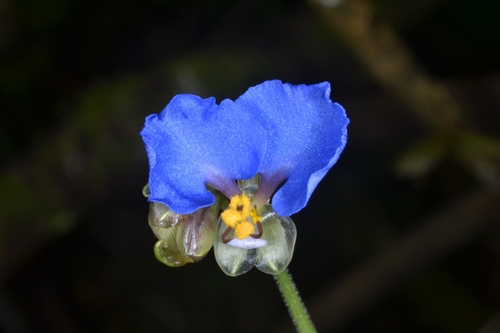
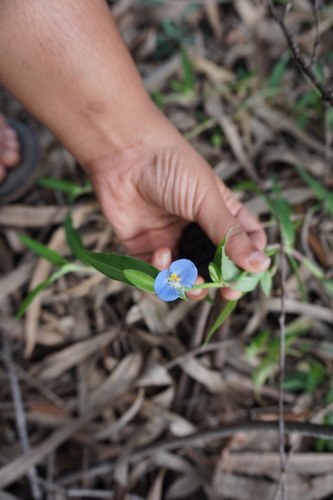
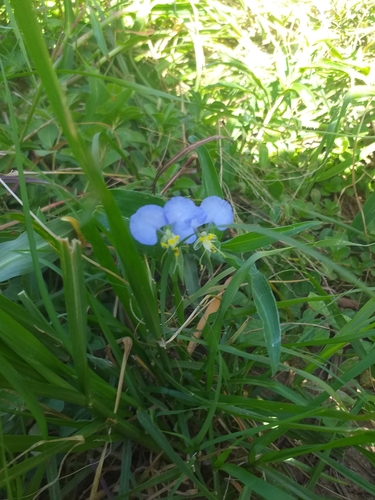
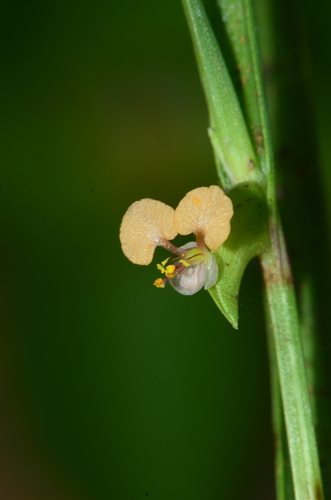
Cyanotis axillaris
(L.) D. Don ex Sweet
Blue ears
iNaturalist· cc-by-nc-sa
(c) satish nikam, some rights reserved (CC BY-NC-SA), uploaded by satish nikam
iNaturalist· cc-by
(c) Ramesh Shenai Jr., some rights reserved (CC BY), uploaded by Ramesh Shenai Jr.
iNaturalist· cc-by
(c) Hopeland, some rights reserved (CC BY), uploaded by Hopeland
Summary
Source: WikipediaCyanotis axillaris is a species of perennial plants in the family Commelinaceae. It is native to Indian Subcontinent, southern China, Southeast Asia and Northern Australia. It grows in monsoon forest, woodland and wooded grassland. It uses medical plant in India and it uses as food for pigs.
Description
A succulent herb. It is often creeping but can curve upwards. It keeps growing from year to year. The stems are 70 cm long. They form roots at the nodes. The leaves are sword shaped and 2-15 cm long by 4-12 mm wide. The base of the leaf clasps the stem. There are 2-6 flowers which do not have stalks and occur in the axils of leaves. They are blue-purple. The fruit is a capsule 6-7 mm long. The seed are brown and have several pits.
Edible Uses
The seeds are threshed, hulled, and ground into flour, or boiled and ground to mix with other flours. The leaves, seeds, tubers, and roots are all edible parts.
Traditional Uses
The plants are pulled and threshed and the hulls removed from the seeds. The seeds are ground into flour. The seeds also are boiled and ground and mixed with other flours.
Distribution
A tropical plant. It grows in humid sandy places. It grows in open sites along streams and rice fields. It can grow in swamps and marshes. It grows up to 250 m altitude. It is damaged by frost or drought.
Where It Grows
Asia, Andamans, Australia, Cambodia, China, Himalayas, India, Indochina, Indonesia, Laos, Malaysia, Myanmar, Nepal, Pacific, Philippines, SE Asia, Sri Lanka, Thailand, Vietnam, Oceania,
Cultivation
Plants can be grown from cuttings.
Notes
There are about 50 Cyanotis species.
Synonyms
Also Known As
Alikbangon, Baghanulla, Damro, Golagandi, Itsaka, Kinkungluang, Myitcho, Narido, Nirpulli, Nirupalli, Phakplap-na, Qiao bao hua, Rau eo, Rau trai, Sabilau, Simchiru ara, Soltra, Soltraj, Tena arkha, Valukkeippul, Vichaka, Yaphophot-lek
References (23)
- Ambasta, S.P. (Ed.), 2000, The Useful Plants of India. CSIR India. p 153
- Bodkin, F., 1991, Encyclopedia Botanica. Cornstalk publishing, p 309
- Burkill, I.H., 1966, A Dictionary of the Economic Products of the Malay Peninsula. Ministry of Agriculture and Cooperatives, Kuala Lumpur, Malaysia. Vol 1 (A-H) p 727
- Cherikoff V. & Isaacs, J., The Bush Food Handbook. How to gather, grow, process and cook Australian Wild Foods. Ti Tree Press, Australia p 198
- Cooper, W. and Cooper, W., 2004, Fruits of the Australian Tropical Rainforest. Nokomis Editions, Victoria, Australia. p 131
Show all 23 references Hide references
- Cribb, A.B. & J.W., 1976, Wild Food in Australia, Fontana. p 136
- Dey, A. & Mukhererjee, A., 2015, Living and Survival Amidst Hunger: Wild Edible Botanicals as a Prime Forest Productivity in the Rural Purulia District, West Bengal, India from Colonial to Present. Research Journal of Forestry 9(3): 71-86
- Elliot, W.R., & Jones, D.L., 1984, Encyclopedia of Australian Plants suitable for cultivation. Vol 3. Lothian. p 138
- GAMMIE,
- GUPTA & KANODIA,
- Hong Deyuan; Robert A. DeFilipps, COMMELINACEAE, Flora of China
- Kenneally, K.E., Edinger, D. C., and Willing T., 1996, Broome and Beyond, Plants and People of the Dampier Peninsula, Kimberley, Western Australia. Department of Conservation and Land Management. p 202
- Marandi, R. R. & Britto, S. J., 2015, Medicinal Properties of Edible Weeds of Crop Fields and Wild plants Eaten by Oraon Tribals of Latehar District, Jharkhand. International Journal of Life Science and Pharma Research. Vo. 5. (2) April 2015
- Ogle, B. M., et al, 2003, Food, Feed or Medicine: The Multiple Functions of Edible Wild Plants in Vietnam. Economic Botany 57(1): 103-117
- Paczkowska, G. & Chapman, A.R., 2000, The Western Australian Flora. A Descriptive Catalogue. Western Australian Herbarium. p 40
- Prodr. fl. nepal. 46. 1825
- PROSEA (Plant Resources of South East Asia) handbook Volume 10 Cereals. p 150
- Singh, H.B., Arora R.K.,1978, Wild edible Plants of India. Indian Council of Agricultural Research, New Delhi. p 84
- Sinha, R. & Lakra, V., 2007, Edible weeds of tribals in Jharkhand, Orissa and West Bengal. Indian Journal of Traditional Knowledge 6(1) January 2007 pp 217-222
- Swapna, M. M. et al, 2011, A review on the medicinal and edible aspects of aquatic and wetland plants of India. J. Med. Plants Res. 5 (33) pp. 7163-7176
- WATT,
- Wheeler, J.R.(ed.), 1992, Flora of the Kimberley Region. CALM, Western Australian Herbarium, p 1022
- World Checklist of Useful Plant Species 2020. Royal Botanic Gardens, Kew