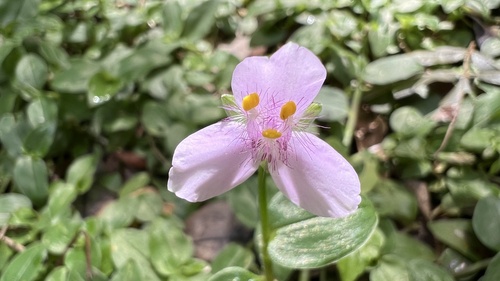
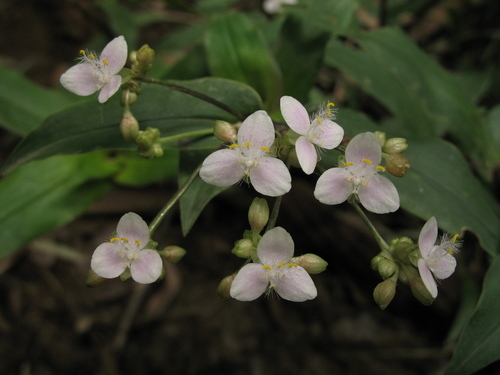
Cartonema parviflorum
Hassk.
Bush potato
iNaturalist· cc-by
(c) coenobita, some rights reserved (CC BY), uploaded by coenobita
Summary
Source: WikipediaCartonema parviflorum, commonly known in wiridjagu, is a herb in the Commelinaceae family. It is native to northern Australia (Western Australia, Northern Territory, and Queensland) and New Guinea. The perennial erect herb typically grows to a height of 0.2 to 0.6 metres (0.7 to 2.0 ft). It blooms between March and June producing yellow flowers. It is found along watercourses, damp areas and in seasonally inundated areas in the Kimberley region in Western Australia where it grows in sandy-gravelly soils.
Description
A small herb. It grows 20-60 cm high. It keeps growing from year to year. It may die back to the tuber (corm). The tuber is about 1.5 cm across. The leaves are 10-30 cm long and very narrow. They are grass-like and dark green. The flower spikes are 30-50 cm long. They are loose and open. The flowers are about 1 cm across and white.
Edible Uses
The corms are roasted and eaten; they have a strong spicy smell.
Traditional Uses
The corms are roasted and eaten. They have a strong spicy smell.
This uses section is brief — help expand it
Distribution
A tropical plant. It grows in northern Australia on moist sandy ground. It is often along the edges of swamps.
Where It Grows
Australia*,
Cultivation
Plants can be grown from seed or tubers.
Production
The dead plants are pulled up to harvest the corm.
Notes
There are about 10 Cartonema species. These have also been put in the family Cartonemataceae.
Also Known As
Arda, Rambag, Wiridjagu
References (16)
- Bindon, P., 1996, Useful Bush Plants. Western Australian Museum. p 77
- Cherikoff V. & Isaacs, J., The Bush Food Handbook. How to gather, grow, process and cook Australian Wild Foods. Ti Tree Press, Australia p 198
- Crawford, I. M., 1982, Traditional Aboriginal Plant Resources in the Kalumburu Area: Aspects in Ethno-economics. Records of the Western Australian Museum Supplement No. 15
- Cribb, A.B. & J.W., 1976, Wild Food in Australia, Fontana. p 160
- Elliot, W.R., & Jones, D.L., 1982, Encyclopedia of Australian Plants suitable for cultivation. Vol 2. Lothian. p 467
Show all 16 references Hide references
- Kenneally, K.E., Edinger, D. C., and Willing T., 1996, Broome and Beyond, Plants and People of the Dampier Peninsula, Kimberley, Western Australia. Department of Conservation and Land Management. p 202
- Lazarides, M. & Hince, B., 1993, Handbook of Economic Plants of Australia, CSIRO. p 49
- Levitt, D., 1981, Plants and people. Aboriginal uses of plants on Groote Eylandt, Australian Institute of Aboriginal Studies, Canberra. p 87
- Lim, T. K., 2015, Edible Medicinal and Non Medicinal Plants. Volume 9, Modified Stems, Roots, Bulbs. Springer p 23
- Low, T., 1991, Wild Food Plants of Australia. Australian Nature FieldGuide, Angus & Robertson. p 104
- Low, T., 1992, Bush Tucker. Australia’s Wild Food Harvest. Angus & Robertson. p 119
- Paczkowska, G. & Chapman, A.R., 2000, The Western Australian Flora. A Descriptive Catalogue. Western Australian Herbarium. p 40
- RIRDC, 2010, New Root Vegetables for the Native Food Industry, Australian Government RIRDC Publication 9/161
- Smith, M & Kalotas, A. C., 1985, Bardi Plants: An Annotated List of Plants and Their Use by the Bardi Aborigines of Dampierland, in North-western Australia. Rec. West Aust. Mus. 1985, 12(3): 317-359
- Vigilante, T., et al, 2013, Island country: Aboriginal connections, values and knowledge of the Western Kimberley islands in the context of an island biological survey. Records of the Western Australian Museum Supplement 81: 145-182
- Wheeler, J.R.(ed.), 1992, Flora of the Kimberley Region. CALM, Western Australian Herbarium, p 1019