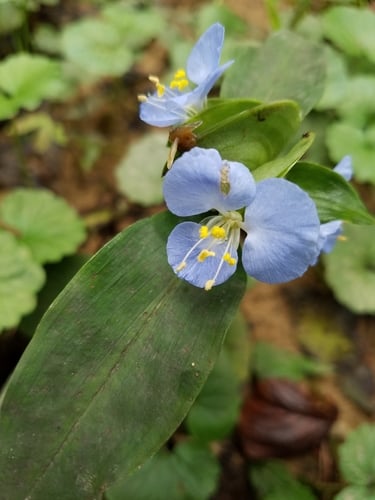
Commelina benghalensis
L.
Dayflower, Tropical Spiderweed
iNaturalist· cc-by-nc
(c) meng6868, some rights reserved (CC BY-NC)
iNaturalist· cc-by-nc
(c) V.Arun, some rights reserved (CC BY-NC)
iNaturalist· cc-by-nc
(c) V.Arun, some rights reserved (CC BY-NC)
Summary
Source: WikipediaCommelina benghalensis, commonly known as the Benghal dayflower, tropical spiderwort, or wandering Jew, kanshira in Bengali, is a perennial herb native to tropical Asia and Africa. It has been widely introduced to areas outside its native range, including to the neotropics, Hawaii, the West Indies and to both coasts of North America. It has a long flowering period, from spring to fall in subtropical areas, and throughout the year closer to the equator. It is often associated with disturbed soils. In both it native range and areas where it has been introduced it is usually considered a weed, sometimes a serious one. In the United States it has been placed on the Federal Noxious Weed List. It is considered a moderate weed of rice cultivation in Asia. In its native range of sub-Saharan Africa, India, Sri Lanka, and much of Southeast Asia, it is considered a serious weed of an enormous range of crops from tea and coffee to cassava and peanuts. Additional agricultural damage is caused by the fact that it can host the nematode Meloidogyne incognita and the Groundnut rosette virus. In China it is used as a medicinal herb that is said to have diuretic, febrifugal and anti-inflammatory effects, while in Pakistan it is used to cure swellings of the skin, leprosy and as a laxative.
Description
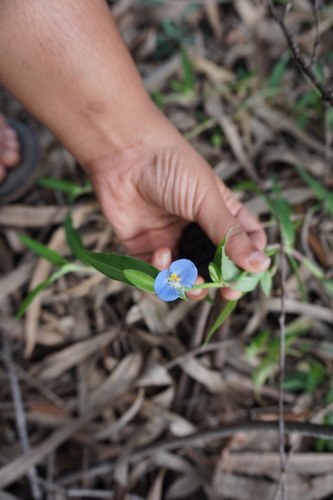
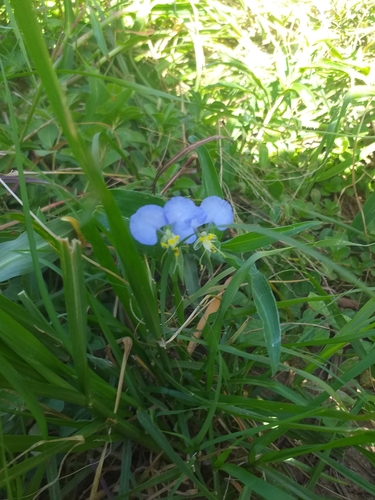
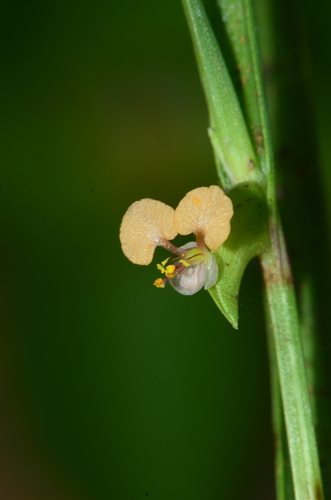
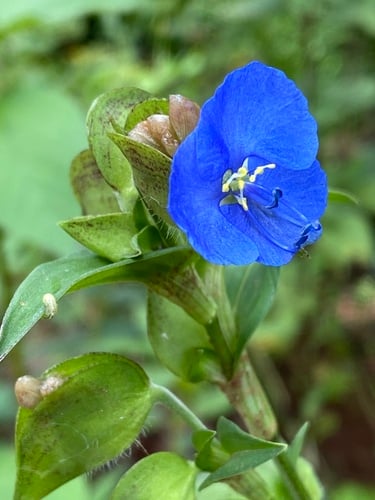
A slender, juicy, creeping herb, often with hairs. It has underground branches, as well as branches on the ground surface. Plants continue to grow from year to year. Plants are only about 25 cm high but can spread quite widely. It has roots at the nodes. The leaves are oval, and pointed at both ends. They are wavy along the edge, and 4 to 7 cm long. The leaf clasps the stem. The flowers are blue, with three petals 3 to 4 mm long. The flowers are produced in the axils of the upper leaves during summer. The fruit have 3 cavities, with 2 seeds in 2 of them and one seed in the other. The seeds are about 2 mm long.
Edible Uses
The young leaves are eaten cooked as a vegetable, potherb, or fried, and can be stored for 4-5 days. Leaves are also boiled in water and eaten with salt and chilli peppers. The seeds are ground into flour and made into bread. The starchy rhizomes and roots are cooked and eaten, particularly as a famine food.
Traditional Uses
The young leaves are eaten cooked as a vegetable. They are also used as a potherb. They are also fried. The leaves boiled in water and eaten mixed with salt and chilli peppers. The seeds are ground into flour and made into bread. The starchy rhizomes are cooked and eaten. The young leaves can be stored for 4-5 days.
Medicinal Uses
In China, the plant is used medicinally as a diuretic, febrifuge and anti-inflammatory. In Pakistan it is used as animal fodder and also eaten by humans as a vegetable. It is also used there medicinally, but with different purported effects, including as a laxative and to cure inflammations of the skin as well as leprosy. The people of Nepal eat the young leaves as a vegetable, use a paste derived from the plant to treat burns, and treat indigestion with a juice produced from the roots. Its use as a famine food in India has been recorded. In southeast Asia and Africa it is used as fodder and also medicinally as a poultice.
Known Hazards
This plant has low palatability and is only rarely eaten as a very minor vegetable. It easily becomes established as a weed.
Distribution
A tropical plant. It grows most commonly in fertile soils under humid conditions throughout the tropics. It is common in waste places, near settlements, at low and medium altitudes throughout the islands of the Philippines. It grows from sea level to 2300 m altitude, in China. In Nepal it grows between 900-2000 m altitude. It grows in moist places. It grows in wetlands. It can grow in arid places. In Sichuan and Yunnan.
Where It Grows
Africa, American Samoa, Argentina, Asia, Australia, Bangladesh, Benin, Botswana, British Indian Ocean Terr., BIOT, Burkina Faso, Cameroon, Cape Verde, Central Africa, China, Congo, Côte d'Ivoire, East Africa, Eswatini, Ethiopia, Gambia, Ghana, Guam, Guinea, Guinée, Guinea-Bissau, Hawaii, Himalayas, India, Indochina, Indonesia, Ivory Coast, Japan, Kenya, Laos, Madagascar, Malawi, Malaysia, Mozambique, Myanmar, Namibia, Nauru, Nepal, Niger, Nigeria, Northeastern India, NW India, Pacific, Pakistan, Papua New Guinea, PNG, Philippines, Sahel, SE Asia, Senegal, Sierra Leone, Solomon Islands, South Africa, Southern Africa, South America, South Sudan, Sri Lanka, Sudan, Swaziland, Taiwan, Tanzania, Thailand, Togo, Tonga, Uganda, USA, Venezuela, West Africa, Zambia, Zimbabwe,
Cultivation
Plants are grown from seed.
Propagation
Seed - Stem cuttings Root cuttings
Other Uses
A dye is obtained from the sap in the flowers.
Production
Leaves are collected during the early flush of the rainy season.
Other Information
It is only rarely eaten. It is a very minor vegetable. It has low palatability. The roots and tubers are cooked as a famine food.
Notes
There are about 230 Commelina species. It easily becomes established as a weed.
Nutrition
| Part | Moisture | kJ | kcal | Protein | Vit A | Vit C | Iron | Zinc |
|---|---|---|---|---|---|---|---|---|
| Leaves raw | 86.2 | 180 | 43 | 2.3 | — | — | 7.1 | 0.6 |
Synonyms
Also Known As
Addo arxa, Alikbangon, Amala, Androko, A wei ya mo, Bakna, Ban kane, Bat baitta shak, Biasbias, Bokna, Bondium, Brambangan, Buchna, Chhura, Chura, Corogoma, Damba, Dzadza, Ekoropot, Ennadri, Fan bao cao, Geneya, Gewor, Guredural, Hairy wandering Jew, Holagabis, Ikengera, Itula, Jawarzaal, Jwaray, Kafura, Kana ara, Kana keerai, Kanangakarai, Kanavazhai, Kanchara, Kanchata, Kanchira, Kandhara, Kane jhar, Kane sag, Kani, Kaniseera, Kanjura, Kanna-manna, Kannae, Kanshira, Kansira, Kansiri, Kanteri, Kanuraka, Kanya sag, Kaua-kaini, Kena, Kenar, Keniyu, Kerina, Kermuw, Kolar, Kona simolu, Kona simulu, Korogwa, Kurveng, Leng, Lolo, Mpovupovu, Myit-cho, Nnanda ennene, Narray, Nhkongo, Nkongo, Odielo, Oolooh-ooloohan, Orandi, Pak prap, Petoongan, Petungan, Portotion, Sabilau, Surung, Tali korang, Tamba-gangala, Telka bhaji, Thenga puttu keerai, Vennadevikura, Wangden-khoibi, Wetkyok, Wohaankkur, Yekola wonfankur, Zobut
References (133)
- Acharya K. P. and Acharya, R., 2010, Eating from the Wild: Indigenous knowledge on wild edible plants in Parroha VDC of Rupandehi District, Central Nepal. International Journal of Social Forestry. 3(1):28-48
- Achigan-Dako, E, et al (Eds), 2009, Catalogue of Traditional Vegetables in Benin. International Foundation for Science.
- Addis, G., et al, 2013, The Role of Wild and Semi-wild Edible Plants in Household Food Sovereignty in Hamer and Konso Communities, South Ethiopia. Ethnobotany Research & Applications. 11:251-271
- Ambasta, S.P. (Ed.), 2000, The Useful Plants of India. CSIR India. p 138
- Ara, R. I. T., 2015, Leafy Vegetables in Bangladesh. Photon eBooks. p 125
Show all 133 references Hide references
- Arinathan, V., et al, 2007, Wild edibles used by Palliyars of the western Ghats, Tamil Nadu. Indian Journal of Traditional Knowledge. 6(1) pp 163-168
- Aryal, K. P., et al, 2018, Diversity and use of wild and non-cultivated edible plants in the Western Himalaya. Journal of Ethnobiology and Ethnomedicine (2018) 14:10
- Asfaw, Z., Conservation and use of traditional vegetables in Ethiopia. FAO
- Asfaw, Z. and Tadesse, M., 2001, Prospects for Sustainable Use and Development of Wild Food Plants in Ethiopia. Economic Botany, Vol. 55, No. 1, pp. 47-62
- Batawila, K., et al, 2007, Diversite et gestion des legumes de cueillete au Togo. African Journal of Food, Agriculture, Nutrition and Development 7( 3& 4): 65
- Bandyopadhyay, S., et al, 2012, A Census of Wild Edible Plants from Howrah District, West Bengal, India. Proceedings of UGC sponsored National Seminar 2012
- Banerjee, A., et al, 2013, Ethnobotanical Documentation of Some Wild Edible Plants in Bankura District, West Bengal, India. The Journal of Ethnobiology and Traditional Medicine. Photon 120 (2013) 585-590
- Baro, D., Baruah, S. and Borthukar, S. K. 2015, Documentation on wild vegetables of Baksa district, BTAD (Assam). Scholars Research Library. Archives of Applied Science Research, 2015, 7 (9):19-27
- Bhatia, H., et al, 2018, Traditionally used wild edible plants of district Udhampur, J&K, India. Journal of Ethnobiology and Ethnomedicine (2018) 14:73
- Brickell, C. (Ed.), 1999, The Royal Horticultural Society A-Z Encyclopedia of Garden Plants. Convent Garden Books. p 291
- BROWN,
- Burkill, I.H., 1966, A Dictionary of the Economic Products of the Malay Peninsula. Ministry of Agriculture and Cooperatives, Kuala Lumpur, Malaysia. Vol 1 (A-H) p 654
- Chandrakumar, P., et al, 2015, Ethnobotanical studies of wild edible plants of Gond, Halba and Kawar tribes of Salekasa Taluka, Gondia District, Maharashtra State, India. International Research Journal of Pharmacy 6(8)
- Chauhan, S. H., et al, 2018, Consumption patterns of wild edibles by the Vasavas: a case study from Gujarat, India. Journal of Ethnobiology and Ethnomedicine (2018) 14:5
- Chowdery, T., et al, 2014, Wild edible plants of Uttar Dinajpur District, West Bengal. Life Science Leaflets. 47:pp 20-36 http://lifesciencesleaflets.ning.com
- Dangol, D. R., 2002, Economic uses of forest plant resources in western Chitwan, Nepal. Banko Janakari, 12(2): 56-64
- Dansi, A., et al, 2008, Traditional leafy vegetables and their use in the Benin Republic. Genet Resour Crop Evol (2008) 55:1239–1256
- Dey, A. & Mukhererjee, A., 2015, Living and Survival Amidst Hunger: Wild Edible Botanicals as a Prime Forest Productivity in the Rural Purulia District, West Bengal, India from Colonial to Present. Research Journal of Forestry 9(3): 71-86
- Dhyani, S.K., & Sharma, R.V., 1987, Exploration of Socio-economic plant resources of Vyasi Valley in Tehri Garwhal. J. Econ. Tax. Bot. Vol. 9 No. 2 pp 299-310
- Dobriyal, M. J. R. & Dobriyal, R., 2014, Non Wood Forest Produce an Option for Ethnic Food and Nutritional Security in India. Int. J. of Usuf. Mngt. 15(1):17-37
- Duke, J.A., 1992, Handbook of Edible Weeds. CRC Press. p 76
- Dutta, U., 2012, Wild Vegetables collected by the local communities from the Churang reserve of BTD, Assam. International Journal of Science and Advanced Technology. Vol. 2(4) p 120
- FAO, 1988, Traditional Food Plants, FAO Food and Nutrition Paper 42. FAO Rome p 214
- Flora of Pakistan. www.eFloras.org
- Flora of Solomon Islands
- Fowler, D. G., 2007, Zambian Plants: Their Vernacular Names and Uses. Kew. p 65
- Fox, F. W. & Young, M. E. N., 1982, Food from the Veld. Delta Books. p 158
- Gallagher, D. E., 2010, Farming beyond the escarpment: Society, Environment, and Mobility in Precolonial Southeastern Burkina Faso. PhD University of Michigan.
- GAMMIE,
- Gautam, R. S., et al, 2022, Ethnobotanical Review of Wild Edible Plants of Nepal. Journal of Natural History Museum Volume 32, 2021-22 p 110
- Goode, P., 1989, Edible Plants of Uganda. FAO p 26, p 36, p 39
- Grivetti, L. E., 1980, Agricultural development: present and potential role of edible wild plants. Part 2: Sub-Saharan Africa, Report to the Department of State Agency for International Development. p 42, 49
- Grubben, G. J. H. and Denton, O. A. (eds), 2004, Plant Resources of Tropical Africa 2. Vegetables. PROTA, Wageningen, Netherlands. p 212
- GUPTA,
- GUPTA & KANODIA,
- Harkonen, M. & Vainio-Mattila, K., 1998, Some examples of Natural Products in the Eastern Arc Mountains. Journal of East African Natural History 87:265-278
- Henty, E.E., & Pritchard, G.S., 1973, Weeds of New Guinea and their control. Botany Bulletin No 7, Division of Botany, Lae, PNG. p 28
- Heyne, K. 1927,
- Hong Deyuan; Robert A. DeFilipps, COMMELINACEAE, Flora of China
- Hossain, U. & Rahman, A., 2018, Study and quantitative analysis of wild vegetable floral diversity available in Barisal district, Bangladesh. Asian J. Med. Biol. Res. 2018, 4 (4), 362-371
- Hussey, B.M.J., Keighery, G.J., Cousens, R.D., Dodd, J., Lloyd, S.G., 1997, Western Weeds. A guide to the weeds of Western Australia. Plant Protection Society of Western Australia. p 22
- Hu, Shiu-ying, 2005, Food Plants of China. The Chinese University Press. p 308
- Jadhav, R., et al, 2015, Forest Foods of Northern Western Ghats: Mode of Consumption, Nutrition and Availability. Asian Agri-History Vol. 19, No. 4: 293-317
- Jain et al, 2011, Dietary Use and Conservation Concern of Edible Wetland Plants at Indo-Burma Hotspot: A Case Study from Northeast India. Journal of Ethnobiology and Ethnomedicine 7:29 p 6
- Jardin, C., 1970, List of Foods Used In Africa, FAO Nutrition Information Document Series No 2.p 13, 69
- Johns, T., and Kokwaro, J.O., 1991, Food Plants of the Luo of Siayo District, Kenya. Economic Botany 45(1), pp 103-113
- Joshi, N., et al, 2007, Traditional neglected vegetables of Nepal: Their sustainable utilization for meeting human needs. Tropentag 2007. Conference on International Agricultural Research for Development.
- Joshi, N. & Siwakoti, M., 2012, Wild Vegetables Used by Local Community of Makawanpur District and Their Contribution to Food Security and Income Generation. Nepal Journal of Science and Technology Vol. 13, No. 1 (2012) 59-66
- Kar, A., & Borthakur, S. K., 2008, Wild vegetables of Karbi - Anglong district, Assam, Natural Product Radiance, Vol. 7(5), pp 448-460
- Karthi, Sathya, & Salome, 2014, Uncultivated Edible Greens from Small Millet Farms Tamil Nadu India. IDRC p
- Khan, M. & Hussain, S., 2014, Diversity of wild edible plants and flowering phenology of district Poonch (J & K) in the northwest Himalaya. Indian Journal of Sci, Res. 9(1): 032-038
- Khan, M. T., et al, 2016, Ethnobotanical Study of Wild Flora in the Remote Areas of Northern Pakistan. Wulfenia Journal Vol. 23, No 10 p 153
- Kiran, K. C., et al, 2019, Diversity and Seasonal Availability of Potential Wild Edible Plants from Vidarbha Region of Maharashtra State, India. Int.J.Curr.Microbiol.App.Sci (2019) 8(2): 1434-1446
- Lamp, C & Collet F., 1989, Field Guide to Weeds in Australia. Inkata Press. p 80
- Lazarides, M. & Hince, B., 1993, Handbook of Economic Plants of Australia, CSIRO. p 63
- Long, C., 2005, Swaziland's Flora - siSwati names and Uses http://www.sntc.org.sz/flora/
- Low, T., 1991, Wild Herbs of Australia and New Zealand. Angus & Robertson. p 102
- Lugod, G.C. and de Padua L.S., 1979, Wild Food Plants in the Philippines. Vol. 1. Univ. of Philippines Los Banos. p 25
- Lulekal, E., et al, 2011, Wild edible plants in Ethiopia: a review on their potential to combat food insecurity. Afrika Focus - Vol. 24, No 2. pp 71-121
- Luo, B., et al, 2019, Wild edible plants collected by Hani from terraced rice paddy agroecosystem in Honghe Prefecture, Yunnan, China. Journal of Ethnobiology and Ethnomedicine 15:56
- Lyimo, M., et al, 2003, Identification and nutrient composition of indigenous vegetables of Tanzania. Plant Foods for Human Nutrition. 58: 85-92
- Magwede, K., van Wyk, B.-E., & van Wyk, A. E., 2019, An inventory of Vhavenḓa useful plants. South African Journal of Botany 122 (2019) 57–89
- Mahadkar, S., Valvi, S. & Rathod, V., 2012, Nutritional assessment of some selected wild edible plants as a good source of mineral. Asian Journal of Plant Science and Research 2(4):468-472
- Majeed, M., et al, 2021, Gathered Wild Food Plants among Diverse Religious Groups in Jhelum District, Punjab, Pakistan. Foods 2021, 10, 594.
- Malaisse, F., 1997, Se nourrir en floret claire africaine. Approche ecologique et nutritionnelle. CTA., p 91.
- Maheshwari, J.K., & Singh, J.P., 1984, Contribution to the Ethnobotany of Bhoxa Tribe of Bijnor and Pauri Garhwal Districts, U.P. J. Econ. Tax. Bot. Vol.5. No.2 pp 253-
- Manandhar, N.P., 2002, Plants and People of Nepal. Timber Press. Portland, Oregon. p 167
- Martin, F.W. & Ruberte, R.M., 1979, Edible Leaves of the Tropics. Antillian College Press, Mayaguez, Puerto Rico. p 183
- Maundu, P. et al, 1999, Traditional Food Plants of Kenya. National Museum of Kenya. 288p
- McMakin, P.D., 2000, Flowering Plants of Thailand. A Field Guide. White Lotus. p 83
- Mercy, N. A., et al, 2016, Survey of Wild Vegetables in the Lebialem Highlands of South Western Cameroon. Journal of Plant Sciences 4(6): 172-184
- Mishra, N., et al, 2016, Indigenous knowledge in utilization of wetland plants in Bhadrak district, Odisha, India. Indian Journal of Natural Products and Resources. Vol. 7(1) pp. 82-89
- Misra, S., 2018, Ethno Botany and Nutritional Status of Some Edible Plants of South Odisha, India. International Journal of Advances in Agricultural Science and Technology, Vol.5 Issue.2, February- 2018, pg. 21-32
- Molla, A., Ethiopian Plant Names. http://www.ethiopic.com/aplants.htm
- Monsalud, M.R., Tongacan, A.L., Lopez, F.R., & Lagrimas, M.Q., 1966, Edible Wild Plants in Philippine Forests. Philippine Journal of Science. p 454
- Masoodi, H. U. R. & Sundriyal, R. C., 2020, Richness of non-timber forest products in Himalayan communities—diversity, distribution, use pattern and conservation status. Journal of Ethnobiology and Ethnomedicine 16:56
- Msuya, T. S., et al, 2010, Availability, Preference and Consumption of Indigenous Foods in the Eastern Arc Mountains, Tanzania, Ecology of Food and Nutrition, 49:3, 208-227
- Mutie, F. G., 2020, Conservation of Wild Food Plants and Their Potential for Combatting Food Insecurity in Kenya as Exemplified by the Drylands of Kitui County. Plants 2020, 9, 1017
- Mutie, F. M., et al, 2023, Important Medicinal and Food Taxa (Orders and Families) in Kenya, Based on Three Quantitative Approaches. Plants 2023, 12, 1145
- Narayanan Ratheesh, M. K. et al, 2011, Wild edible plants used by the Kattunaikka, Paniya and Kuruma tribes of Wayanad District, Kerala, India. Journal of Medicinal Plants Research Vol. 5(15), pp. 3520-3529
- Ochse, J.J. et al, 1931, Vegetables of the Dutch East Indies. Asher reprint. p 111
- Pagag, K. & Borthakur, S.K., 2012, Wild edible wetland plants from Lakhimpur district of Assam, India. Pleione 6(2): 322 - 327
- Patiri, B. & Borah, A., 2007, Wild Edible Plants of Assam. Geethaki Publishers. p 149
- Pegu, R., et al, 2013, Ethnobotanical study of Wild Edible Plants in Poba Reserved Forest, Assam, India. Research Journal of Agriculture and Forestry Sciences 1(3):1-10
- Peters, C. R., O'Brien, E. M., and Drummond, R.B., 1992, Edible Wild plants of Sub-saharan Africa. Kew. p 14
- Phangchopi, U., et al, 2015, Diversity of wild edible plants in Marat Longri Wildlife Sanctuary, Assam. Indian Journal of Natural Products and Resources Vol. 6(4), December 2015 pp. 305-313
- Plowes, N. J. & Taylor, F. W., 1997, The Processing of Indigenous Fruits and other Wildfoods of Southern Africa. in Smartt, L. & Haq. (Eds) Domestication, Production and Utilization of New Crops. ICUC p 189
- Prabha, Y. P., et al, 2010, Documentation of Wild Edible Plants of Melghat Forest, Dist. Amravati, Maharashtra State, India. Ethnobotanical Leaflets 14: 751-58, 2010.
- Prafulla, S., 2017, Wild Food Diversity of Nawegaon-Nagzira Tiger Reserve in Gondia-Bhandara district of Maharashtra, India. Int. J. of Life Sciences, 2017, Vol. 5 (4): 620-626
- Rajkalkshmi, P. et al, 2001, Total carotenoid and beta-carotene contents of forest green leafy vegetables consumed by tribals of south India. Plant Foods for Human Nutrition 56:225-238
- Ramachandran, V. S., 2007, Wild edible plants of the Anamalais, Coimbatore district, western Ghats, Tamil Nadu. Indian Journal or Traditional Knowledge. 6(1) pp 173-176
- Rana, D., et al, 2019, Ethnobotanical knowledge among the semi-pastoral Gujjar tribe in the high altitude (Adhwari’s) of Churah subdivision, district Chamba, Western Himalaya. Journal of Ethnobiology and Ethnomedicine (2019) 15:10
- Rasingam, L., 2012, Ethnobotanical studies on the wild edible plants of Irula tribes of Pillur Valley, Coimbatore district, Tamil Nadu, India. Asian Pacific Journal of Tropical Biomedicine. (2012) S1493-S1497
- Recher, P, 2001, Fruit Spirit Botanical Gardens Plant Index. www.nrg.com.au/~recher/ seedlist.html p 2
- Regassa, T., et al, 2014, Ethnobotany of Wild and Semi-Wild Edible Plants of Chelia District, West-Central Ethiopia. Science, Technology and Arts Research Journal. 3(4): 122-134
- RILEY & BROKENSHA,
- Romanowski, N., 2007, Edible Water Gardens. Hyland House. p 106
- Royal Botanic Gardens, Kew (1999). Survey of Economic Plants for Arid and Semi-Arid Lands (SEPASAL) database. Published on the Internet; http://www.rbgkew.org.uk/ceb/sepasal/internet [Accessed 10th April 2011]
- Rubaihayo, E. B., Conservation and use of traditional vegetables in Uganda. Bioversity International.
- Ruiters-Welcome, A. K., 2019, Food plants of southern Africa. Ph.D. thesis. Univ. of Johannesburg p 45
- Sakar, A. & Das, A. P., 2018, The traditional knowledge on edible wild leafy vegetables of Rabha Tribe in Duars of North Bengal: a potential reinforcement to food security. Pleione 12(2): 275 - 281. 2018.
- Sarma, H., et al, 2010, Updated Estimates of Wild Edible and Threatened Plants of Assam: A Meta-analysis. International Journal of Botany 6(4): 414-423
- Sarvalingam, A., et al, 2014, Wild edible plant resources used by the Irulas of the Maruthamalai Hills, Southern Western Ghats, Coimbatore, Tamil Nadu. Indian Journal of Natural Products and Resources 5(2):198-201
- SAXENA,
- SHANKARNARAYAN & SAXENA,
- Sher, H. et al, 2011, Ethnobotanical and Economic Observations of Some Plant Resources from the Northern Parts of Pakistan. Ethnobotany research & Applications 9:027-041
- Shumsky, S., et al, 2014, Institutional factors affecting wild edible plant (WEP) harvest and consumption in semi-arid Kenya. Land Use Policy 38(2014) 48-69
- Singh, B., et al, 2012, Wild edible plants used by Garo tribes of Nokrek Biosphere Reserve in Meghalaya, India. Indian Journal of Traditional Knowledge. 11(1) pp 166-171
- Singh, H.B., Arora R.K.,1978, Wild edible Plants of India. Indian Council of Agricultural Research, New Delhi. p 22
- Singh, V. and Singh, P., 1981, Edible Wild Plants of Eastern Rajasthan. J. Econ. Tax. Bot. Vol 2 pp 197-207
- Sp. pl. 1:41. 1753, nom. cons.
- Swapna, M. M. et al, 2011, A review on the medicinal and edible aspects of aquatic and wetland plants of India. J. Med. Plants Res. 5 (33) pp. 7163-7176
- Swaziland's Flora Database http://www.sntc.org.sz/flora
- Termote, C., et al, 2014, Assessing the potential of wild foods to reduce the cost of a nutritionally adequate diet: An example from eastern Baringo District, Kenya. Food and Nutrition Bulletin, vol. 35, no. 4
- Teron, R. & Borthakur, S. K., 2016, Edible Medicines: An Exploration of Medicinal Plants in Dietary Practices of Karbi Tribal Population of Assam, Northeast India. In Mondal, N. & Sen, J.(Ed.) Nutrition and Health among tribal populations of India. p 150
- Thapa, L. B., et al, 2014, Wild Edible Plants used by endangered and Indigenous Raji Tribe in Western Nepal. International Journal of Applied Sciences and Biotechnology. Vol 2(3):243-252
- Topp, J. M. W., 1988, An Annotated Check List of the Flora of Diego Garcia, British Ocean Territory. Atoll Research Bulletin No. 313
- Tredgold, M.H., 1986, Food Plants of Zimbabwe. Mambo Press. p 43
- Vainio-Mattila, K., 2000, Wild vegetables used by the Sambaa in the Usumbara Mountains, NE Tanzania. Ann. Bot. Fennici 37:57-67
- Vartak, V.D. and Kulkarni, D.K., 1987, Monsoon wild leafy vegetables from hilly regions of Pune and neighbouring districts, Maharashtra state. J. Econ. Tax. Bot. Vol. 11 No. 2 pp 331-335
- Vernon, R., 1983, Field Guide to Important Arable Weeds of Zambia. Dept of Agriculture, Chilanga, Zambia. p 102
- WATT,
- Welcome, A. K. & Van Wyk, B.-E., 2019, An inventory and analysis of the food plants of southern Africa. South African Journal of Botany 122 (2019) 136–179
- Wild edible plants of Himachal Pradesh
- World Checklist of Useful Plant Species 2020. Royal Botanic Gardens, Kew
- Yimer, A., et al, 2021, Ethnobotanical study of wild edible plants used by Meinit Ethnic Community at Bench-Maji Zone, Southwest Ethiopia. Research Square. p 5
- Yuncker, T.G., 1959, Plants of Tonga, Bernice P. Bishop Museum, Hawaii, Bulletin 220. p 77
- Zereen, A., et al, 2013, Ethnobotanical Studies of Wild Herbs of Central Punjab, Pakistan. Bangladesh J. Plant Taxon 20(1): 67-76