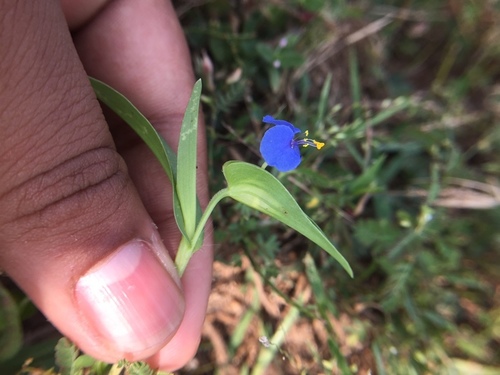
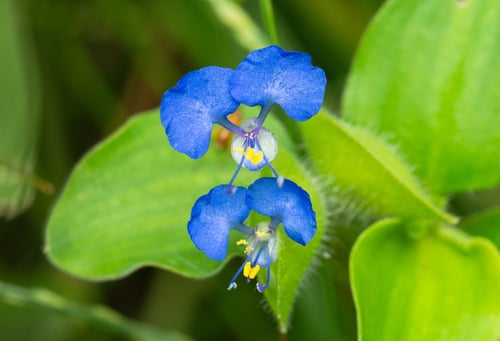
Cartonema spicatum
R. Br.
iNaturalist· cc-by-nc-sa
(c) Reiner Richter, some rights reserved (CC BY-NC-SA), uploaded by Reiner Richter
iNaturalist· cc-by-nc
(c) Rene, some rights reserved (CC BY-NC)
Summary
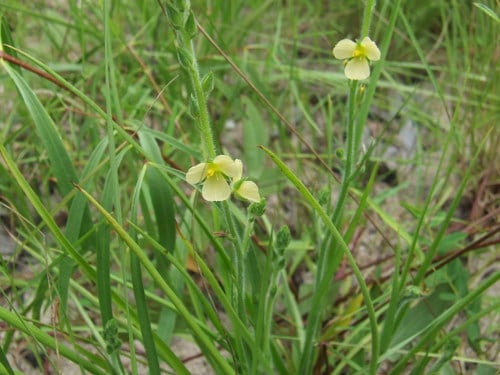
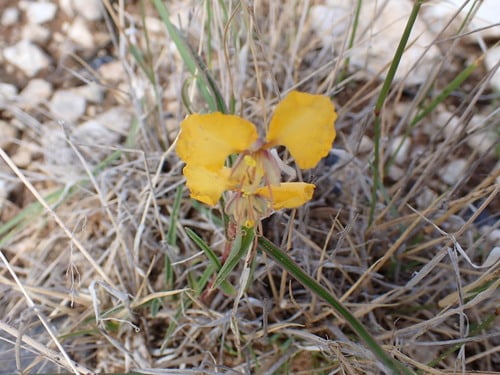
Source: WikipediaCartonema spicatum is a herb in the Commelinaceae family. The perennial herb typically grows to a height of 0.1 to 0.35 metres (0.3 to 1.1 ft). It blooms between January and July producing yellow flowers. It is found in the Kimberley region in Western Australia where it grows in a variety of soils over basalt or sandstone.
Description
A slender herb which keeps growing from year to year. It is 20-30 cm high. The stems are hairy. The leaves are long, narrow and hairy. They are 15-25 cm long by 0.4-0.7 cm wide. The leaves are grass like with veins running along the leaf. The leaf is pointed at the tip and has a sheath at the base. The flowers are yellow. They are about 2 cm across. They occur in spikes at the end of the shoot. The fruit is a small capsule. It is 0.5-0.8 cm long and enclosed in hairy papery bracts. The small tubers are edible.
Edible Uses
The small tubers are cooked and eaten.
Traditional Uses
The small tubers are cooked and eaten.
This uses section is brief — help expand it
Distribution
It is a tropical plant. It grows in northern Australia. It grows in open forest often on rocky outcrops. It grows on moist sandy ground. It does well in hot places.
Where It Grows
Australia*,
Cultivation
Plants can be grown from seed or tubers.
Production
Tubers are harvested in the dry season.
Notes
There are about 10 Cartonema species.
Nutrition
| Part | Moisture | kJ | kcal | Protein | Vit A | Vit C | Iron | Zinc |
|---|---|---|---|---|---|---|---|---|
| Root | 72.2 | 495 | 118 | 1 | — | 2 | 10 | 1.5 |
Also Known As
Andjambendord, Dikkala anbadjan
References (12)
- Brock,J., 1993, Native Plants of Northern Australia, Reed. p 116
- Cherikoff V. & Isaacs, J., The Bush Food Handbook. How to gather, grow, process and cook Australian Wild Foods. Ti Tree Press, Australia p 198
- Cribb, A.B. & J.W., 1976, Wild Food in Australia, Fontana. p 160
- Elliot, W.R., & Jones, D.L., 1982, Encyclopedia of Australian Plants suitable for cultivation. Vol 2. Lothian. p 467
- Garde, M., et al, 2003, A Preliminary List of Kundedjnjenghmi Plant Names. Northern Land Council. (Arnhem Land, Australia)
Show all 12 references Hide references
- Lazarides, M. & Hince, B., 1993, Handbook of Economic Plants of Australia, CSIRO. p 49
- Levitt, D., 1981, Plants and people. Aboriginal uses of plants on Groote Eylandt, Australian Institute of Aboriginal Studies, Canberra. p 87
- Lim, T. K., 2015, Edible Medicinal and Non Medicinal Plants. Volume 9, Modified Stems, Roots, Bulbs. Springer p 23
- Low, T., 1991, Wild Food Plants of Australia. Australian Nature FieldGuide, Angus & Robertson. p 104
- Low, T., 1992, Bush Tucker. Australia’s Wild Food Harvest. Angus & Robertson. p 119
- Morley, B.D., & Toelken, H.R., (Eds), 1983, Flowering Plants in Australia. Rigby. p 369
- Paczkowska, G. & Chapman, A.R., 2000, The Western Australian Flora. A Descriptive Catalogue. Western Australian Herbarium. p 39