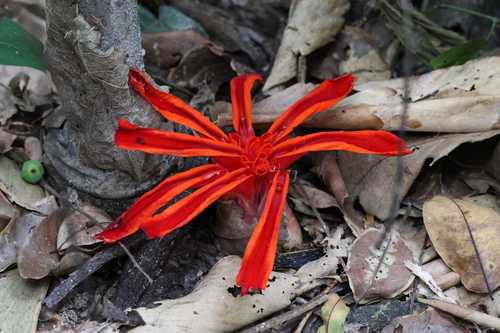
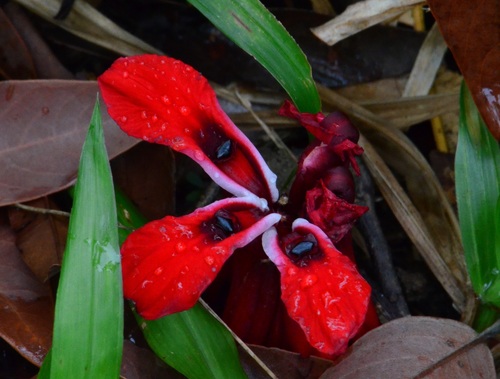
Curcuma zanthorrhiza
Roxb.
Javanese turmeric
iNaturalist· cc-by-nc
(c) Jason Alexander, some rights reserved (CC BY-NC), uploaded by Jason Alexander
iNaturalist· cc-by
(c) Jason Alexander, some rights reserved (CC BY)
Summary
Source: WikipediaCurcuma xanthorrhiza, known as temulawak, Java ginger, Javanese ginger, or Javanese turmeric is a plant species, belonging to the ginger family. It is known in Javanese as temulawak, in Sundanese as koneng gede (large turmeric) and in Madurese as temu labak. The scientific name is sometimes written as Curcuma xanthorrhiza, but this is an orthographical variant. This plant originated from Indonesia, more specifically from Java island, out of which it spread to several places in the biogeographical region Malesia. Currently, most of the temu lawak is cultivated in Indonesia, Malaysia, Thailand, and the Philippines. Outside of South East Asia, cultivars may be found also in China, Indochina, Barbados, India, Japan, Korea, the United States and some countries in Europe. Curcuma xanthorrhiza flourishes up to 1500 m above sea level in a tropical climate. Its rhizomes develop well in loose soil.
Description
A large ginger family herb. It can be 2 m high. The rhizome is large. The rhizome and tuberous roots are yellow. It forms many tillers or runners. It has robust false stems. It has sheaths near the base. The leaves are alternate and narrowly oval. They are wedge shaped at the base and extend along the leaf stalk. They are 25-100 cm long by 8-20 cm wide. The flowering shoot grows from the rhizome or underground stem beside the leaf stalk. The stalk is 10-25 cm long and 1-2 cm thick. The flowers are short and broad and they develop in a sequence along the stalk.
Edible Uses
Curcuma xanthorrhiza is used as a medicinal plant. The rhizome contains an ethereal oil (5ml per kg), it primarily consists of Sesquiterpenes. There is also a content of Curcumin (at least 1%, Ph. Eur.) and starch. Curcuma xanthorrhiza is used for dyspepsia. It is a spice too. According to one source it is an effective deterrent and pesticide of mushroom mites. In Java, there is a drink made from the juice of Curcuma zanthorrhiza called sari temulawak.
Traditional Uses
The rhizome is grated and the meal left standing in water to dissolve the bitterness then the water is poured off and the meal eaten as pudding. The young shoots are eaten raw or cooked. The tips of the young rhizomes is eaten fresh. The flowering shoots are eaten cooked.
Medicinal Uses
The rhizomes are an important ingredient into many 'jamus' (traditional Indonesian medicinal preparations). They are said to be antiinflammatory, cholagogue, febrifuge, galactagogue and laxative. They are used to treat various abdominal complaints and liver disorders, including jaundice and gallstones. A decoction of the rhizome is also used as a remedy for fever and constipation, and taken by women to lessen uterine inflammation after giving birth. Other applications are against bloody diarrhoea, dysentery, inflammation of the rectum, haemorrhoids, stomach disorders caused by cold, infected wounds, skin eruptions, acne vulgaris, eczema, smallpox and anorexia.
Distribution
A tropical plant. It needs a fertile humus rich soil and light shade. In southern China it grows beside rivers at about 800 m above sea level.
Where It Grows
Africa, Andamans, Asia, Australia, Bangladesh, Cambodia, China, Congo DR, Guyana, India*, Indochina, Indonesia, Madagascar, Malaysia, Myanmar, North America, Philippines, SE Asia*, South America, Sri Lanka, Taiwan, Thailand, USA,
Cultivation
It can be grown by division of the rhizome.
Propagation
Seed - best sown as soon as it is ripe. Germinates best at temperatures around 20°c. Division of the rhizome when the plant is dormant.
Other Uses
A yellow dye is obtained from the rhizomes.
Other Information
It is cultivated throughout Java.
Notes
There are about 50 Curcuma species. They are mostly in SE Asia.
Synonyms
Also Known As
Java ginger, Koneng gede, Temu lawak, Temu lawas, Temu raya
References (18)
- Arora, R. K., 2014, Diversity in Underutilized Plant Species - An Asia-Pacific Perspective. Bioversity International. p 102
- Burkill, I.H., 1966, A Dictionary of the Economic Products of the Malay Peninsula. Ministry of Agriculture and Cooperatives, Kuala Lumpur, Malaysia. Vol 1 (A-H) p 723
- Facciola, S., 1998, Cornucopia 2: a Source Book of Edible Plants. Kampong Publications, p 248
- Fl. ind. 1:25. 1820 "zanthorrhiza"
- GRIN
Show all 18 references Hide references
- Lembaga Biologi Nasional, 1977, Ubi-Ubian, Balai Pustaka, Jakarta. p 84
- Lim, T. K., 2015, Edible Medicinal and Non Medicinal Plants. Volume 9, Modified Stems, Roots, Bulbs. Springer p 30
- Martin, F.W. & Ruberte, R.M., 1979, Edible Leaves of the Tropics. Antillian College Press, Mayaguez, Puerto Rico. p 225
- Ochse, J. J. et al, 1931, Vegetables of the Dutch East Indies. Asher reprint. p 739 (As xanthorrhiza)
- Purseglove, J.W., 1972, Tropical Crops. Monocotyledons. Longmans p 522
- Recher, P, 2001, Fruit Spirit Botanical Gardens Plant Index. www.nrg.com.au/~recher/ seedlist.html p 4
- Sirirugsa, P., 1999, Thai Zingiberaceae: Species Diversity and their Uses. http://www.iupac.org/symposia/proceedings/phuket 97
- Sukarya, D. G., (Ed.) 2013, 3,500 Plant Species of the Botanic Gardens of Indonesia. LIPI p 1100
- Terra, G.J.A., 1973, Tropical Vegetables. Communication 54e Royal Tropical Institute, Amsterdam, p 43
- van Wyk, B., 2005, Food Plants of the World. An illustrated guide. Timber press. p 165
- Wiersema, J. H. & Leon, B., 2013, World Economic Plants. A Standard Reference CRC Press. 2nd Ed. p 220
- World Checklist of Useful Plant Species 2020. Royal Botanic Gardens, Kew
- Zeven, A. C. & de West, J. M. J., 1982, Dictionary of cultivated plants and their regions of diversity. Wageningen. p 64