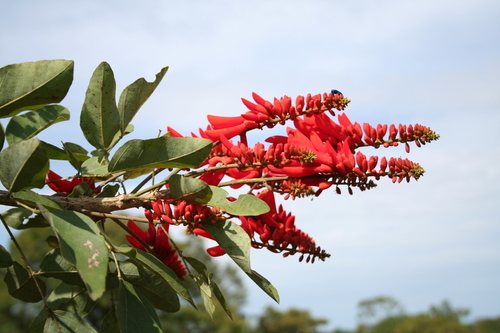
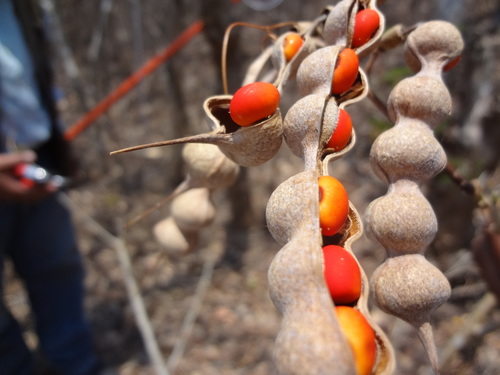
Albizia chinensis
(Osbeck) Merr.
iNaturalist· cc-by-nc
(c) JODY HSIEH, some rights reserved (CC BY-NC), uploaded by JODY HSIEH
iNaturalist· cc0
no rights reserved, uploaded by 葉子
Summary
Source: WikipediaAlbizia chinensis is a species of legume in the genus Albizia, native to south and Southeast asia, from India to China and Indonesia. The genus is named after the Italian nobleman Filippo degli Albizzi, belonging to the famous Florentine family Albizzi, who introduced it to Europe in the mid-18th century, and it is sometimes incorrectly spelled Albizzia.
Description
A tree. It loses its leaves during the year. It grows 30 m tall. The leaves have 6-12 pairs of pinnae and 20-35 pairs of leaflets. The flower heads have 10-20 flowers.
Edible Uses
Albizia chinensis is a browse tree, its leaves being readily eaten by goats, but they rarely touched its bark since it contain saponin. It is also a shade tree in plantations. It can be planted as an ornamental tree.
Known Hazards
The bark and leaves are toxic to grazing animals. The bark has been used as a fish poison.
Distribution
It is a subtropical plant. In Sikkim it occurs between 450-1,500 m above sea level.
Where It Grows
Asia, China, India, Northeastern India, Sikkim, Thailand,
Cultivation
A plant of low to moderate elevations in humid tropical and subtropical monsoon climates. It is found at elevations up to 1,800 metres. It grows best in areas where annual daytime temperatures are within the range 22 - 32°c, but can tolerate 15 - 45°c. It can tolerate occasional, short-lived, light frosts. It prefers a mean annual rainfall in the range 2,500 - 3,500mm, but tolerates 1,000 - 5,000mm. Requires a sunny position. The tree is adapted to poor soils, high pH, is fairly salt-tolerant and thrives on lateritic alluvial soil and sandy mining areas. Prefers a pH in the range 5.5 - 7.3, tolerating 4.5 - 8.5. The tree has proved to be invasive in many of the areas into which it has been introduced. Trees tolerate frequent pruning. This species has a symbiotic relationship with certain soil bacteria, these bacteria form nodules on the roots and fix atmospheric nitrogen. Some of this nitrogen is utilized by the growing plant but some can also be used by other plants growing nearby.
Propagation
Seed - requires pre-treatment. The seed has a hard seedcoat and needs to be scarified to allow water to permeate. This can be done by abrading the seed coat or softening it by soaking it in water. A common method is to pour a small amount of boiling water over the seed, so that the water cools quickly enough not to cook and kill the seed. Then soak the seed in warm water for 12 - 24 hours prior to sowing. Seedlings can be transplanted into the field when they are 6 - 8 weeks old.
Other Uses
A gum of low quality is extracted from the bark. This has been mixed with other gums and used as an extender. The bark contains triterpenes which have spermicidal activity. An extract of the wood has repellent property to subterranean termites. The sapwood is white, the heartwood light to dark brown. The wood is light in weight, soft and not very durable. It is resistant to termite and other insects attack. Its use is limited to house building, light furniture, tea chests and veneers. In India, it is used for boat building. The tree produces low quality firewood. The tree has an extensive root system and is planted for slope stabilization. As a fast growing, nitrogen-fixing tree legume, it is planted for soil improvement and remains important in the reforestation of degraded land. It is planted as a pioneer species in northern Thailand in reforestation projects to restore native woodland - it is planted in degraded woodland and open areas in a mix with various other species that all have the ability to grow fast; produce dense, weed-suppressing crowns; and attract seed-dispersing wildlife, particularly birds and bats. It is used as a shade tree and weed suppressor in tea and coffee plantations, often in a mixture with other trees. Shade tolerant herbs are sometimes planted under the trees as well as other crops such as pineapple.
Synonyms
Also Known As
Rato siris, Sa per mu
References (3)
- Sundriyal, M. & Sundriyal, R. C., 2004, Structure, Phenology, Fruit Yield, and Future Prospects of some Prominent Wild Edible Plant Species of the Sikkim Himalaya, India. Journal of Ethnobiology 24(1): 113-138 (As Albizia stipulata)
- Sutjaritjai, N., et al, 2019, Traditional Uses of Leguminosae among the Karen in Thailand. Plants 2019, 8, 600 p 5
- World Checklist of Useful Plant Species 2020. Royal Botanic Gardens, Kew