Calpocalyx brevibracteatus
Harms
gbif· cc-by
Royal Botanic Gardens, Kew
gbif· cc-by-nc-sa
GBIF
gbif· cc-by-nc-sa
GBIF
Description
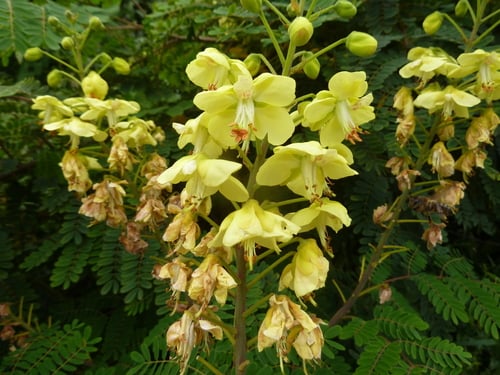
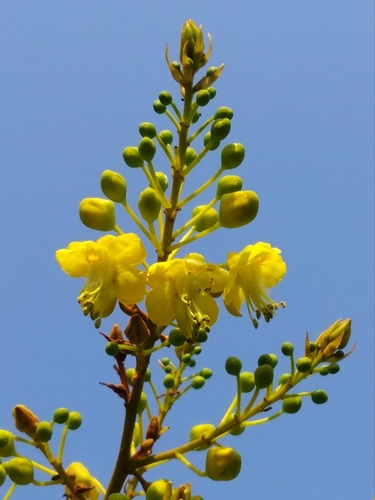
A small tree. It grows 15-30 m high. The trunk is straight and cylinder shaped. It is 50 cm across. The bark is dark grey. The leaves are alternate and twice divided. The side leaflets are 15-20 cm long with 5-6 pairs of smaller leaflets. These are 7-15 cm long by 2-6 cm wide. The flowers are in a spike 6-10 cm long in the axils of leaves or at the ends of branches. The flowers are pink to orange. The fruit are pods up to 17 cm long and 4.5 cm wide. They are flattened and taper to the base and are rounded at the tip. There are 5-10 seeds. These are angular and flattened. The seeds are 4-5 cm long.
Edible Uses
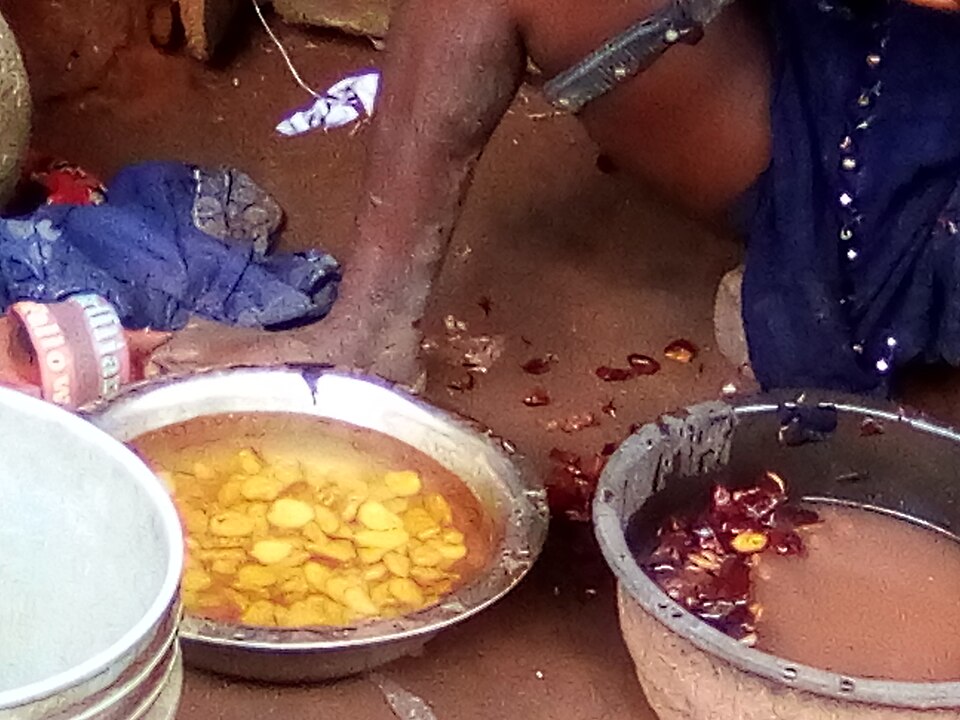
The seeds are edible after cooking. The ash of burnt seedpods is rich in potash. It is used as a salt.
Traditional Uses
The seeds are edible after cooking.
This uses section is brief — help expand it
Medicinal Uses
The bark is used in traditional medicine; a maceration is applied as a mouthwash to treat sores, and the inner bark is used against stomach-ache.
Known Hazards
The branches are hollow and may be inhabited by ants.
Distribution
A tropical plant. It grows in evergreen forest on moist soils. It is often along rivers. It does well in areas with 2,500 mm of rain per year. It can grow on a range of soils.
Where It Grows
Africa, Benin, Cameroon, Central Africa, Côte d'Ivoire, Ghana, Ivory Coast, Liberia, Nigeria, Sierra Leone, Togo, West Africa,
Cultivation
The pods split open explosively scattering the seeds.
Propagation
Seed - a high germination rate can be expected within 6 - 15 days. (This probably refers to the fresh seed.)
Other Uses
The leaves and bark contain tannins. The ash of burnt seedpods is rich in potash. It is used in making soap. The heartwood is dark brown, often variegated with red and black; it is distinctly demarcated from the greyish sapwood. The grain is irregular, texture moderately coarse. The wood is heavy and durable. It is difficult to work, but attractive when properly finished. The wood is used as posts, planks etc in house building, for tool handles and canoes. The wood is used for fuel, but it crackles as it burns and is of inferior quality.
Notes
There are 3-6 Calpocalyx species. Also as Mimosaceae.
Also Known As
Akeba, Baa, Bao, Kolei
References (11)
- Bircher, A. G. & Bircher, W. H., 2000, Encyclopedia of Fruit Trees and Edible Flowering Plants in Egypt and the Subtropics. AUC Press. p 75
- Burkill, H. M., 1985, The useful plants of west tropical Africa, Vol. 3. Kew.
- Busson, 1965,
- Dalziel, J. M., 1937, The Useful plants of west tropical Africa. Crown Agents for the Colonies London.
- Hawthorne, W.& Marshall, C., 2013, Nimba Western Area Iron Ore Concentrator Mining Project Environmental and Social Impact Assessment. AcelorMittel Liberia. p 464
Show all 11 references Hide references
- Jardin, C., 1970, List of Foods Used In Africa, FAO Nutrition Information Document Series No 2.p 40
- Lemmens, R.H.M.J., 2006. Calpocalyx brevibracteatus Harms. [Internet] Record from Protabase. Louppe, D., Oteng-Amoako, A.A. & Brink, M. (Editors). PROTA (Plant Resources of Tropical Africa), Wageningen, Netherlands. < http://database.prota.org/search.htm>. Accessed 14 October 2009.
- Menninger, E.A., 1977, Edible Nuts of the World. Horticultural Books. Florida p 90
- Peters, C. R., O'Brien, E. M., and Drummond, R.B., 1992, Edible Wild plants of Sub-saharan Africa. Kew. p 129
- Vivien, J., & Faure, J.J., 1996, Fruitiers Sauvages d'Afrique. Especes du Cameroun. CTA p 203
- World Checklist of Useful Plant Species 2020. Royal Botanic Gardens, Kew