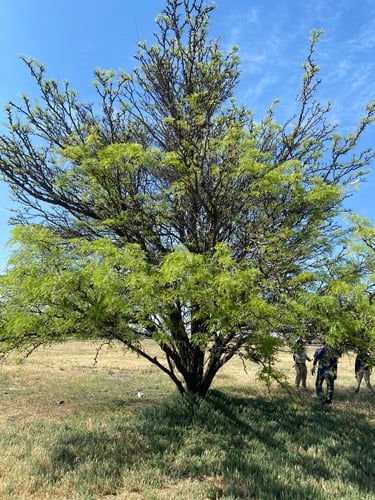
Calopogonium mucunoides
Desv.
Calapo
iNaturalist· cc-by-nc-nd
(c) Zig Madycki, some rights reserved (CC BY-NC-ND), uploaded by Zig Madycki
iNaturalist· cc-by-nc
(c) Sarahí Díaz, some rights reserved (CC BY-NC)
iNaturalist· cc-by
(c) U.S. Fish and Wildlife Service Southeast Region, some rights reserved (CC BY)
Summary
Source: WikipediaCalopogonium mucunoides, called calopo and wild ground nut, is a species of flowering plant in the family Fabaceae, native to the New World Tropics, and introduced as a forage crop and a green manure to the tropics of Africa, Madagascar, the Indian Subcontinent, Asia, Malesia, Papuasia, and Australia. In some locales it has become a serious invasive species.
Description
A trailing or twining herb. It grows to several metres long. The stems are covered with long spreading rusty hairs. The leaflets are oval and 1.5-16 cm long by 1.3-11.5 cm wide. They are rounded at the base and ending abruptly in a small tip at the top. The side leaflets are slanting at an angle, and hairy on both sides. The leaf stalk is 2-16 cm long. The flower arrangements are 1-10 cm long, on stalks 0-17 cm long. These stalks have rusty hairs. There are 6 flowers in a cluster but these are well separated. The largest petal is violet or blue. The fruit are long and narrow and 2-4.5 cm long by 3.5-5 mm wide. These pods can be straight or curved. They have rusty hairs and 5-8 seeds. The seeds are dark brown and almost square. They are 2.5-3.7 cm long by 2.5-3 mm wide. The seed scar is round, and in the centre.
Edible Uses
None known
Medicinal Uses
None known
Distribution
It is a tropical plant. It grows from sea level to 550 m altitude in the tropics near the equator. It commonly becomes self sown on waste land. It suits hot, humid, tropical conditions with rainfall over 1500 mm per year. It cannot grow in shade. In Yunnan.
Where It Grows
Africa, American Samoa, Asia, Australia, Burkina Faso, Central Africa, Central African Republic, CAR, Central America, China, Dominican Republic, East Africa, Fiji, Guiana, Guianas, Guinea, Guinée, Guinea-Bissau, Guyana, India, Indochina, Indonesia, Laos, Malaysia, Mozambique, Pacific, Papua New Guinea, PNG, Sao Tome and Principe, SE Asia, Sierra Leone, South America*, Suriname, Taiwan, Venezuela, Vietnam, West Africa, West Indies,
Cultivation
It grows best in areas where the annual rainfall exceeds 1,250 mm. Plants are not tolerant of frost. Vigorous growth occurs on soils of all textures. Succeeds in very acid soils with a pH as low as 4.5 - 5. Requires a sunny position - growth declines markedly if the plant is shaded. Plants are moderately drought-tolerant but may die out if the dry season is prolonged Calopo grows rapidly and is able to cover the soil in 3 - 6 months after sowing and even sooner on newly cleared, fertile land. It forms a dense entangled sward in 4 - 5 months after sowing, but the plants are short-lived and may only persist for 1 - 2 years. When grown as a cover crop in plantation crops in a mixture with tropical kudzu and centro, calopo is the first to become established but also the first to be shaded out. Long-term persistence is through recruitment of new plants from seedlings. The root system is dense and rather shallow, its deepest roots reaching a depth of about 50 cm. Flowering in calopo is initiated by short days. It is self-pollinated and seeds freely. This species has a symbiotic relationship with certain soil bacteria, these bacteria form nodules on the roots and fix atmospheric nitrogen. Some of this nitrogen is utilized by the growing plant but some can also be used by other plants growing nearby.
Propagation
Seed - Calopo is usually propagated by seed, sown at 1-3 kg/ha. Seed is normally drilled in rows when sown into new plantations or broadcast in stands to be used for forage production. After seed is broadcast, the seed-bed may be rolled to improve establishment. Newly harvested seed usually has more than 75% hard seed. Mechanical scarification, soaking in concentrated sulphuric acid for 30 minutes, or soaking in hot water (75C) for 3 minutes is recommended to enhance germination. Although calopo stems root at the nodes when in contact with moist soil the establishment of stem cuttings inserted directly into soil is generally poor. Use of pre and post-emergence herbicides or hand weeding promotes the establishment of calopo. As calopo nodulates promiscuously with native rhizobia, seeds are usually not inoculated. If inoculum is applied, then cowpea strains such as the Australian CB 756 are used. When planted as a cover crop in plantations it is usually sown in a mixture with other legumes such as Calopogonium caeruleum, Centrosema pubescens and Pueraria phaseoloides with 1-3 kg/ha of calopo in a total mixture of 10- 15 kg/ha of legume seed. When sown for forage production, calopo has been successfully used in mixtures with stoloniferous grasses, such as molasses grass (Melinis minutiflora Beauv.) and Rhodes grass (Chloris gayana Kunth), and with tussock grasses such as setaria (Setaria sphacelata (Schumacher) Stapf & Hubbard ex M.B. Moss). Good results have been obtained from oversowing it into existing stands of pangola grass (Digitaria eriantha Steud.) which have been harrowed
Other Uses
Fodder Green manure Mulch Pioneer Soil conditioner Soil stabilization Agroforestry Uses: A valuable pioneer legume, planted as a green manure to protect the soil surface, reduce soil temperature, fix atmospheric nitrogen, improve soil fertility and control the growth of weeds. It is an important cover crop for plantation crops, especially rubber and oil palm, where it is often grown in a mixture with centro (Centrosema pubescens) and tropical kudzu (Pueraria phaseoloides). Calopo grows vigorously, shedding a large amount of leaf litter onto the soil which smothers most weeds. The effect of calopo and associated legumes in improving soil fertility may last for 14 - 16 years. In an experiment in Malang, Indonesia, a green manure crop of calopo grown for 3 months contained about 65 kg/ha nitrogen in its leaves, shoots and roots. Calopo is a pioneer species: it provides soil protection against erosion, reduces soil temperature, improves soil fertility and controls weeds (Cook et al., 2005; Chin Chen Peng et al., 1997). Although not widely used, calopo is the most popular legume amongst Brazilian farmers and is the legume seed produced in greatest volume in Brazil (Pizarro, 2001). Other Uses: None known Special Uses Carbon Farming Food Forest Nitrogen Fixer
Other Information
It is not know if it is used for food in Papua New Guinea.
Notes
There are 8 Calopogonium species.
Synonyms
Also Known As
Lamdau long
References (14)
- Ambasta S.P. (Ed.), 2000, The Useful Plants of India. CSIR India. p 98
- Ann. Sci. Nat. (Paris) 9:423. 1826
- Burkill, I.H., 1966, A Dictionary of the Economic Products of the Malay Peninsula. Ministry of Agriculture and Cooperatives, Kuala Lumpur, Malaysia. Vol 1 (A-H) p 417
- Cooper, W. and Cooper, W., 2004, Fruits of the Australian Tropical Rainforest. Nokomis Editions, Victoria, Australia. p 202
- Franklin, J., Keppel, G., & Whistler, W., 2008, The vegetation and flora of Lakeba, Nayau and Aiwa Islands, Central Lau Group, Fiji. Micronesica 40(1/2): 169–225, 2008
Show all 14 references Hide references
- Jackes, B.R., 2001, Plants of the Tropics. Rainforest to Heath. An Identification Guide. James Cook University. p 54
- Lazarides, M. & Hince, B., 1993, Handbook of Economic Plants of Australia, CSIRO. p 43
- Martin, F.W. & Ruberte, R.M., 1979, Edible Leaves of the Tropics. Antillian College Press, Mayaguez, Puerto Rico. p 198
- Peekel, P.G., 1984, (Translation E.E.Henty), Flora of the Bismarck Archipelago for Naturalists, Division of Botany, Lae, PNG. p 253, 252
- Pham-Hoang Ho, 1999, An Illustrated Flora of Vietnam. Nha Xuat Ban Tre. p 947
- Purseglove, J.W., 1968, Tropical Crops Dicotyledons, Longmans. p 218
- Terra, G.J.A., 1973, Tropical Vegetables. Communication 54e Royal Tropical Institute, Amsterdam, p 34
- Verdcourt, B., 1979, Manual of New Guinea Legumes. Botany Bulletin No 11, Division of Botany, Lae, Papua New Guinea. p 481
- World Checklist of Useful Plant Species 2020. Royal Botanic Gardens, Kew