Calopogonium caeruleum
(Benth.) Sauvalle
Wild jicama
iNaturalist· cc-by-nc
(c) Russell Cumming, some rights reserved (CC BY-NC), uploaded by Russell Cumming
iNaturalist· cc0
no rights reserved
iNaturalist· cc0
no rights reserved
Summary
Calopogonium caeruleum is a fast-growing evergreen climber reaching 5 m tall and 0.3 m wide, hardy to UK zone 10. Insect-pollinated flowers appear on nitrogen-fixing plants suitable for light, medium, or heavy soils with preference for well-drained conditions; tolerates nutritionally poor soil. Grows in full shade to full sun, prefers moist soil, and thrives in mildly acidic to mildly alkaline soils and very acidic conditions.
Description
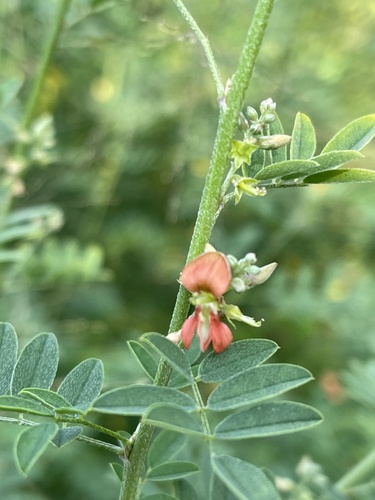
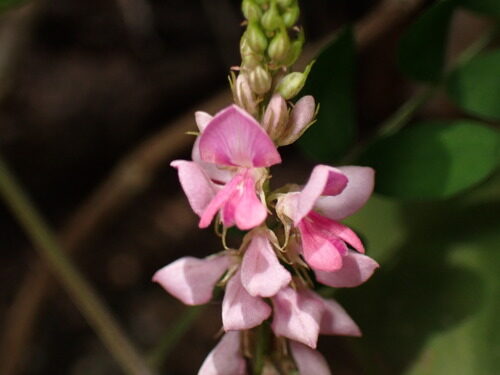
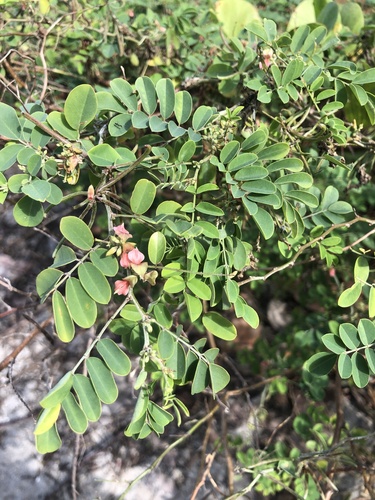
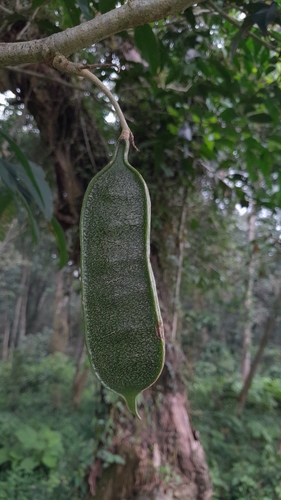
A slightly woody vine or creeper. It keeps growing from year to year. It is twining with side branches. It grows 10 m long. The stems are slender and cylinder shaped. The leaves are alternate and have 3 leaflets. The leaflets are papery. They are 5-11 cm long by 3-8 cm wide. The end leaflets are wedge shaped and the side ones unequal at the base. The edges are wavy. The upper surface are dull green and lower leaves are pale green. The flowers are in groups 12-45 cm long with flowers in groups of 4 to 5. The pods are 3-8 cm long by 1 cm wide. They are flattened and squeezed between the seeds. The seeds are almost square and reddish-brown.
Edible Uses
None known
Traditional Uses
The roots are used for starch.
This uses section is brief — help expand it
Medicinal Uses
None known
Distribution
It is a tropical plant. In Argentina it grows below 1,000 m above sea level.
Where It Grows
Antilles, Argentina, Asia, Brazil, Central America, Cuba, Dominican Republic, Hispaniola, Indochina, Mexico, Paraguay, Puerto Rico, SE Asia, South America, Trinidad, Vietnam, West Indies,
Cultivation
Calopogonium caeruleum is adapted to the humid tropics but it is also somewhat drought-tolerant. It grows better in cooler conditions than centro (Centrosema pubescens) and in the elevated tropics can grow up to an altitude of about 800 metres. It grows best in areas with a mean annual rainfall of 1,000 - 3,000mm, but will persist in environments with as little as 700mm. It prefers environments with daily temperatures ranging from 18 - 25°c, tolerating 10 - 32°c. Succeeds in most soils if they are well drained. Plants prefer a sunny position, but are very tolerant of shading. Plants can succeed in acid soils with a pH as low as 4.0. Calopogonium caeruleum has been widely planted throughout the humid tropics, and has escaped from cultivation and become naturalised in many areas. It has considerable weed potential, often smothering desirable grasses and other understorey species. It has invaded seasonally wet tropical environments. The seed can remain viable in the soil for several years. When growing in the humid tropics it flowers indeterminately through the first wet season, producing seed into the dry season. It is capable of producing moderate amounts of seed even in its first year. This species has a symbiotic relationship with certain soil bacteria, these bacteria form nodules on the roots and fix atmospheric nitrogen. Some of this nitrogen is utilized by the growing plant but some can also be used by other plants growing nearby.
Propagation
Seed - Usually established from seed, sowing into a cultivated seedbed at the beginning of the wet season. Establishment can be slow and may be improved by addition of P fertiliser and lime, and by controlling weeds. Current recommendations for cover crop under oil palm in southeast Asia are to seed C. caeruleum and Pueraria phaseoloides at 1-1.5 and 5-7.5 kg/ha seed, respectively. Can be established by stem cuttings but low success rates (5% of cuttings) are common. Using older stem material and treating stems with root-promoting hormones can improve success rates. Slower to establish than C. mucunoides and Pueraria phaseoloides and may take 20 months to achieve a complete cover. As a green manure crop, can be established by broadcasting into upland rice following the final weeding. Mid-season plantings may reduce rice yields.
Other Uses
Fodder Green manure Mulch Soap Soil conditioner Agroforestry Uses: Plants can be grown as a green manure crop. The plant gives good soil cover; builds up soil fertility through its leaf fall and nitrogen production; and can be used to smother weeds such as Imperata cylindrica. It is grown in plantations where it can be fully productive in full sun and up to 40% shade, it grows well in mature coconut plantations where there is 30 - 40% shade, and will still do fairly well in heavy shade. Will grow productively in mature coconut plantations (60-70% PAR ). One of the most productive herbaceous legumes, generally producing yields of 3-7 t/ha/year DM. Produced DM yields of 1-1.5 t/ha/year under mature oil palm (10% light transmission), out yielding a wide range of common herbaceous legumes. As a green manure crop/mulch , leaf fall from uncut C. caeruleum can be as high as 7 t/ha/year DM. In Nigeria, it had the second highest green manure effect on maize yield among 12 legumes tested, providing an N equivalent of about 90 kg/ha.Companion species. Legumes: Planted as a cover crop in southeast Asian plantation agriculture, often in a species mixture with one or more of the species C. mucunoides , Centrosema molle , Pueraria phaseoloides and Desmodium ovalifolium . Other Uses: The plant is used by laundresses in El Salvador to take dirt out of clothes whilst rubbing them. Special Uses Carbon Farming Food Forest Nitrogen Fixer
Other Information
It is a famine food.
Synonyms
Also Known As
Cudzu criollo, Frijol boniato, Jicama cimarrona, Jicama de monte, Jiquima dulce, Lamdau lam
References (2)
- Kermath, B. M., et al, 2014, Food Plants in the Americas: A survey of the domesticated, cultivated and wild plants used for Human food in North, Central and South America and the Caribbean. On line draft. p 166
- Miguel, E., et al, 1989, A checklist of the cultivated plants of Cuba. Kulturpflanze 37. 1989, 211-357