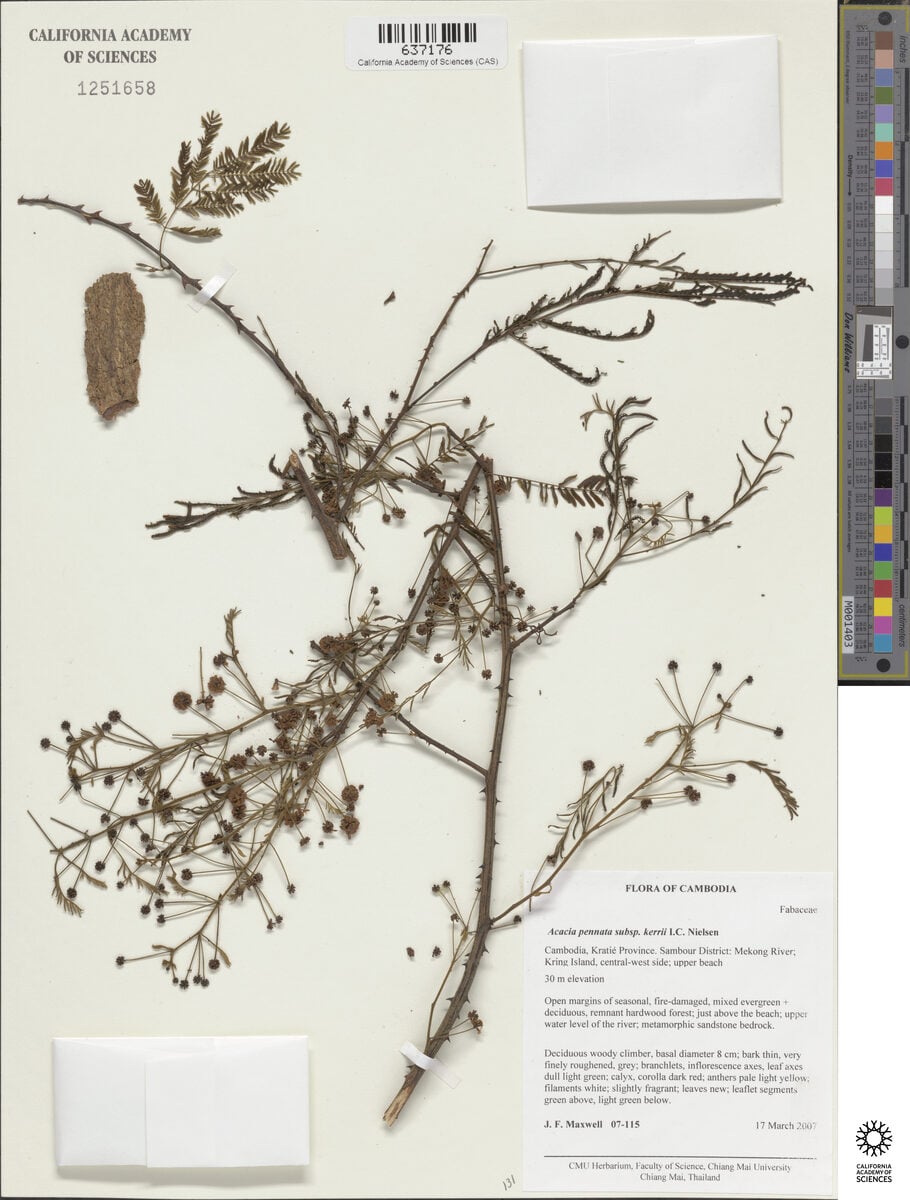
Adenanthera pavonina
L.
Barbados pride, Coral Pea, Bead Tree
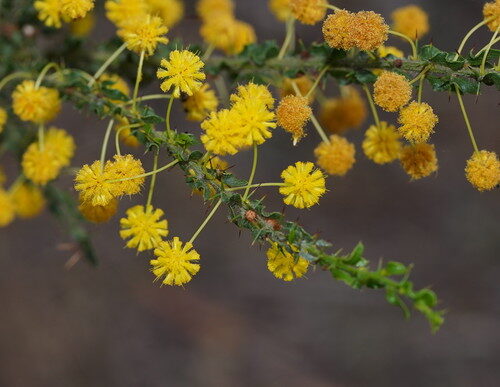
iNaturalist· cc-by-nc
(c) Cheongweei Gan, some rights reserved (CC BY-NC), uploaded by Cheongweei Gan
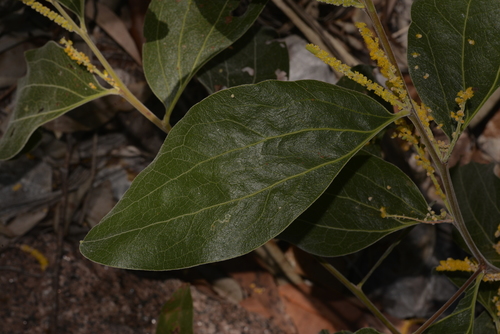
iNaturalist· cc-by-nc
(c) usebcm, some rights reserved (CC BY-NC), uploaded by usebcm
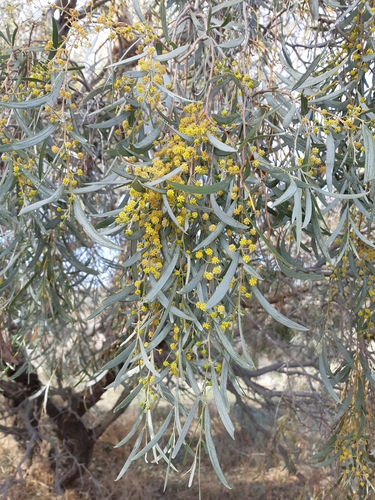
iNaturalist· cc-by-sa
(c) Douglas Goldman, some rights reserved (CC BY-SA), uploaded by Douglas Goldman
Summary
Source: WikipediaAdenanthera pavonina (red sandalwood) is a species of leguminous tree native to southern Asia and northern Australasia. Its uses include food and drink, traditional medicine, and timber.
Description
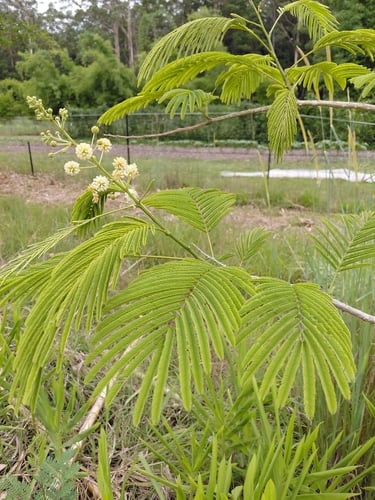
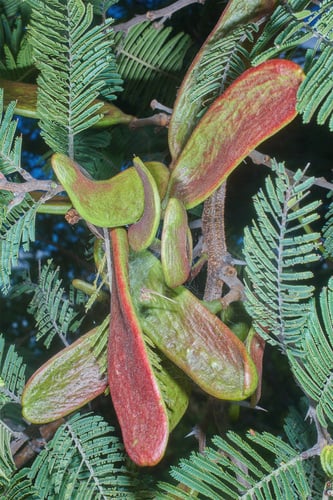
A deciduous tree up to 7-20 m high. It spreads to 4 m across. It loses many of its leaves during the hot dry season of the year. The stem is erect and slender. The bark is smooth and light brown. The leaves are green and divided twice into leaflets. The whole leaf is 30-45 cm long. The leaf is divided into 3-5 pairs of segments 10-15 cm long. Each is divided again into 10-18 alternate oblong leaflets. These are 1.7-4 cm long by 0.8-2 cm wide. These leaflets are dark green on top and paler underneath. The flowers are small and white or yellow. They occur at the ends of branches. The fruit is a long (20 cm) dark brown pod with red seeds. The pod twists up as it opens. The seeds are shiny red and hard and 0.7-1 cm across. The pods remain on the tree long after ripening. It is a legume.
Edible Uses
The bright red seeds are the main food product and can be eaten raw or cooked. They are commonly roasted, shelled, and eaten with rice, and are easily digested and enjoyed by both children and adults. The seeds taste like soya beans and contain 25% oil and 39% protein. Boiling may be required to neutralize potential toxicity. Young leaves are cooked and used as a vegetable. The flowers are also eaten. The plant is noted as a famine food and a minor edible leafy vegetable.
Traditional Uses
The young leaves are cooked and eaten as a vegetable. The flowers are also eaten. The seeds are roasted and shelled and eaten. The seeds are also powdered to make coffee.
Medicinal Uses
The plant has antibacterial and haemagglutinin properties. A leaf decoction is used to treat rheumatism and gout. The bark is used in treating leprosy. A decoction combining bark and leaves is taken for dysentery, diarrhoea, and tonsillitis. The wood is used as a tonic, and pulverized wood mixed with water is taken orally for migraines and headaches. In vitro studies indicate that leaf extract has antibacterial activity against the intestinal pathogen Campylobacter jejuni. High doses of seed extract have demonstrated an anti-inflammatory effect in studies conducted in rats and mice.
Known Hazards
This tree is useful for nitrogen fixation, and it is often cultivated for forage, as an ornamental garden plant or urban tree, and as a medicinal plant. For example, the young leaves can be cooked and eaten. The raw seeds are toxic, but may be eaten when cooked. In Singapore, the species forms part of the diet of local Raffles' banded langurs. The botanist Edred Corner stated that in India, the seeds have been used as units of weight for fine measures, of gold for instance, throughout recorded history because the seeds are known to be almost constant in weight. Indeed, the Malay name for the tree, saga, has been traced to the Arabic for 'goldsmith'. The seeds have long been a symbol of love in China, and its name in Chinese is xiang si dou (Chinese: 相思豆), or "mutual love bean". The beauty of the seeds has led to them being used as beads for jewellery. The small, yellowish flower grows in dense drooping rat-tail flower heads, almost like catkins. The curved hanging pods, with a bulge opposite each seed, split open into two twisted halves to reveal the hard, scarlet seeds. This tree is used for making soap, and a red dye can be obtained from the wood. The wood, which is extremely hard, is also used in boat-building, making furniture and for firewood. The tree is fast-growing, with an attractive, spreading canopy that makes it suitable as a shade tree, and for ornamental purposes in large gardens or parks. However, it is also known for producing much litter in the form of leaves, twigs and especially seed pods which crack open while still on the branch, so releasing their seeds, before themselves falling to the ground. In traditional medicine, a decoction of the young leaves and bark of Adenanthera pavonina is used to treat diarrhoea. Also, the ground seeds are used to treat inflammation. Preliminary scientific studies appear to support these traditional uses. In vitro studies show that Adenanthera pavonina leaf extract has antibacterial activity against the intestinal pathogen Campylobacter jejuni. Also, high doses of seed extract have an anti-inflammatory effect in studies in rats and mice.
Distribution
A tropical plant. It grows in the tropical lowlands and up to 600 m. It is often planted as a shade and ornamental tree. It also grows wild in the rainforest. It suits humid locations. It prefers well drained soil and an open sunny position. It cannot tolerate drought and in frost tender. It will grow on most soil types. It suits hardiness zones 11-12. In the Cairns Botanical Gardens. In XTBG Yunnan.
Where It Grows
Africa, American Samoa, Antigua-Barbuda, Arabia, Australia, Asia, Bahamas, Barbados, Brazil, Burkina Faso, Cambodia, Cameroon, Central Africa, Chad, China, Congo, Cook Islands, Dominica, Dominican Republic, East Africa, East Timor, FSM, Fiji, French Guiana, Ghana, Grenada, Guadeloupe, Guianas, Guam, Guinea-Bissau, Haiti, Hawaii, India, Indochina, Indonesia, Jamaica, Laos, Madagascar, Malaysia, Maldives, Malesia*, Marquesas, Martinique, Mauritius, Micronesia, Middle East, Mozambique, Myanmar, Nauru, New Caledonia, Nigeria, Niue, North America, Pacific, Pakistan, Palau, Papua New Guinea, PNG, Philippines, Pohnpei, Reunion, Samoa, Sao Tome & Principe, SE Asia, Sierra Leone, Singapore, Solomon Islands, South America, Southern Africa, Sri Lanka, St Lucia, Suriname, Taiwan, Tanzania, Thailand, Timor-Leste, Tonga, Togo, Tokelau, Tonga, Tuvalu, Uganda, USA, Vanuatu, Vietnam, West Africa, West Indies,
Cultivation
It grows best in areas where annual daytime temperatures are within the range 22 - 28°c, but can tolerate 12 - 36°c. It prefers a mean annual rainfall in the range 3,000 - 5,000mm, but tolerates 2,000 - 6,000mm. Prefers a sunny position, tolerating light shade. Succeeds in any moderately fertile, moisture-retentive soil. It is found in the wild on a variety of soils, from deep, well-drained to shallow and rocky. Prefers a pH in the range 5 - 7, tolerating 4.5 - 7.5. Established plants are drought tolerant. Requires a position sheltered from high winds. Plants can become invasive in lowland regions. Growth is initially slow but increases rapidly after the first year, during which average annual growth rates of 23 - 26mm in diameter and 200 - 230cm in height can be attained. Trees planted 1 x 2 metres apart for windbreaks and at 2 x 2 metres in plantations can be thinned in 3 - 5 years to provide fuel wood and construction materials. For shade trees, spacing varies from 5 to 10 metres, depending on the companion crop and site. Trees resprout easily, allowing for coppice management with good survival. The tree is susceptible to breakage in high winds, with most of the damage occurring in the crown. The seeds are fairly uniform and were traditionally used as weights by apothecaries and goldsmiths - each seed weighing nearly 4grains (0.25g). This species has a symbiotic relationship with certain soil bacteria, these bacteria form nodules on the roots and fix atmospheric nitrogen. Some of this nitrogen is utilized by the growing plant but some can also be used by other plants growing nearby.
Propagation
The seedcoat is extremely hard and requires scarification before sowing, otherwise germination may take 12 months or more. Pre-soaking in warm water for 12–24 hours is the easiest method. Treated seed can achieve 100% germination in as little as 1–4 days, though 10 days is more typical. Seed can be sown in situ, in nursery beds, or in containers. Seedlings reach 8–30cm in approximately 3 months. Nodal cuttings can be taken and rooted in sand in a closed case. Seed stores well for several years in sealed containers at room temperature. Propagation from large cuttings has been reported as successful in India.
Other Uses
The tree is a natural pioneer species. Its fast growth and ability to fix atmospheric nitrogen make it suitable for land reclamation and re-establishing woodland. The spreading canopy of light, feathery foliage provides attractive shade, and the tree is often planted in coffee, clove, and rubber plantations for this purpose. It is also planted along field borders as part of windbreaks. The small leaves break down easily, making the species a good green manure, and it is compatible with most tropical field and tree crops including spices, coffee, and coconuts. The bark is rich in saponins and can be used to wash clothes or as a hair shampoo. A red dye obtained from shredded bark has been used to dye clothes and is used by Hindus in India for the sacred forehead mark. The glossy red seeds are used as toys and for beads in necklaces and other ornaments. Historically used to weigh gold, silver, and diamonds due to their narrow weight range; goldsmiths also use the seeds in soldering. The heartwood is bright yellow when fresh, turning red on exposure to air, and is sharply demarcated from the light grey sapwood, which can be up to 5cm wide. The wood is heavy, hard, strong, close-grained, and durable. It can range from easy to somewhat difficult to work, planes easily, and takes a high finish. The heartwood resists dry wood termites. It is a valued timber used for cabinet making, construction, flooring, paving blocks, vehicle bodies, and fine art. The wood burns readily and produces significant heat; it is esteemed for fuel in the Pacific Islands and used in both above- and below-ground ovens. It also yields very good charcoal.
Production
It grows quickly. In the southern hemisphere flowering occurs November to February and fruiting from December to March.
Other Information
A minor edible leafy vegetable. Famine food. The seeds are especially eaten by children. Cooked seeds are sold in markets in Samoa. It is sold in local markets in Laos.
Notes
There are 12 Adenanthera species in tropical Asia. Also as Mimosaceae.
Synonyms
Also Known As
Anikundumani, Bandi guruvenda, Barricarri, Bis, Bisa, Butsu bis, Check-long, Circassian bean, Coral Wood, False wiliwili, Haihongdou, Hua 'ula'ula, Kaikes, Kongquedou, Kunchandana, Laihere, Lera, Lopa, Ma klam ton, Madatiya, Madhoshi, Mai-chek, Maklam-tah-chang, Manjadi, Manjetti, Mwetkwem, Nabis, Phak lam, Phak mak lam, Pohon saga merah, Pomea, Rakta kambal, Red Sandalwood, Saga hutan, Saga, Sa lae khwo, Telentundalel, Thorligunj, Trachquach, Volantsaramanga, Ywe, Ywe-gyi, Ywe-ni
References (85)
- Ambasta S.P. (Ed.), 2000, The Useful Plants of India. CSIR India. p 14
- Barrau, J., 1976, Subsistence Agriculture in Polynesia and Micronesia. Bernice P. Bishop Museu, Bulletin 223 Honolulu Hawaii. Kraus reprint. p 56
- Barwick, M., 2004, Tropical and Subtropical Trees. A Worldwide Encyclopedic Guide. Thames and Hudson p 10
- Bircher, A. G. & Bircher, W. H., 2000, Encyclopedia of Fruit Trees and Edible Flowering Plants in Egypt and the Subtropics. AUC Press. p 10
- Blench, R., 2004, Fruits and Arboriculture in the Indo-Pacific Region. Indo-Pacific Prehistory Association Bulletin 24. (Taipei Papers Volume 2) p 34
Show all 85 references Hide references
- Bodkin, F., 1991, Encyclopedia Botanica. Cornstalk publishing, p 48
- Bole, P.V., & Yaghani, Y., 1985, Field Guide to the Common Trees of India. OUP p 31
- Bremness, L., 1994, Herbs. Collins Eyewitness Handbooks. Harper Collins. p 33
- Brock, J., 1993, Native Plants of Northern Australia, Reed. p 81
- Burkill, H. M., 1985, The useful plants of west tropical Africa, Vol. 3. Kew.
- Burkill, I.H., 1966, A Dictionary of the Economic Products of the Malay Peninsula. Ministry of Agriculture and Cooperatives, Kuala Lumpur, Malaysia. Vol 1 (A-H) p 46
- Cabalion, P. and Morat, P., 1983, Introduction le vegetation, la flore et aux noms vernaculaires de l'ile de Pentcoste (Vanuatu), In: Journal d'agriculture traditionnelle et de botanique appliquee JATBA Vol. 30, 3-4
- Cherikoff V. & Isaacs, J., The Bush Food Handbook. How to gather, grow, process and cook Australian Wild Foods. Ti Tree Press, Australia p 198
- Clarke, W.C. & Thaman, R.R., 1993, Agroforestry in the Pacific Islands: Systems for sustainability. United Nations University Press. New York. p 221
- Cooper, W. and Cooper, W., 2004, Fruits of the Australian Tropical Rainforest. Nokomis Editions, Victoria, Australia. p 305
- Cowie, I, 2006, A Survey of Flora and vegetation of the proposed Jaco-Tutuala-Lore National Park. Timor-Lests (East Timor) www.territorystories.nt/gov.au p 50
- Cribb, A.B. & J.W., 1976, Wild Food in Australia, Fontana. p 103
- Cruz-Garcia, G. S., & Price, L. L., 2011, Ethnobotanical investigation of 'wild' food plants used by rice farmers in Kalasin, Northeast Thailand. Journal of Ethnobiology and Ethnomedicine 7:33
- Dunlop, C.R., Leach, G.J. & Cowie, I.D., 1995, Flora of the Darwin Region. Vol 2. Northern Territory Botanical Bulletin No 20. p 20
- Elliot, W.R., & Jones, D.L., 1982, Encyclopedia of Australian Plants suitable for cultivation. Vol 2. Lothian. p 151
- Etherington, K., & Imwold, D., (Eds), 2001, Botanica's Trees & Shrubs. The illustrated A-Z of over 8500 trees and shrubs. Random House, Australia. p 76
- Facciola, S., 1998, Cornucopia 2: a Source Book of Edible Plants. Kampong Publications, p 151
- Flora of Australia Volume 12, Mimosaceae (excl. Acacia) Caesalpiniaceae. Melbourne: CSIRO Australia (1998) p xiii, 4, 5.
- Franklin, J., Keppel, G., & Whistler, W., 2008, The vegetation and flora of Lakeba, Nayau and Aiwa Islands, Central Lau Group, Fiji. Micronesica 40(1/2): 169–225, 2008
- French, B., 1986, Food Plants of Papua New Guinea, Asia Pacific Science Foundation p 75
- French, B.R., 2010, Food Plants of Solomon Islands. A Compendium. Food Plants International Inc. p 291
- Friday, J. B., 2005, Forestry and Agroforestry Trees of East Timor. http://www.ctahr.hawaii.edu/forestry/data/Timor/Timor trees.html
- Gardner, S., et al, 2000, A Field Guide to Forest Trees of Northern Thailand, Kobfai Publishing Project. p 157
- Hall, N. et al, 1972, The Use of Trees and Shrubs in the Dry Country of Australia, AGPS, Canberra. p 197
- Hani Medicine of Xishuangbanna, 1999, p 691
- Hardwick, G., 2001, Economically Useful Plants for Northern Australia: Master Species List. Crusader eBooks.
- Havel, J.J., 1975, Forest Botany, Volume 3 Part 2 Botanical taxonomy. Papua New Guinea Department of Forests, p 105
- Hearne, D.A., & Rance, S.J., 1975, Trees for Darwin and Northern Australia. AGPS, Canberra p 14, Pl 4
- Hedrick, U.P., 1919, (Ed.), Sturtevant's edible plants of the world. p 26
- ILDIS Legumes of the World http:www;ildis.org/Legume/Web
- Jackes, B.R., 2001, Plants of the Tropics. Rainforest to Heath. An Identification Guide. James Cook University. p 64
- Jones D, L, 1986, Ornamental Rainforest Plants in Australia, Reed Books, p 148
- Kachenchart, B., et al, 2008, Phenology of Edible Plants at Sakaerat Forest. In Proceedings of the FORTROP II: Tropical Forestry Change in a Changing World. Bangkok, Thailand.
- Lazarides, M. & Hince, B., 1993, Handbook of Economic Plants of Australia, CSIRO. p 9
- Lebot, V. & Sam, C., Green desert or ‘all you can eat’? How diverse and edible was the flora of Vanuatu before human introductions?. Terra australis 52 p 410
- Llamas, K.A., 2003, Tropical Flowering Plants. Timber Press. p 211
- Luczaj, L., et al, 2021, Wild food plants and fungi sold in the markets of Luang Prabang, Lao PDR. Journal of Ethnobiology and Ethnomedicine (2021) 17:6
- Lugod, G.C. and de Padua L.S., 1979, Wild Food Plants in the Philippines. Vol. 1. Univ. of Philippines Los Banos. p 41
- Maiden, J. H., 1889, The Useful Native Plants of Australia (including Tasmania). The Technology Museum of NSW, Sydney. p 5
- Mbuya, L.P., Msanga, H.P., Ruffo, C.K., Birnie, A & Tengnas, B., 1994, Useful Trees and Shrubs for Tanzania. Regional Soil Conservation Unit. Technical Handbook No 6. p 80
- McMakin, P.D., 2000, Flowering Plants of Thailand. A Field Guide. White Lotus. p 51
- Menninger, E.A., 1977, Edible Nuts of the World. Horticultural Books. Florida p 89
- Milow, P., et al, 2014, Malaysian Species of Plants with Edible Fruits or Seeds and Their Valuation. International Journal of Fruit Science, 14:1-27, 2014
- Nakahara, K. et al, 2002, Antimutagenicity of Some Edible Thai Plants, and a Biocative Carbazole Alkaloid, Mahanine, Isolated from Micromelum minutum. Journal of Agricultural and Food Chemistry. 50: 4796-4892
- Nicholson, N & H., 1996, Australian Rainforest Plants 3, Terania Rainforest Publishing. NSW. p 6
- Parham, B. E. V., 1972, Plants of Samoa. New Zealand Department of Scientific and Industrial Research. Information Series. No. 85 p 67
- Peekel, P.G., 1984, (Translation E.E.Henty), Flora of the Bismarck Archipelago for Naturalists, Division of Botany, Lae, PNG. p 210, 208
- Pham-Hoang Ho, 1999, An Illustrated Flora of Vietnam. Nha Xuat Ban Tre. p 817
- Plants of Haiti Smithsonian Institute http://botany.si.edu/antilles/West Indies
- Price, S.H. & J.L., Wild Food, Medicine and useful plants of the Wet tropics. Kwik Kopy, Cairns. p 3
- Recher, P, 2001, Fruit Spirit Botanical Gardens Plant Index. www.nrg.com.au/~recher/ seedlist.html p 4
- Selvam, V., 2007, Trees and shrubs of the Maldives. RAP Publication No. 2007/12
- Setalaphruk, C. & Price, L. L., 2007, Children's traditional ecological knowledge of wild food resources: a case study in a rural village in Northeast Thailand. Journal of Ethnobiology and Ethnomedicine. 3:33
- Siemonsma, J. S. & Kasem Piluek, eds. 1993. Vegetables. In: Plant Resources of South-East Asia (PROSEA) 8:311
- Singh, H.B., Arora R.K.,1978, Wild edible Plants of India. Indian Council of Agricultural Research, New Delhi. p 39
- Slik, F., www.asianplant.net
- Smith, A.C., 1985, Flora Vitiensis Nova, Lawaii, Kuai, Hawaii, Volume 3 p 56
- Sp. pl. 1:384. 1753
- Staples, G.W. and Herbst, D.R., 2005, A tropical Garden Flora. Bishop Museum Press, Honolulu, Hawaii. p 302
- Subramaniam, S., and Sharif, M. R. et al, 1994, Lipids from the seeds of seven Fijian plant species. Food Chemistry. 49:11-13
- Sujanapal, P., & Sankaran, K. V., 2016, Common Plants of Maldives. FAO & Kerala FRI, p 22
- Sukarya, D. G., (Ed.) 2013, 3,500 Plant Species of the Botanic Gardens of Indonesia. LIPI p 105
- Sutjaritjai, N., et al, 2019, Traditional Uses of Leguminosae among the Karen in Thailand. Plants 2019, 8, 600 p 4
- Swaminathan, M.S., and Kochnar, S.L., 2007, An Atlas of Major Flowering Trees in India. Macmillan. p 138 (As Adenanthera microsperma)
- Thaman, R.R., 1976, The Tongan Agricultural System, University of the South Pacific, Suva, Fiji. p 378
- Thaman, R. and W. Clarke, Paper on Agroforestry on Aneityum and Tanna, Vanuatu from Internet
- Thaman, R. R, 2016, The flora of Tuvalu. Atoll Research Bulletin No. 611. Smithsonian Institute p 88
- Townsend, K., 1994, Across the Top. Gardening with Australian Plants in the tropics. Society for Growing Australian Plants, Townsville Branch Inc. p 70
- United Nations University. Appendix One hundred Pacific Island agroforestry trees (2)
- Verdcourt, B., 1979, Manual of New Guinea Legumes. Botany Bulletin No 11, Division of Botany, Lae, Papua New Guinea. p 138
- Walter, A. & Sam C., 2002, Fruits of Oceania. ACIAR Monograph No. 85. Canberra. p 83
- Walter, A & Sam, C., 1995, Indigenous Nut Trees in Vanuatu: Ethnobotany and Variability. In South Pacific Indigenous Nuts. ACIAR Proceedings No 69. Canberra. p 57
- WATT
- Whistler, W.A., 2004, Rainforest Trees of Samoa. Isle Botanica Honolulu, Hawaii. p 69
- Whistler, W. A., 1988, Ethnobotany of Tokelau: The Plants, Their Tokelau Names, and Their Uses. Economic Botany 42(2): 155-176
- http://cookislands.bishopmuseum.org
- World Checklist of Useful Plant Species 2020. Royal Botanic Gardens, Kew
- www.worldagroforestrycentre.org/sea/products/afdbases/af
- Yuncker, T.G., 1959, Plants of Tonga, Bernice P. Bishop Museum, Hawaii, Bulletin 220. p 131
- Yunupinu Banjgul, Laklak Yunupinu-Marika, et al. 1995, Rirratjinu Ethnobotany: Aboriginal Plant Use from Yirrkala, Arnhem Land, Australia. Northern Territory Botanical Bulletin No 21. Parks and Wildlife Commission of the Northern Territory. p 15.