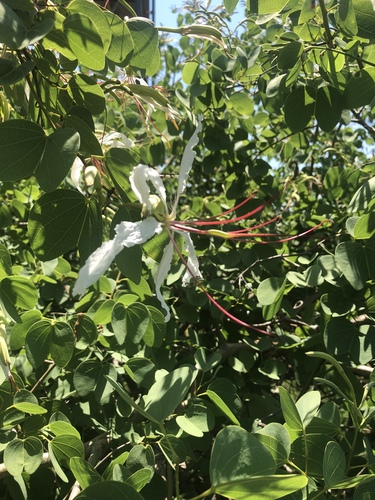
Vachellia nilotica
(L.) P.J. H. Hurter & Mabb.
Egyptian thorn, Scented-pod acacia
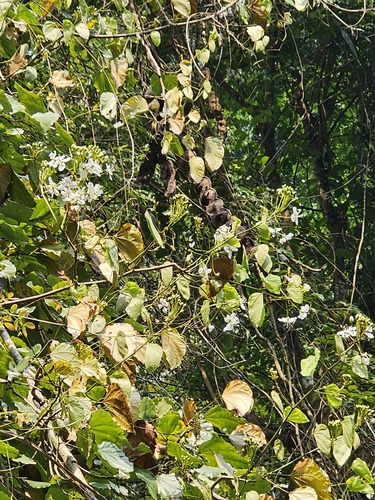
iNaturalist· cc-by-nc
(c) janet_taylor, some rights reserved (CC BY-NC), uploaded by janet_taylor
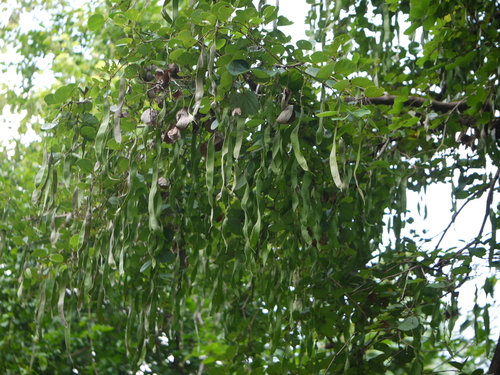
iNaturalist· cc-by-nc
(c) Troos van der Merwe, some rights reserved (CC BY-NC), uploaded by Troos van der Merwe
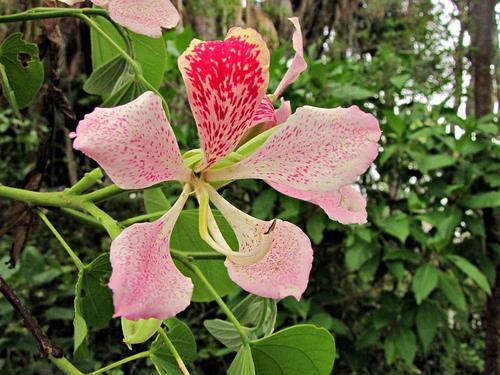
iNaturalist· cc-by-nc
(c) Elavarasan M, some rights reserved (CC BY-NC), uploaded by Elavarasan M
Summary
Source: WikipediaVachellia nilotica, more commonly known as Acacia nilotica, and by the vernacular names of gum arabic tree, babul, thorn mimosa, Egyptian acacia or thorny acacia, is a flowering tree in the family Fabaceae. It is native to Africa, the Middle East and the Indian subcontinent.
Description
A small spiny tree. It varies a lot in details. It is mostly about 6 m high but can be 20 m high. It is often branched from the base. The crown is usually rounded. The bark is brown-black and rough. It has cracks along it. The young shoots are reddish-brown and hairy. It has thorns up to 10 cm long. The thorns often point away from the shoot tip. The leaves divide twice and are grey-green. New growth occurs in the dry season. Small glands are visible along the leaf stalk. The flowers have a scent. They are rounded heads and are bright yellow. The pods can be straight or curved. They are about 17 cm long and 2 cm wide. They are green and fleshy when young. They have a sweet smell. They are rounded at both ends. The pods turn purple-brown when mature. Gum is exuded out of the pods if they are squeezed. There are 8-15 seeds. they are flat and about 1 cm across. They are smooth and dark brown. The pods rot and do not break open. Seven subspecies have been recognised.
Edible Uses
Young pods, young leaves, and shoots are all used as vegetables. Sprouted seeds are also eaten as a vegetable. Seeds can be mixed with dates and fermented into an alcoholic beverage, and the flowers are made into fritters. Well-roasted seeds are ground into a powder and used as an adulterant mixed with coffee, and roasted seeds are also used as a condiment. The gum from the stems is eaten mixed with sesame seeds, fried in ghee, or used in the preparation of sweetmeats and candied flowers. A type of wine known as 'sak' is made from the bark.
Traditional Uses
The pulp in the pod is eaten. It is also boiled in water and sugar added to make a drink, The young pods can be used as a vegetable or the seeds fried and eaten alone. The gum is edible and used for sweets. It is mixed with sesame seeds and fried in ghee. It is eaten fresh or roasted. It is used in the preparation of candied flowers. The flowers are made into fritters. A bark is used to make wine. The bark is also eaten with meat soup. It can be used to curdle milk.
Medicinal Uses
The bark, gum, leaves, and pods are used in various traditional medicines. The bark, leaves, and pods are rich in tannins and are consequently astringent. Extracts of the plant have been shown to inhibit at least four species of pathogenic fungi. The bark is used both internally as a decoction and externally as a wash. Its astringency makes it particularly effective against diarrhoea and dysentery; it is also used as a nerve stimulant and in the treatment of leprosy, coughs, and intestinal pains. The gum and bark have both been used for cancers and tumours of the ear, eye, or testicles; chest conditions including colds, congestion, coughs, and tuberculosis; indurations of the liver and spleen; fevers; gallbladder problems; haemorrhage; haemorrhoids; leucorrhoea; ophthalmia; sclerosis; and smallpox. The root has been used to treat tuberculosis and is said to cure impotence. Bruised leaves are applied as a poultice on ulcers, and the wood has been used in the treatment of smallpox.
Known Hazards
Especially in times of drought, many Acacia species can concentrate high levels of the toxin Hydrogen cyanide in their foliage, making them dangerous for herbivores to eat.
Distribution
It is a tropical plant. It is common in Africa. It grows in the Sahel and the Sahara. It grows in semi arid and arid areas. It can grow on a wide variety of soils. Near the equator is grows from 600-1800 m altitude. It is also grown in India. It can grow in arid places.
Where It Grows
Africa, Algeria, Andamans, Angola, Antigua-Barbuda, Asia, Australia, Bahamas, Barbados, Botswana, Burkina Faso, Caribbean, Central Africa, Chad, China, Cuba, East Africa, Egypt, Ethiopia, Gambia, Ghana, Grenada, Guadeloupe, Guinea-Bissau, Himalayas, India, Indochina, Indonesia, Iran, Iraq, Israel, Kenya, Libya, Madagascar, Malawi, Mali, Martinique, Mauritania, Mauritius, Mediterranean, Middle East, Montserrat, Morocco, Mozambique, Myanmar, Namibia, Nepal, Niger, Nigeria, North Africa, North America, Oman, Pakistan, Puerto Rico, Sahel, SE Asia, Senegal, Somalia, South Africa, Southern Africa, South Sudan, Sri Lanka, St Lucia, Sudan, Syria, Tanzania, Togo, Uganda, USA, Vietnam, West Africa, West Indies, Yemen, Zambia, Zimbabwe,
Cultivation
Plants are grown from seed. There are 6,000-11,000 seeds per kg. Bad and insect damaged seeds can be floated off in water. For fresh seeds, seed treatment is no necessary. For dry stored seed the hard seed coat needs to be broken. Normally this is by putting the seeds in very hot water and letting the water cool down overnight then planting the seeds immediately. It can be done by scratching the seed. Seed stores well if kept in a cool dry insect free place.
Propagation
Seed is best sown fresh while still moist. Seeds ejected during rumination by sheep or collected from cattle and goat droppings germinate readily due to the softening effect of fermentation and moisture on the seedcoat. If not sown moist, the seedcoat hardens and scarification is recommended to speed germination: pour a small amount of nearly boiling water over the seeds (taking care not to cook them), then soak in warm water for 12–24 hours until swollen. If seeds have not swollen by then, carefully nick the seedcoat without damaging the embryo and soak for a further 12 hours before sowing. Germination rates for moist or treated seed are generally 50–90%, typically beginning 1–3 weeks after sowing and mostly complete within one month. Seeds can be sown directly in the field or raised in nurseries and transplanted later. For direct sowing, ridge-sowing is recommended at a rate of 1 kg per ha.
Other Uses
Vachellia nilotica is a valuable species for reclaiming wasteland, particularly on alkaline soils and in areas where fuelwood is scarce. It is a pioneer species with a deep, extensive root system: on dry sites, the taproot develops first, followed by lateral roots that become compact and massive with age; on flooded sites, the root system is largely lateral. Trees are used in reforestation projects, especially on inundated land, and tolerate pruning well, making them suitable as hedge plants to protect plantations from grazing animals and to serve as firebreaks. A sticky red resin known as Indian Gum Arabic exudes from the bark. It is sweet but of poorer quality than the gum arabic of Acacia senegal, and is used in printing and dyeing calico, as a sizing material for cotton and silk, and in paper manufacture. The gum is also used in candles, inks, matches, and paints, and serves as an emulsifying and suspending agent. Harvesting involves wounding the tree by removing part of the bark and bruising the surrounding area. Good-quality gum is reddish, almost completely water-soluble, and tasteless, and is usually traded in ball form. The gum obtained from the pods is used for dyes and inks in India. The bark and seedpods are rich in tannin: the inner bark contains 18–23% tannin, whole pods 12–19%, and de-seeded pods 18–27%. In Sudan, de-seeded pods can reach tannin contents of up to 50%. Seeds are generally removed as their high sugar-like content tends to cause tannin liquor to ferment. The bark is used for tanning and dyeing material black or various shades of brown. Dried mature pods produce a pinkish-white colour in local Sudanese tanneries. Tannins are used to dye cloth yellow, and when combined with an iron-rich mud mordant yield khaki-to-brown, grey, and black dyes for cotton. For bark harvesting, trees are felled, the bark beaten off with wooden mallets, then sun-dried, chopped into chips, and sent to tanneries — often as a by-product of timber felling. An extract of the root is a potential inhibitor of tobacco mosaic virus. An aqueous extract of the fruit, rich in tannin (18–23%), has shown algicidal activity against multiple genera including Chroccoccus, Closterium, Coelastrum, Cosmarium, Cyclotella, Euglena, Microcystis, Oscillatoria, Pediastrum, Rivularia, Spirogyra, and Spirulina. Fibre from the bark of slender branches is used for coarse ropes and paper; these branches are also used as toothbrushes and chewsticks. The heartwood is pale red to deep red-brown, darkening on exposure, and is clearly distinct from the yellowish-white sapwood. The wood is strong, heavy, hard, durable, close-grained, and resistant to water and ants — harder than teak and very shock-resistant. It is used for agricultural implements, sugar and oil presses, boat handles, brake blocks, cart wheels, planks, tent pegs, and similar items. Wood shavings are used as raw material for paper pulp. The wood is also valuable as fuel and for producing charcoal.
Production
It is a reasonably fast growing tree. It can be cut back and allowed to regrow.
Notes
There are about 1,350 Acacia species. Over 1,000 occur in Australia. Pods contain 30% tannins useful for tanning leather. The bark, leaf and gum are used for medicine. It has anticancer properties. Also as Mimosaceae.
Synonyms
Also Known As
Amour, Atteleh, Babhul, Babool, Babu, Babul, Baryomodi, Chiseo, Chiwiriri, Ekapelimen, Grar, Gum arabic, Indian gum arabic tree, Kantzi, Karivelom, Keo cau, Lamour, Maraa, Mfuko, Mgunga, Mooka, Mpampa, mu-Cemeri, Mufuku, Muwulagavega, Ngagaga, N'tokorio, Namalenga, Ngagaga, Nile acacia, Olkiloriti, Ol-koloriti, Saa anula, Scented thorn, Subyu, Suntwood, Teli babhul, Tugaar
References (60)
- W. T. Aiton, Hortus kew. ed. 2, 5:465. 1813 (As Acacia nilotica)
- Alyegba, S. S. et al, 2013, Ethnobotanical Survey of Edible Wild Plants in Tiv Communities of Benue State, Nigeria. Journal of Natural Sciences Research. Vol.3, No.7 (As Acacia nilotica)
- Atato, A., et al, 2010, Diversity of Edible Wild Fruit Tree Species of Togo. Global Science Books. (As Acacia nilotica)
- Ballal, M. E., et al, 2014, Ethno-botany of Natural Forests of Nuba Mountains, South Kordofan State, Sudan. Journal of Forest Poducts & Industries. 3(1):13-19 (As Acacia nilotica)
- Behera, K. K. et al, 2008, Wild Edible Plants of Mayurbhanj District, Orissa, India. J. Econ. Taxon. Bot. Vol. 32 (Suppl,) pp 305-314 (As Acacia nilotica)
Show all 60 references Hide references
- Bekele-Tesemma A., Birnie, A., & Tengnas, B., 1993, Useful Trees and Shrubs for Ethiopia. Regional Soil Conservation Unit. Technical Handbook No 5. p 54 (As Acacia nilotica)
- Biocyclopedia Edible Plant Species (As Acacia arabica)
- Bircher, A. G. & Bircher, W. H., 2000, Encyclopedia of Fruit Trees and Edible Flowering Plants in Egypt and the Subtropics. AUC Press. p 4 (As Acacia nilotica)
- Bernholt, H. et al, 2009, Plant species richness and diversity in urban and peri-urban gardens of Niamey, Niger. Agroforestry Systems 77:159-179 (As Acacia nilotica)
- Bole, P.V., & Yaghani, Y., 1985, Field Guide to the Common Trees of India. OUP p 7 (As Acacia nilotica)
- BROKENSHA & RILEY, (As Acacia nilotica)
- Bunderson, W. T. et al, 2002, Common Agroforestry Species in Malawi. Malawi Agroforestry Extension Project, Pubication No. 46, Lilongwe. p 12 (As Acacia nilotica)
- Burkill, H. M., 1985, The useful plants of west tropical Africa, Vol. 3. Kew. (As Acacia nilotica)
- Chandrakumar, P., et al, 2015, Ethnobotanical studies of wild edible plants of Gond, Halba and Kawar tribes of Salekasa Taluka, Gondia District, Maharashtra State, India. International Research Journal of Pharmacy 6(8) (As Acacia nilotica)
- Dharani, N., 2002, Field Guide to common Trees & Shrubs of East Africa. Struik. p 28 (As Acacia nilotica)
- Dobriyal, M. J. R. & Dobriyal, R., 2014, Non Wood Forest Produce an Option for Ethnic Food and Nutritional Security in India. Int. J. of Usuf. Mngt. 15(1):17-37 (As Acacia nilotica)
- Ethiopia: Famine Food Field Guide. http://www.africa.upenn.edu/faminefood/category1.htm (As Acacia nilotica)
- Facciola, S., 1998, Cornucopia 2: a Source Book of Edible Plants. Kampong Publications, p 151 (As Acacia nilotica)
- FAGG (As Acacia nilotica)
- Flora of Pakistan. www.eFloras.org (As Acacia nilotica)
- Gallagher, D. E., 2010, Farming beyond the escarpment: Society, Environment, and Mobility in Precolonial Southeastern Burkina Faso. PhD University of Michigan. (As Acacia nilotica)
- Grubben, G. J. H. and Denton, O. A. (eds), 2004, Plant Resources of Tropical Africa 2. Vegetables. PROTA, Wageningen, Netherlands. p 559 (As Acacia nilotica)
- Hahn, K., et al, 2018, The Use of Wild Plants for Food: a National Scale Analysis for Burkina Faso (West Africa) Flora et Vegetatio Sudano-Sambesica 21, 25-33 (As Acacia nilotica)
- Hearne, D.A., & Rance, S.J., 1975, Trees for Darwin and Northern Australia. AGPS, Canberra p Pl 1 (As Acacia nilotica)
- Hedrick, U.P., 1919, (Ed.), Sturtevant's edible plants of the world. p 18 (As Acacia arabica)
- Hepper, E.N., 1993, Illustrated Encyclopedia of Bible Plants, IVP, England. p 172 (As Acacia nilotica)
- Kahlon, L. K. & Singh, R., 2019, Traditional knowledge & Dynamics of edible plants of primitive tribal group ‘Paudi Bhuyan’ with changing demography migration patterns in Northern Odisha. Indian Journal of Traditional Knowledge Vol 18(1), pp 7-15
- Katende, A.B., Birnie, A & Tengnas B., 1995, Useful Trees and Shrubs for Uganda. Identification, Propagation and Management for Agricultural and Pastoral Communities. Technical handbook No 10. Regional Soil Conservation Unit, Nairobi, Kenya. p 52 (As Acacia nilotica)
- Kintzios, S. E., 2006, Terrestrial Plant-Derived Anticancer Agents and Plant Species Used in Anticancer research. Critical Reviews in Plant Sciences. 25: pp 79-113 (As Acacia nilotica)
- Lazarides, M. & Hince, B., 1993, Handbook of Economic Plants of Australia, CSIRO. p 5 (As Acacia nilotica)
- Lulekal, E., et al, 2011, Wild edible plants in Ethiopia: a review on their potential to combat food insecurity. Afrika Focus - Vol. 24, No 2. pp 71-121 (As Acacia nilotica)
- Manandhar, N.P., 2002, Plants and People of Nepal. Timber Press. Portland, Oregon. p 66 (As Acacia nilotica)
- Mannheimer, C. A. & Curtis. B.A. (eds), 2009, Le Roux and Muller's Field Guide to the Trees and Shrubs of Namibia. Windhoek: Macmillan Education Namibia. p 112 (As Acacia nilotica)
- Martin, F.W. & Ruberte, R.M., 1979, Edible Leaves of the Tropics. Antillian College Press, Mayaguez, Puerto Rico. p 197 (As Acacia nilotica)
- Maundu, P. et al, 1999, Traditional Food Plants of Kenya. National Museum of Kenya. p 43 (As Acacia nilotica)
- Maydell, H. von, 1990 Trees and shrubs of the Sahel: their characteristics and uses. Margraf. p (As Acacia nilotica)
- Mbuya, L.P., Msanga, H.P., Ruffo, C.K., Birnie, A & Tengnas, B., 1994, Useful Trees and Shrubs for Tanzania. Regional Soil Conservation Unit. Technical Handbook No 6. p 60 (As Acacia nilotica)
- Milson. J., 2000, Trees and Shrubs of north-west Queensland. DPI p 140 (As Acacia nilotica)
- Molla, A., Ethiopian Plant Names. http://www.ethiopic.com/aplants.htm (As Acacia nilotica)
- Mutie, F. M., et al, 2023, Important Medicinal and Food Taxa (Orders and Families) in Kenya, Based on Three Quantitative Approaches. Plants 2023, 12, 1145
- Nassif, F., & Tanji, A., 2013, Gathered food plants in Morocco: The long forgotten species in Ethnobotanical Research. Life Science Leaflets 3:17-54 (As Acacia arabica)
- Palgrave, K.C., 1996, Trees of Southern Africa. Struik Publishers. p 246 (As Acacia nilotica)
- Peters, C. R., O'Brien, E. M., and Drummond, R.B., 1992, Edible Wild plants of Sub-saharan Africa. Kew. p 127 (As Acacia nilotica)
- Pham-Hoang Ho, 1999, An Illustrated Flora of Vietnam. Nha Xuat Ban Tre. p 823 (As Acacia nilotica)
- Prachi, K., et al, 2012, Underutilized wild fruits of North Maharashtra. Journal of Research in Plant Sciences. (2012) 1:071-076 (As Acacia nilotica)
- Purseglove, J.W., 1968, Tropical Crops Dicotyledons, Longmans. p 209 (As Acacia nilotica)
- Roodt, V., 1998, Trees & Shrubs of the Okavango Delta. Medicinal Uses and Nutritional value. The Shell Field Guide Series: Part 1. Shell Botswana. p 195 (As Acacia nilotica)
- Royal Botanic Gardens, Kew (1999). Survey of Economic Plants for Arid and Semi-Arid Lands (SEPASAL) database. Published on the Internet; http://www.rbgkew.org.uk/ceb/sepasal/internet [Accessed 26th April 2011] (As Acacia nilotica)
- Ruffo, C. K., Birnie, A. & Tengnas, B., 2002, Edible Wild Plants of Tanzania. RELMA p 86 (As Acacia nilotica)
- Ruiters-Welcome, A. K., 2019, Food plants of southern Africa. Ph.D. thesis. Univ. of Johannesburg p 62
- SAXENA; (As Acacia nilotica)
- SHANKARNARAYAN & SAXENA (As Acacia nilotica)
- Siemonsma, J. S. & Kasem Piluek, eds. 1993. Vegetables. In: Plant Resources of South-East Asia (PROSEA) 8:311 (As Acacia nilotica)
- Sukarya, D. G., (Ed.) 2013, 3,500 Plant Species of the Botanic Gardens of Indonesia. LIPI p 101 (As Acacia nilotica)
- Usher, G., 1974, A Dictionary of Plants Used by Man. Constable. p 11 (As Acacia nilotica)
- van Wyk, Ben-Erik, 2019, The diversity and multiple uses of southern African legumes. Australian Systematic Botany, 2019, 32, 519–546
- Wehmeyer, A. S, 1986, Edible Wild Plants of Southern Africa. Data on the Nutrient Contents of over 300 species (As Acacia nilotica)
- Welcome, A. K. & Van Wyk, B.-E., 2019, An inventory and analysis of the food plants of southern Africa. South African Journal of Botany 122 (2019) 136–179
- Williamson, J., 2005, Useful Plants of Malawi. 3rd. Edition. Mdadzi Book Trust. p 11 (As Acacia nilotica)
- World Checklist of Useful Plant Species 2020. Royal Botanic Gardens, Kew