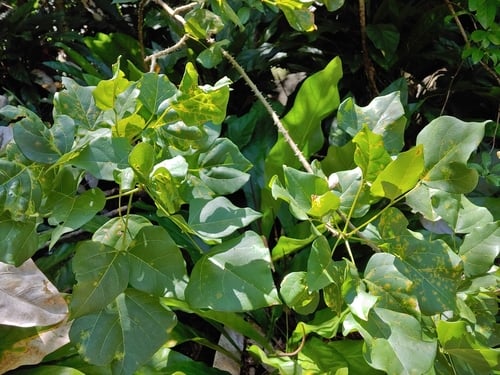
Vachellia oerfota
(Forssk.) Kyal. & Boatwr.
iNaturalist· cc-by-nc
(c) James Bailey, some rights reserved (CC BY-NC), uploaded by James Bailey
iNaturalist· cc-by-nc
(c) Ali Mohammed Alzahrani, some rights reserved (CC BY-NC)
iNaturalist· cc-by-nc
(c) Nick Helme, some rights reserved (CC BY-NC), uploaded by Nick Helme
Summary
Source: WikipediaVachellia oerfota is a shrub or tree native to Africa and West Asia.
Description
A shrub or tree. It grows 1-5 m tall. When it is cut or bruised it gives a strong, unpleasant smell. The crown is flattened. There are several branches from ground level. There are spines in pairs and they are 2 cm long. The leaves are about 3 cm long. There are 3-12 pairs on pinnae with 5-15 pairs of leaflets on each. The flowers are white. They are clustered in balls of 1-3 in the axils of spines. The fruit are flat pods 5-10 cm long. They are 2.3 cm wide. The seeds are olive green. There are 5-10 seeds per pod.
Edible Uses
The gum is used in drinks.
Medicinal Uses
It is an important legume tree commonly browsed by goats and camels in Africa. It is valued as a fodder by pastoralists. The leaves and pods are high in calcium, and the leaves are a good source of phosphorus. The bark extract is said to have medicinal value amongst the Borana of Ethiopia, where it is boiled amongst other things for colds. Amongst the Samburu of Kenya is used for "women's stomach pain, hetpatitis, fever and gonorrhoea". It is used in making beverages. The bark is peeled, soaked in water and drunk as tea.
Known Hazards
Especially in times of drought, many Acacia species can concentrate high levels of the toxin Hydrogen cyanide in their foliage, making them dangerous for herbivores to eat.
Distribution
It is a tropical plant. It grows along river valleys. It grows below 100 mm rainfall.
Where It Grows
Africa, Arabia, Central Africa, Chad, Djibouti, East Africa, Egypt, Ethiopia, Iran, Kenya, Middle East, North Africa, Oman, Saudi Arabia, Somalia, Sudan, Tanzania, Uganda, Yemen,
Cultivation
Prefers a well-drained, circumneutral to slightly acid soil and a position in full sun. Plants respond well to coppicing and pollarding. This species has a symbiotic relationship with certain soil bacteria, these bacteria form nodules on the roots and fix atmospheric nitrogen. Some of this nitrogen is utilized by the growing plant but some can also be used by other plants growing nearby.
Propagation
The seed of most, if not all, members of this genus has a hard seedcoat and may benefit from scarification before sowing to speed up germination. This can usually be done by pouring a small amount of nearly boiling water on the seeds (being careful not to cook them!) and then soaking them for 12 - 24 hours in warm water. By this time they should have imbibed moisture and swollen - if they have not, then carefully make a nick in the seedcoat (being careful not to damage the embryo) and soak for a further 12 hours before sowing. Acacia seeds that have matured fully on the bush and have been properly dried have a hard seed coat and can be stored in closed containers without deterioration for 5 - 10 years or more in dry conditions at ambient temperatures. It is best to remove the aril, which attracts weevils and can lead to moulds forming. The arils are easilyremoved by placing the seeds in water and rubbing them between the hands, then drying the seeds and winnowing them.
Other Uses
The bark is a source of tannins. Bark harvested for its tannins should only be taken from mature stems, and only when the sap is rising at the beginning of the growing season - which is when the tannin content is highest and the bark is most easily removed from the wood. A fibre is obtained from the bark. The wood is used for fuel.
Notes
There are about 1,350 Acacia species. Over 1,000 occur in Australia. Also as Mimosaceae. It is probably used as medicine.
Synonyms
Also Known As
Oldepe
References (5)
- Bekele-Tesemma A., Birnie, A., & Tengnas, B., 1993, Useful Trees and Shrubs for Ethiopia. Regional Soil Conservation Unit. Technical Handbook No 5. p 56 (As Acacia oerfota)
- Bull. Herb. Boissier 4(app. 2):213. 1896 (As Acacia oerfota)
- ILDIS Legumes of the World http:www;ildis.org/Legume/Web (As Acacia oerfota)
- Kuhnlein, H. V., et al, 2009, Indigenous Peoples' food systems. FAO Rome p 239 (As Acacia nubia)
- Mutie, F. M., et al, 2023, Important Medicinal and Food Taxa (Orders and Families) in Kenya, Based on Three Quantitative Approaches. Plants 2023, 12, 1145