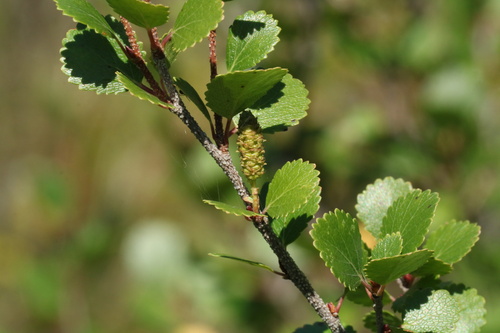
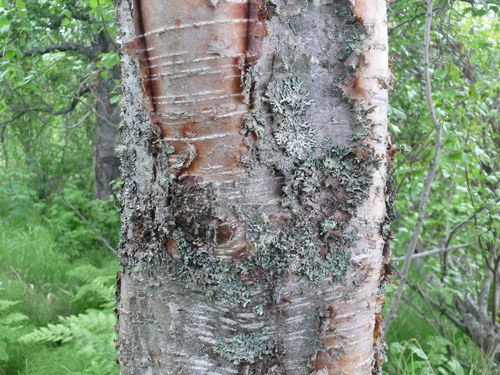
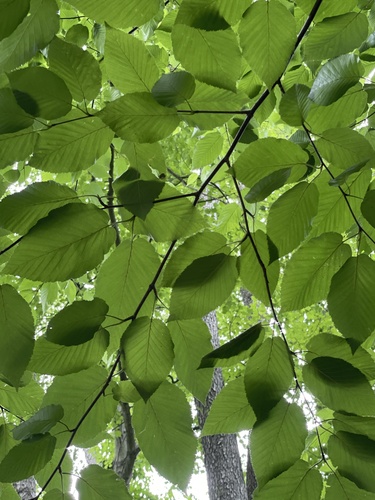
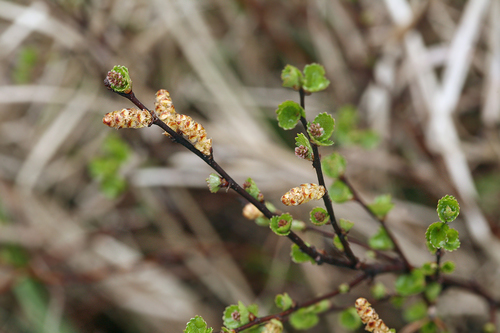
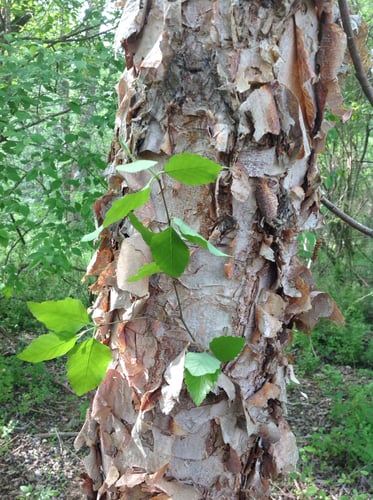
Betula pubescens var. litwinowii
(Doluch.) Asburner & McCall.
gbif· cc-by-nc
Krylenko VV
gbif· cc-by-nc
Krylenko VV
gbif· cc-by-nc
Krylenko VV
Summary
Source: WikipediaBetula pubescens (syn. Betula alba), commonly known as downy birch and also as moor birch, white birch, European white birch or hairy birch, is a species of deciduous tree, native and abundant throughout northern Europe and northern Asia, growing further north than any other broadleaf tree. It is closely related to, and often confused with, the silver birch (B. pendula), but grows in wetter places with heavier soils and poorer drainage; smaller trees can also be confused with the dwarf birch (B. nana). Six varieties are recognised and it hybridises with the silver and dwarf birches. A number of cultivars have been developed, but many are no longer in cultivation. The larva of the autumnal moth (Epirrita autumnata) feeds on the foliage and in some years, large areas of birch forest can be defoliated by this insect. Many fungi are associated with the tree and certain pathogenic fungi are the causal agents of birch dieback disease. The tree is a pioneer species, readily colonising cleared land, but later being replaced by taller, more long-lived species. The bark can be stripped off without killing the tree. The bark and the timber is used for turnery and in the manufacture of plywood, furniture, shelves, coffins, matches, toys and wood flooring. The inner bark is edible and it was ground up and used in bread-making in times of famine. The rising sap in spring can be used to make refreshing drinks, wines, ales and liqueurs and various parts of the tree have been used in herbal medicine.
Description
A temperate tree in the birch family (Betulaceae) found in Tasmania. The variety litwinowii grows to typical birch proportions and produces sap that can be consumed as juice.
Edible Uses
The tree's juice can be drunk.
Medicinal Uses
The outer layer of bark can be stripped off the tree without killing it and can be used to make canoe skins, drinking vessels and roofing tiles. The inner bark can be used for the production of rope and for making a form of oiled paper. This bark is also rich in tannin and has been used as a brown dye and as a preservative. The bark can also be turned into a high quality charcoal favoured by artists. The twigs and young branches are very flexible and make good whisks and brooms. The timber is pale in colour with a fine, uniform texture and is used in the manufacture of plywood, furniture, shelves, coffins, matches and toys, and in turnery. The Sami people of Scandinavia used the bark of both B. pubescens and B. pendula as an ingredient in bread-making; the reddish phloem, just below the outer bark, was dried, ground up and blended with wheat flour to make a traditional loaf. In Finland, mämmi, a traditional Easter food, was packed and baked in boxes of birch bark. Nowadays, cardboard boxes are used, but imprinted with the typical bark pattern. Birch bark was used as an emergency food in times of famine; in Novgorod in 1127–28, desperate people ate it along with such things as the leaves of lime trees, wood pulp, straw, husks and moss. In Iceland, trimmings of birch trees are used with birch sap in the making of a sweet birch liqueur. The removal of bark was at one time so widespread that Carl Linnaeus expressed his concern for the survival of the woodlands. The leaves can be infused with boiling water to make a tea, and extracts of the plant have been used as herbal remedies. Both B. pubescens and B. pendula can be tapped in spring to obtain a sugary fluid. This can be consumed fresh, concentrated into a syrup similar to the better-known maple syrup, or can be fermented into an ale or wine. In Scandinavia and Finland, this is done on a domestic scale, but in the former USSR, particularly Russia, Ukraine, Belarus, Estonia, Latvia and Lithuania, birch sap is harvested commercially and used to manufacture cosmetics, medicines and foodstuffs.
Distribution
It is a temperate plant. Arboretum Tasmania.
Where It Grows
Australia, Caucasica, Georgia, Tasmania,
Synonyms
Also Known As
Arq'i
References (2)
- Bussman, R. W., et al, 2016, A comparative ethnobotany of Khevsureti, Samtskhe-Javakheti, Tusheti, Svaneti, and Racha-Lechkhumi, Republic of Georgia (Sakartvelo), Caucasus. Journal of Ethnobiology and Ethnomedicine (2016) 12:4
- Bussman, R. W., et al, 2021, Unity in diversity—food plants and fungi of Sakartvelo (Republic of Georgia), Caucasus. Journal of Ethnobiology and Ethnomedicine (2021) 17:72 p 7