Cephalotaxus harringtonii
(Knight. ex J. Forbes.) K. Koch.
Japanese Plum Yew, Cowtail Pine, Plum-fruited yew
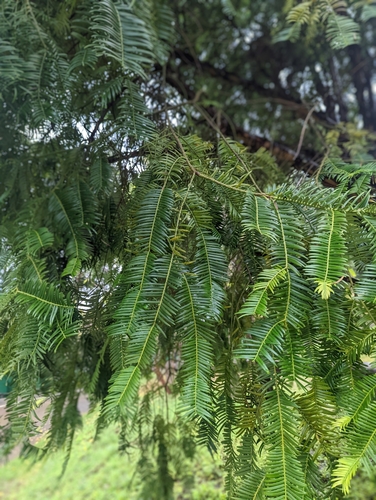
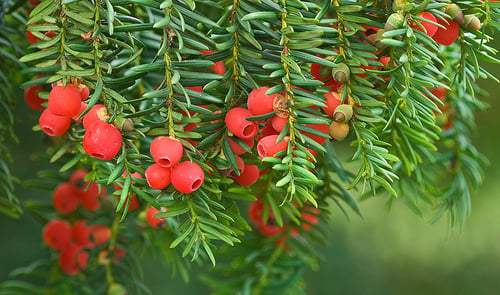
iNaturalist· cc-by-nc
(c) Blake, some rights reserved (CC BY-NC)
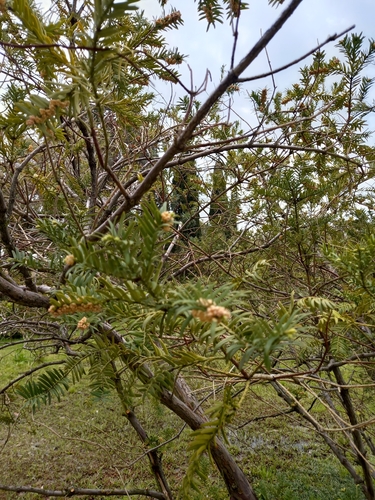
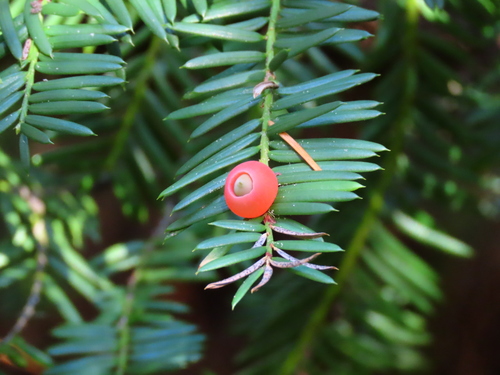
iNaturalist· cc-by-nc
(c) 羅恩至, some rights reserved (CC BY-NC)
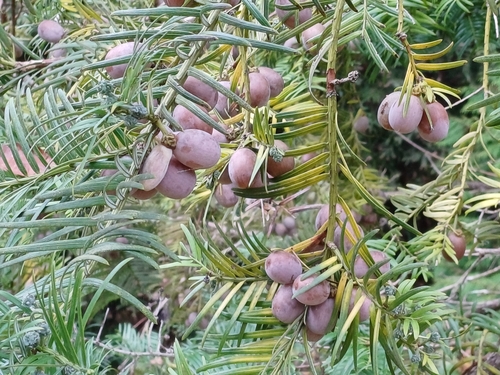
iNaturalist· cc-by-nc
(c) 羅恩至, some rights reserved (CC BY-NC)
Summary
Source: WikipediaCephalotaxus harringtonii, commonly known as Korean plum yew, Japanese plum-yew, Harrington's cephalotaxus, or cowtail pine, is a species of coniferous shrub or small tree in the family Taxaceae. It is native to East Asia, but is occasionally utilised in western gardens and several cultivars exist for these purposes. Japanese plum yew (Korean plum yew) has been in cultivation in Europe since 1829, and many modern horticulturists are familiar with this species, named in honour of Charles Stanhope, 4th Earl of Harrington, one of the first to grow the plant in a European garden, at Elvaston.
Description
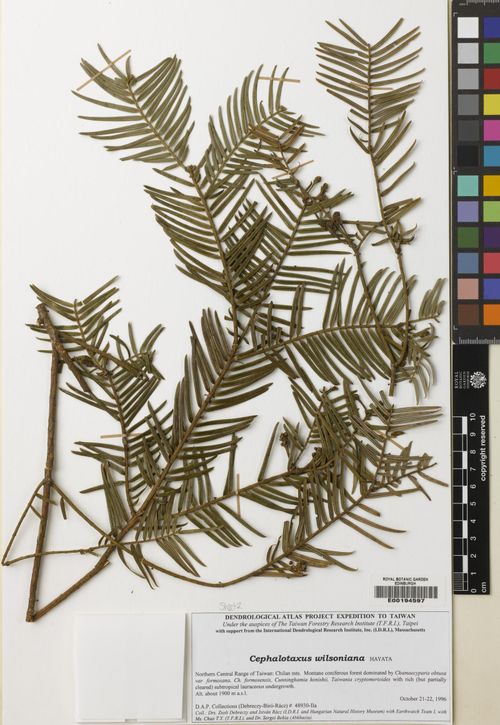
A low spreading evergreen tree. It grows 6-12 m tall. The bark is brown and flaking. The dense branches form a rounded bush like tree. The leaves are needles spread out on each side of the twigs. They curve upwards to forma V shaped trough. They have a prominent central rib. The leaves are narrow and 5 cm long by 3 mm wide. They are dark green above and pointed. They have 2 bands underneath. The male and female flowers are on separate plants. The male flowers are in the axils of leaves and the female flowers are on the tips of shoots. Male flowers are slightly larger than female flowers. The flowers are creamy white. The fruit are 2.5 cm long and oval. They are blue-green and ripen to purple-brown.
Edible Uses
The fleshy, sweet fruit is eaten fresh. Seeds are also edible.
Traditional Uses
The fleshy fruit is sweet and is eaten.
This uses section is brief — help expand it
Medicinal Uses
None mentioned.
Distribution
It grows on most soils except chalk soils. It can grow in shade. In China it grows to 900 m altitude. It suits hardiness zones 6-10. Geelong Botanical Gardens. Hobart Botanical Gardens. Melbourne Botanical Gardens.
Where It Grows
Asia, Australia, Britain, China, Europe, Korea, Japan, Tasmania, USA,
Cultivation
Plants are grown from seed. Seeds can take 2 years to germinate. It can be grown by cuttings.
Notes
There are about 10 Cephalotaxus species. Also put in the family Cephalotaxaceae.
Synonyms
Also Known As
Inu-gaya, Korean plum yew
References (19)
- Bodkin, F., 1991, Encyclopedia Botanica. Cornstalk publishing, p 238
- Bot. Mag. (Tokyo) 44:98. 1930 (As Cephalotaxus harringtonia subsp. drupacea)
- Brickell, C. (Ed.), 1999, The Royal Horticultural Society A-Z Encyclopedia of Garden Plants. Convent Garden Books. p 247
- Coombes, A.J., 2000, Trees. Dorling Kindersley Handbooks. p 34
- Cundall, P., (ed.), 2004, Gardening Australia: flora: the gardener's bible. ABC Books. p 357
Show all 19 references Hide references
- Dendrologie 2(2):102. 1873
- Etherington, K., & Imwold, D., (Eds), 2001, Botanica's Trees & Shrubs. The illustrated A-Z of over 8500 trees and shrubs. Random House, Australia. p 198
- Facciola, S., 1998, Cornucopia 2: a Source Book of Edible Plants. Kampong Publications, p 75 (As Cephalotaxus harringtonia subsp. drupacea)
- Harris, E & J., 1983, Field Guide to the Trees and Shrubs of Britain. Reader's Digest. p 227 (As Cephalotaxus harringtonia subsp. drupacea)
- Hedrick, U.P., 1919, (Ed.), Sturtevant's edible plants of the world. p 179 (As Cephalotaxus harringtonia subsp. drupacea)
- Hibbert, M., 2002, The Aussie Plant Finder 2002, Florilegium. p 63
- Hwang, HS, et al, 2014, Distribution characteristics of plant in the Ungseokbong Mountain, Gyeongsangnam-do, Korea. Journal of Asia-Pacific Biodiversity. 7(2014) e164-e178 (As Cephalotaxus koreana)
- Jackes, D. A., Edible Forest Gardens
- J. Arnold Arbor. 22:571. 1941 (As Cephalotaxus harringtonia subsp. koreana)
- Lee, Y. M., 2014, Important Plants of East Asia II: Endemic Plant Stories. East Asia Biodiversity Conservation Network p 28
- Lord, E.E., & Willis, J.H., 1999, Shrubs and Trees for Australian gardens. Lothian. p 79
- Phillips, R. & Rix, M., 2002, The Botanical Garden Vol. 1. Trees and Shrubs. MacMillan. p 20
- Plants for a Future database, The Field, Penpol, Lostwithiel, Cornwall, PL22 0NG, UK. http://www.scs.leeds.ac.uk/pfaf/ (Also as Cephalotaxus harringtonia subsp. drupacea)
- Young, J., (Ed.), 2001, Botanica's Pocket Trees and Shrubs. Random House. p 220 (Also as Cephalotaxus harringtonia subsp. drupacea)