Coscinium fenestratum
(Goetgh.) Colebr.
False calumba, Yellow vine
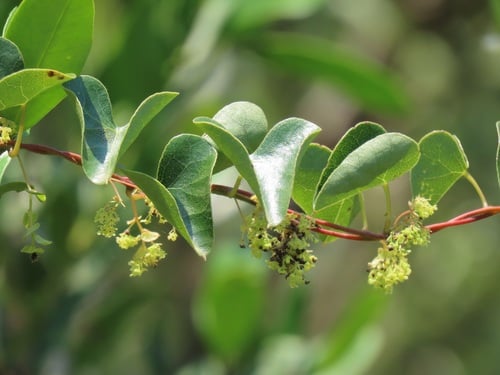
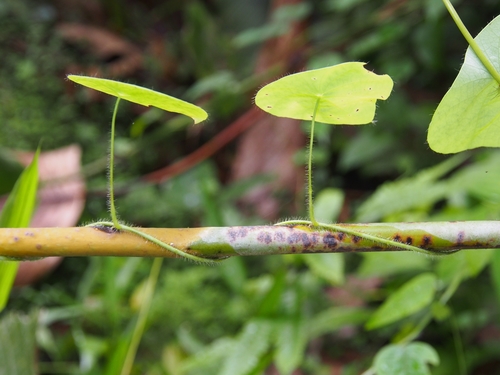
iNaturalist· cc-by-sa
(c) Vinayaraj, some rights reserved (CC BY-SA)
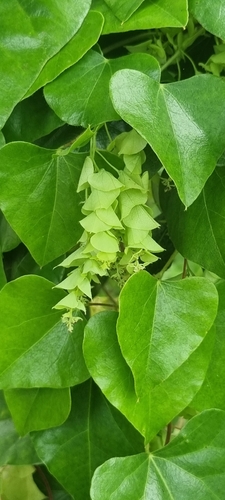
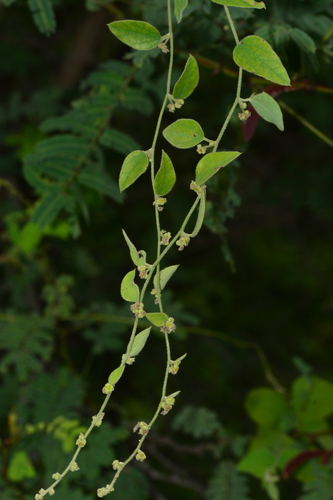
iNaturalist· cc-by-sa
(c) Vinayaraj, some rights reserved (CC BY-SA)
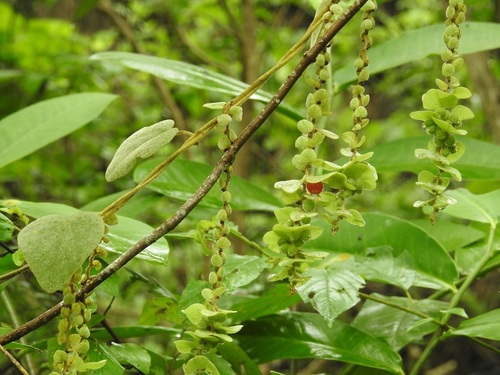
iNaturalist· cc-by-nc
(c) SunGW, some rights reserved (CC BY-NC)
Summary
Source: WikipediaCoscinium fenestratum, or yellow vine as it is sometimes referred to in English, is a flowering woody climber, native to South Asia and Mainland Southeast Asia. It is rare and critically endangered in many of its habitats. Coscinium fenestratum is a member of the family Menispermaceae and the genus Coscinium. The plant is known by many different names, such as: Tree turmeric, False calumba, Colombo weed, Venivel or Weni wel (වෙනිවැල්), Weniwelgeta (වෙනිවැල්ගැට), Baanvalgata (බාන්වැල්ගැට) (in Sinhala), Dāru Haridrā or Kāleyaka (दारुहरिद्रा, कालेयकः in Sanskrit), Mara Manjal (in Tamil and Malayalam), Haem herb (in Thai), Voer Romiet (in Khmer), etc.
Description
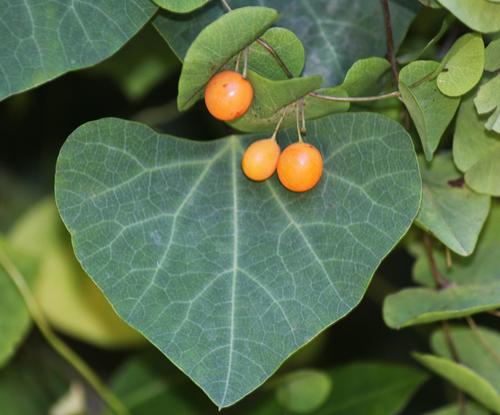
A vine or woody climber. The leaves are leathery and shiny. It has a bright yellow sap. The fruit occur as 1 or 2 fleshy fruit 2 cm across.
This description is brief — help expand it
Edible Uses
Used as a bitter tonic and flavouring.
Traditional Uses
It is used as a bitter tonic.
This uses section is brief — help expand it
Medicinal Uses
Coscinium fenestratum has a long history as a medicinal plant in the various traditional medicines of the region where it grows. This includes Ayurveda, Unani and Siddha medicine in India, Sinhala medicine in Sri Lanka, the Kru Khmer healing traditions in Cambodia, traditional Vietnamese medicine of Thuốc Nam, etc. The plant is used for a large variety of diseases and conditions, from fevers and diabetes to celiac disease and snake bites. It is unclear if all these medicinal uses of C. fenestratum are backed up by science, but laboratory tests have shown that the plant has potent bioactive properties. There is speculation that C. fenestratum might also have found a modern use in the illegal drug market industry.
Known Hazards
Because of the growing populations and industrialization of Asia, the demand for Coscinium fenestratum has increased manifold in the last decades, decimating the natural distribution of the plant dramatically. It is therefore now listed as rare and critically endangered in many of its habitats. Some of these habitats are designated as protected areas or national parks, but that has not safeguarded the plant from opportunistic gathering. Considering the entirety of C. fenestratum's range, not enough field data is available as of 2015 for any reliable assessment of its global status in the IUCN Red List. Locally however, IUCN has categorized C. fenestratum as follows: India: Critically endangered (1997, 2010, 2016) Sri Lanka: Indiscriminate (1997, 2015) Vietnam: Vulnerable (since 1997) Cambodia, Vietnam and west Malaysia: Data deficient (2015) The Indian and Sri Lankan populations of C. fenestratum are probably the most disturbed and severely affected. Over a 75 year period (three generations for this species), the plant population has been reduced by 80% due to indiscriminate gathering by local people. Hardly any mature plants are left in the wild. Experiments with cultivating Coscinium fenestratum, instead of harvesting the plant in its natural environment, is carried out at present.
Distribution
It is a tropical plant. It grows in the Western Ghats in India. It grows in deciduous and evergreen forests.
Where It Grows
Asia, Cambodia, India, Indonesia, Malaysia, SE Asia, Sri Lanka, Thailand, Vietnam,
Cultivation
A dioecious species, both male and female forms need to be grown if seed is required.
Other Uses
A yellow dye resembling turmeric is obtained from the yellow wood. It is sometimes used in combination with turmeric (Curcuma longa). The freshly cut stems can be made into a strong rope by twisting them.
Production
In India it flowers and fruits August to October. Plants can live for 25 years.
Notes
It is used as medicine. Due to over-harvesting it is an endangered species.
Synonyms
Also Known As
Colombo weed, Daru haridra, Haem herb, Mara manjal, Tree turmeric, Vor romiet, Weniwel
References (3)
- Encyclopedia of Life.
- Wiersema, J. H. & Leon, B., 2013, World Economic Plants. A Standard Reference CRC Press. 2nd Ed. p 205
- World Checklist of Useful Plant Species 2020. Royal Botanic Gardens, Kew