Commiphora pyracanthoides
Engl.
Common corkwood, Firethorn corkwood
iNaturalist· cc-by
(c) Wynand Uys, some rights reserved (CC BY)
iNaturalist· cc-by
(c) Wynand Uys, some rights reserved (CC BY)
iNaturalist· cc-by
(c) Wynand Uys, some rights reserved (CC BY)
Description
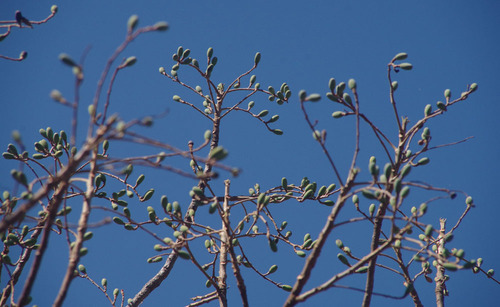
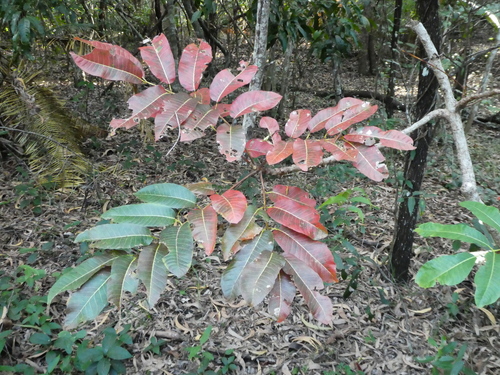
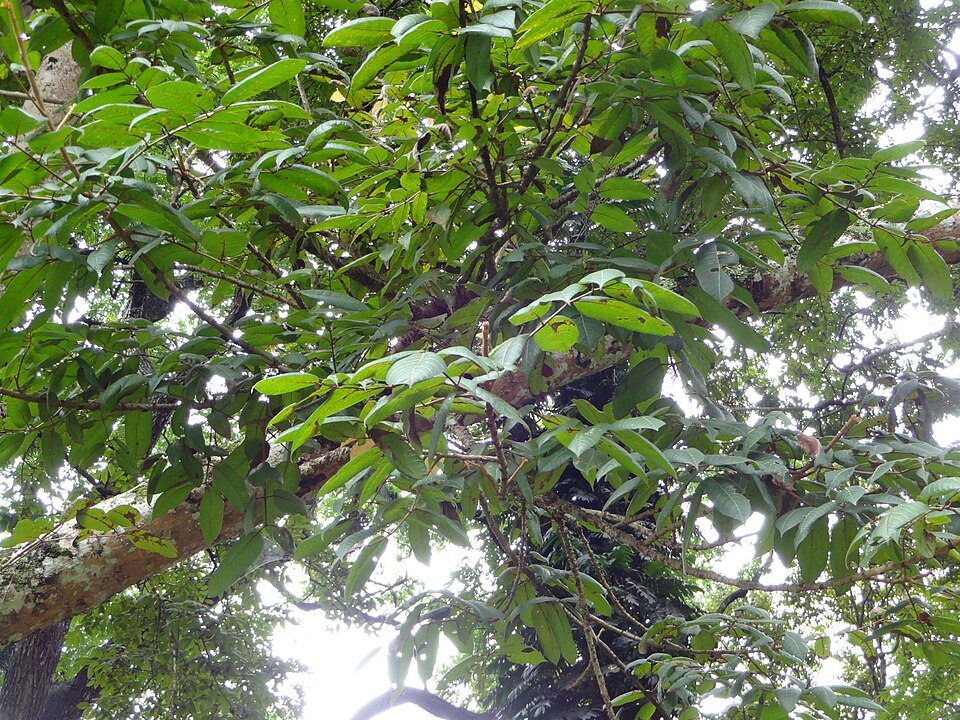
A sprawling, spiny shrub. It grows to 8 m high. The bark is grey, green, yellow or red and flakes in small papery strips. The leaves are clustered on short spiny branches. The leaves are compound but have a single leaflet. It is narrowly oval and 7.5 cm long by 3.2 cm wide. They are bright green above and paler underneath. The flowers are small and pink. They are in clusters on very small branches. The fruit are oval and about 10 mm long. The stone has a 3 or 4 armed false seed layer.
Edible Uses
The gum is eaten despite its bitter taste. The roots are chewed for their sweet, fresh water content.
Traditional Uses
The gum is bitter but eaten. The roots are chewed for the sweet, fresh water. Caution: The fruit is not edible and can irritate the mouth.
This uses section is brief — help expand it
Known Hazards
The fruit is not edible and can irritate the mouth.
Distribution
A tropical plant. It occurs at low altitudes in dry woodland. It grows in areas with a rainfall below 100 mm per year. It can tolerate frost. It suits hot arid areas. It grows on sandy or stony soils often over limestone rocks. It can tolerate drought. It grows between 150-1,800 m above sea level. It can grow in arid places.
Where It Grows
Africa, Angola, Botswana, Central Africa, East Africa, Eswatini, Malawi, Mozambique, Namibia, South Africa, Southern Africa, Swaziland, Zambia, Zimbabwe,
Cultivation
It can be cut back and will re-grow.
Notes
There are about 165 Commiphora species.
Nutrition
| Part | Moisture | kJ | kcal | Protein | Vit A | Vit C | Iron | Zinc |
|---|---|---|---|---|---|---|---|---|
| Roots | 81 | — | — | — | — | — | 0.8 | 0.4 |
Synonyms
Also Known As
Common commiphora, Gewone kanniedood, Mubwabwa, Mukwendewende, Munyera, Mutchove, Muwowo, Seroka
References (22)
- Exell, A.W. et al, (Ed), 1963, Flora Zambesiaca Vol 2 Part 1 Crown Agents, London. p 268
- Arnold, T.H., Wells, M.J. & Wehmeyer, A.S., Khoisan food plants: taxa with potential for future economic exploitation, in Wickens, G.E., Goodin, J.R., and Field, D.V.,(Eds.) 1985, Plants for Arid Lands. Unwin Hyman, London, p 73
- Fowler, D. G., 2007, Zambian Plants: Their Vernacular Names and Uses. Kew. p 15
- Fox, F. W. & Young, M. E. N., 1982, Food from the Veld. Delta Books. p 140
- Grivetti, L. E., 1980, Agricultural development: present and potential role of edible wild plants. Part 2: Sub-Saharan Africa, Report to the Department of State Agency for International Development. p 73
Show all 22 references Hide references
- Long, C., 2005, Swaziland's Flora - siSwati names and Uses http://www.sntc.org.sz/flora/
- Palgrave, K.C., 1996, Trees of Southern Africa. Struik Publishers. p 369
- Palmer & Pitman, 1972,
- Peters, C. R., O'Brien, E. M., and Drummond, R.B., 1992, Edible Wild plants of Sub-saharan Africa. Kew. p 73
- Roodt, V., 1998, Trees & Shrubs of the Okavango Delta. Medicinal Uses and Nutritional value. The Shell Field Guide Series: Part 1. Shell Botswana. p 193
- Royal Botanic Gardens, Kew (1999). Survey of Economic Plants for Arid and Semi-Arid Lands (SEPASAL) database. Published on the Internet; http://www.rbgkew.org.uk/ceb/sepasal/internet [Accessed 5th April 2011]
- Ruiters-Welcome, A. K., 2019, Food plants of southern Africa. Ph.D. thesis. Univ. of Johannesburg p 41
- Scudder, 1971,
- Silberbauer, 1981,
- Story, 1958,
- Swaziland's Flora Database http://www.sntc.org.sz/flora
- van Wyk, B, van Wyk, P, and van Wyk B., 2000, Photographic guide to Trees of Southern Africa. Briza. p 100
- van Wyk, Be., & Gericke, N., 2007, People's plants. A Guide to Useful Plants of Southern Africa. Briza. p 84
- Wehmeyer, A. S, 1986, Edible Wild Plants of Southern Africa. Data on the Nutrient Contents of over 300 species
- Welcome, A. K. & Van Wyk, B.-E., 2019, An inventory and analysis of the food plants of southern Africa. South African Journal of Botany 122 (2019) 136–179
- World Checklist of Useful Plant Species 2020. Royal Botanic Gardens, Kew
- www.zimbabweflora.co.zw 2011