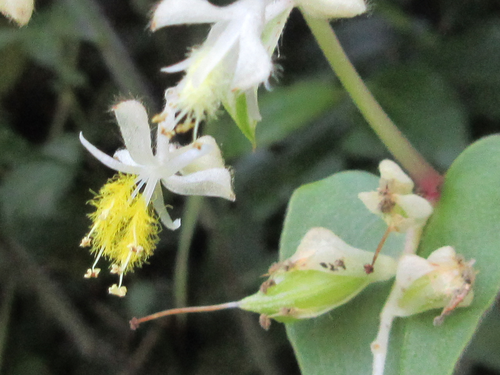
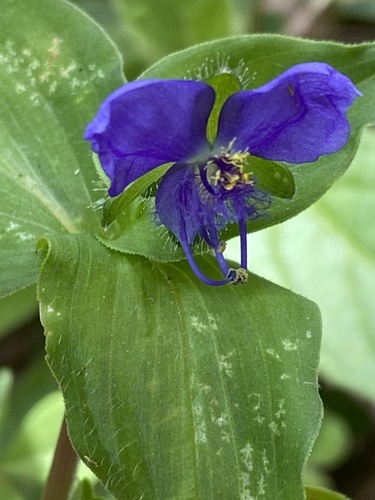
Commelina coelestis
Willd.
Blue spider wort
iNaturalist· cc-by-nc
(c) Francisco Ortiz Navarro, some rights reserved (CC BY-NC)
iNaturalist· cc-by-nc
(c) Francisco Ortiz Navarro, some rights reserved (CC BY-NC)
iNaturalist· cc-by-nc
(c) Francisco Ortiz Navarro, some rights reserved (CC BY-NC)
Summary
Source: WikipediaA compact perennial reaching 50cm tall and 30cm wide, hardy to UK zone 9. Produces hermaphroditic flowers from July to September with seed ripening August to October. Thrives in light, well-drained sandy soil with neutral to mildly alkaline pH. Requires full sun and tolerates both drought and moist conditions.
Description
A herb. It keeps growing from year to year. It develops a clump of finger shaped roots. It grows 40-70 cm tall. The flowers are blue.
This description is brief — help expand it
Edible Uses
The tubers are edible when cooked and are starchy in texture. The plant produces a clump of thin, finger-shaped roots approximately 7–10 cm long that are easy to harvest, though overall yields are low. The flavour is fairly bland with an acceptable texture — not a standout root crop, but suitable in small quantities.
Traditional Uses
The rhizomes or underground stems are used as food.
This uses section is brief — help expand it
Medicinal Uses
None known
Distribution
A tropical plant. Once established it can tolerate drought. In Guatemala it grows between 900-3,500 m above sea level.
Where It Grows
Asia, Central America, El Salvador, Guatemala, Honduras, India, Mexico*, North America,
Cultivation
Plants can be grown from seed. Seed germinate in 4-5 weeks at 20°C. They are transplanted when young. They can also be grown by division. It can be grown from cuttings that root easily.
Propagation
Seed — sow in March in a greenhouse. Germination usually takes 4–5 weeks at 20°C. Prick seedlings into individual pots as soon as they are large enough to handle and plant out in late spring or early summer after the last expected frosts. Division in early spring: the root clump consists of finger-shaped roots joined at their tops, and each division must include at least one growing bud at the top. Pot up divisions and grow on in a greenhouse or cold frame until established, then plant out in late spring after the last expected frosts. Cuttings taken during the growing season root very easily.
Other Uses
None known
Notes
There are about 230 Commelina species.
Synonyms
References (3)
- Enum. pl. 1:69. 1809
- Hedrick, U.P., 1919, (Ed.), Sturtevant's edible plants of the world. p 213
- Plants for a Future database, The Field, Penpol, Lostwithiel, Cornwall, PL22 0NG, UK. http://www.scs.leeds.ac.uk/pfaf/