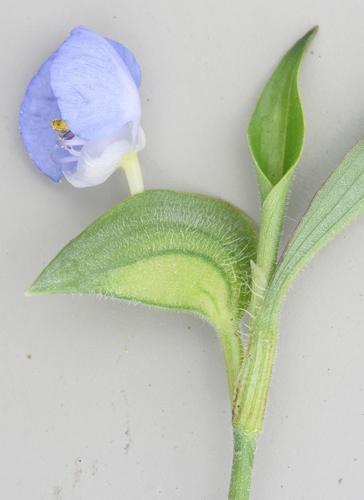
Cyanotis speciosa
(L. f.) Hassk.
Doll's powder puff
iNaturalist· cc-by-nc
(c) Sally Adam, some rights reserved (CC BY-NC), uploaded by Sally Adam
iNaturalist· cc-by-nc
(c) Gigi Laidler, some rights reserved (CC BY-NC)
Description
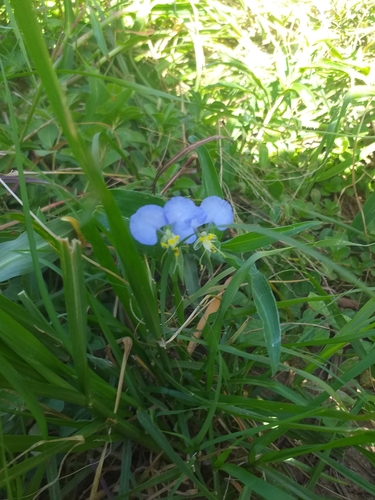
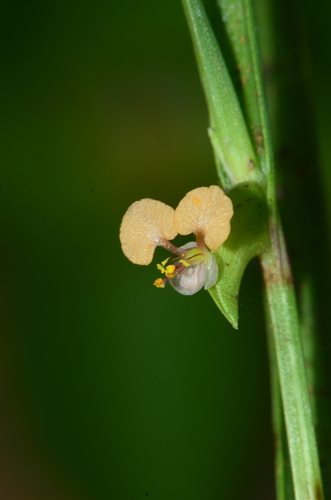
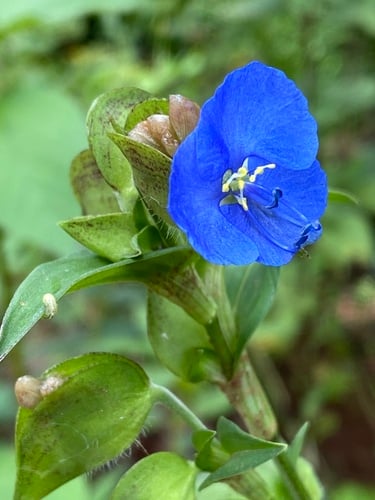
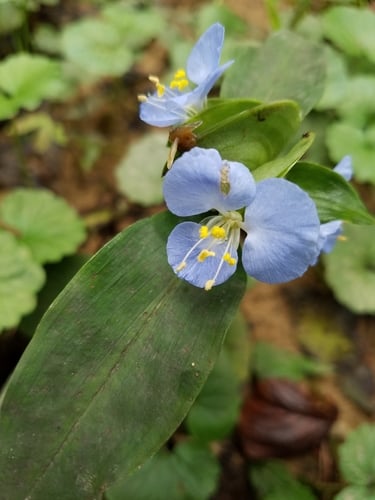
A herb. It keeps growing from year to year. The leaves are in rings near the base. They are 20 cm long and 1 cm wide. The flowering stems are slender and 60 cm long. The uppermost leaves on these stems have dense compact flowers in their axils. The flower petals are violet or blue. The anthers are right yellow.
Edible Uses
The leaves are eaten raw or cooked. It is used as a famine food, though it has average palatability.
Traditional Uses
The leaves are eaten raw or cooked.
This uses section is brief — help expand it
Distribution
A subtropical plant. It grows in hot arid places. It grows in places with a marked dry season. It grows between 10-2,316 m above sea level. It can grow in arid places.
Where It Grows
Africa, Botswana, East Africa, Eswatini, Lesotho, Madagascar, Mozambique, Namibia, South Africa, Southern Africa, Swaziland, Tanzania, Zambia, Zimbabwe,
Other Information
It is a famine food. It is of average palatability.
Synonyms
Also Known As
Hotekao, Inginga, Inkombo, Insonga, Kitija, Nkongo, Udabulamafi
References (10)
- Fox, F. W. & Young, M. E. N., 1982, Food from the Veld. Delta Books. p 158
- Grivetti, L. E., 1980, Agricultural development: present and potential role of edible wild plants. Part 2: Sub-Saharan Africa, Report to the Department of State Agency for International Development. p 49
- Jardin, C., 1970, List of Foods Used In Africa, FAO Nutrition Information Document Series No 2.p 73
- Long, C., 2005, Swaziland's Flora - siSwati names and Uses http://www.sntc.org.sz/flora/
- Martin, F.W. & Ruberte, R.M., 1979, Edible Leaves of the Tropics. Antillian College Press, Mayaguez, Puerto Rico. p 183 (As Cyanotis nodiflora)
Show all 10 references Hide references
- Royal Botanic Gardens, Kew (1999). Survey of Economic Plants for Arid and Semi-Arid Lands (SEPASAL) database. Published on the Internet; http://www.rbgkew.org.uk/ceb/sepasal/internet [Accessed 10th April 2011]
- Ruiters-Welcome, A. K., 2019, Food plants of southern Africa. Ph.D. thesis. Univ. of Johannesburg p 45
- Swaziland's Flora Database http://www.sntc.org.sz/flora
- Welcome, A. K. & Van Wyk, B.-E., 2019, An inventory and analysis of the food plants of southern Africa. South African Journal of Botany 122 (2019) 136–179
- World Checklist of Useful Plant Species 2020. Royal Botanic Gardens, Kew