Pittosporum spinescens
(F. Muell.) L. W. Cayzer, Crisp & I. Telford
Orange-thorn, Native orange, Wallaby apple, Large-fruited orange thorn
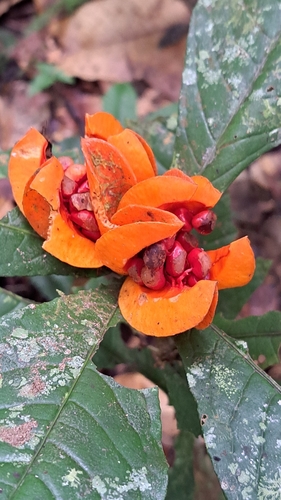
iNaturalist· cc-by-nc
(c) Bruce McLennan, some rights reserved (CC BY-NC), uploaded by Bruce McLennan
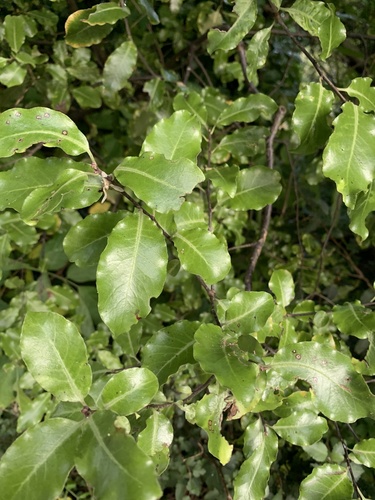
iNaturalist· cc-by-nc
(c) chris_barnesoz, some rights reserved (CC BY-NC)
iNaturalist· cc-by-nc
(c) e-mma, some rights reserved (CC BY-NC)
Summary
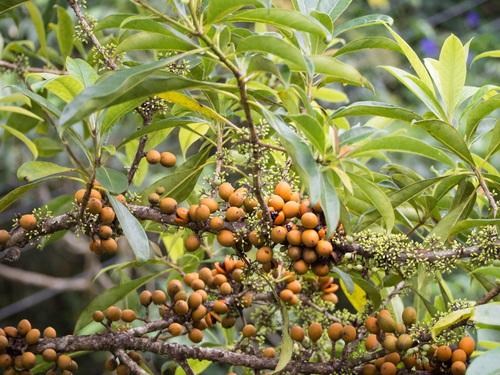
Source: WikipediaPittosporum spinescens is a shrub native to woodlands and dry rainforest of Northern and Eastern Australia and New Guinea. Growing to 7m tall with small leaves clustered on short branches that often terminate in a sharp point. The plant produced edible fruits, 2–3 cm in diameter. It is commonly known as wallaby apple, orange thorn or thorn orange. P. spinescens is very similar in appearance to the closely related Pittosporum multiflorum, but is readily distinguished by its entire leaf margins, in contrast to the toothed leaf margins of the latter.
Description
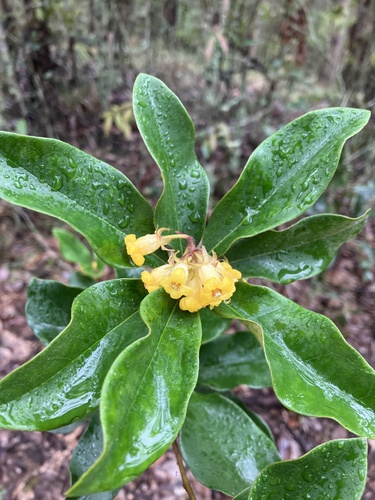
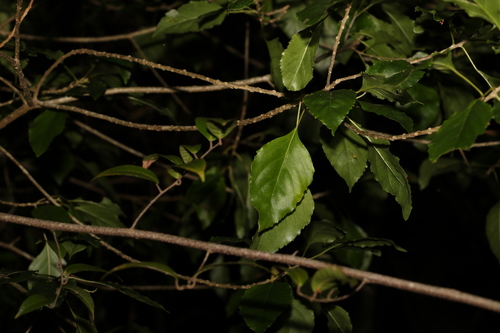
A medium sized shrub. It grows 2-5 m tall and spreads 1-1.5 m wide. The branches are hairy and have thorns. The leaves are oval and green and shiny. The leaves can have lobes and be feather like. They are 1-3 cm long. The flowers are white and about 0.6 cm across. They occur singly in the axils of leaves. The fruit are berries. They are orange and have a thick skin. They are 1.5-2.5 cm across. The seeds are small and in a sticky pulp.
Edible Uses
Fruit - raw. A crunchy texture with a mild, slightly sweet flavour. The orange, globose fruit can be 15 - 50mm in diameter.
Distribution
A tropical plant. It grows near rivers and the coast. It grows from sea level to 1,200 m above sea level. It grows as an understorey plant on alluvial soils. It is best in a rich well-composted soil. It is resistant to frost but damaged by drought. It grows in moist scrubs in Queensland and New South Wales in Australia. Geelong Botanical Gardens.
Where It Grows
Australia*, Indonesia, Pacific, Papua New Guinea, PNG, SE Asia,
Cultivation
Plants are grown from fresh seeds or from tip cuttings. It can be used as a hedge.
Propagation
Seed - it germinates well if sown fresh. Division of offshoots.
Other Uses
The wood is a light uniform yellowish colour; it is close-grained, hard and takes a good polish. The plants dense growth habit and thorns make it suitable for growing as a barrier hedge.
Other Information
The fruit are not attractive.
Synonyms
References (13)
- Anon., 2003, Native Plants for the Fitzroy basin. Society for Growing Australian Plants Inc. (Rockhampton Branch) p 72
- Bodkin, F., 1991, Encyclopedia Botanica. Cornstalk publishing, p 260
- Cooper, W. and Cooper, W., 2004, Fruits of the Australian Tropical Rainforest. Nokomis Editions, Victoria, Australia. p 401
- Cribb, A.B. & J.W., 1976, Wild Food in Australia, Fontana. p 25
- Hedrick, U.P., 1919, (Ed.), Sturtevant's edible plants of the world. p 194 (As Citriobatus sp.)
Show all 13 references Hide references
- Heywood, V.H., Brummitt, R.K., Culham, A., and Seberg, O., 2007, Flowering Plant Families of the World. Royal Botanical Gardens, Kew. p 256 (Genus)
- Melzer, R. & Plumb, J., 2011, Plants of Capricornia. Belgamba, Rockhampton. p 273
- Paczkowska, G . & Chapman, A.R., 2000, The Western Australian Flora. A Descriptive Catalogue. Western Australian Herbarium. p 456
- Townsend, K., 1994, Across the Top. Gardening with Australian Plants in the tropics. Society for Growing Australian Plants, Townsville Branch Inc. p 134
- Wheeler, J.R.(ed.), 1992, Flora of the Kimberley Region. CALM, Western Australian Herbarium, p 278
- Williams, J.B., Harden, G.J., and McDonald, W.J.F., 1984, Trees and shrubs in rainforests of New South Wales and Southern Queensland. Univ. of New England, Armidale. p 50
- www.tradewindsfruit.com
- Young, P.A.R., 1991, Rainforest Guide. Brisbane Forest Park. p 20