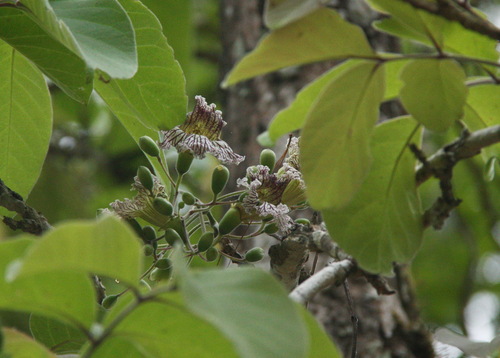
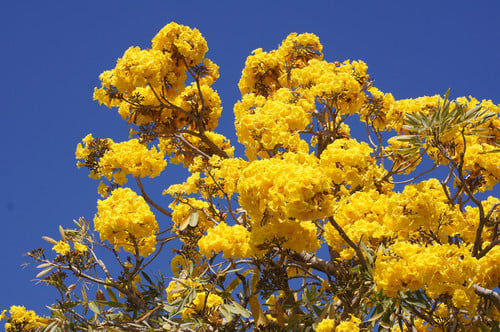
Pyrostegia venusta
(Ker Gawl.) Miers
Flaming trumpet, Flame vine, Golden shower creeper
iNaturalist· cc-by-nc
(c) Geovane Siqueira, some rights reserved (CC BY-NC), uploaded by Geovane Siqueira
iNaturalist· cc-by-sa
(c) alessandradalia, some rights reserved (CC BY-SA)
iNaturalist· cc-by-nc-sa
(c) Belinda Lo, some rights reserved (CC BY-NC-SA)
Summary
Source: WikipediaPyrostegia venusta, also commonly known as flamevine or orange trumpet vine, is a plant species of the genus Pyrostegia of the family Bignoniaceae originally native to southern Brazil, Bolivia, northeastern Argentina and Paraguay; today, it is also a widely cultivated garden species.
Description
A woody vine. It is fast growing and keeps its leaves throughout the year. The leaves are compound with 2 or 3 oval leaflets. The leaves are in opposite pairs along the stem. The central leaflet can be a coiled tendril. The flowers are reddish-orange. They are tube shaped and 9 cm long. They are in clusters or 15-20 at the tips of the branches. The flower clusters often hang down. The fruit are slender dry capsules about 25 cm long.
Edible Uses
The flowers are edible.
Medicinal Uses
The sap extracted from the stem is used to treat coughs. The plant is said to be tonic and antidiuretic. It is used as a general tonic and also for the treatment of conditions such as diarrhoea, dysentery, leucoderma and vitiligo, as well as common diseases of the respiratory tract, such as bronchitis, flu, and cold. The plant contais various medicinally active compounds, including terpenoids, alkaloids, tannins, steroids, and saponins. Plant extracts have shown significant antioxidant activity due to the flavonoids and b-carotene, and the plant is of potential use as a natural antioxidant and scavenger of free radicals.. Studies support the usefulness of the plant in traditional therapies for treating disorders like flu and colds, that induce sickness behaviors. An extract of the plant has shown potent wound healing capacity as shown by wound contraction and increased tensile strength of the skin.
Distribution
It is a tropical plant. It grows in disturbed semi-evergreen forests in full sun and well-drained soils up to 1,300 m above sea level. In Yunnan
Where It Grows
Argentina, Asia, Bolivia, Brazil*, China, Dominican Republic, India, Indonesia, Myanmar, Paraguay, SE Asia, South America*, St Helena, West Indies,
Cultivation
It can be grown by stem cuttings and layering.
Propagation
Seed - Cuttings of half-ripe wood, 2 - 3 nodes long. Layering Suckers.
Other Uses
Capable of covering everything that can offer a good support, the plant can quickly produce an effective screen. Heavy or frequent pruning is needed to restrain it to trellises or arbors, but the brilliant flower display makes this extra work worth the effort. It is ideal for covering fences but will often produce most of the flowers and foliage at the top of the fence. Regularly heading back several of the stems can help develop some of the flowers and foliage on the lower and middle portions of the fence.
Synonyms
Also Known As
Akar hujan emas, Akar trompet emas, Kyet-thon-pyu-nwe, Shwe-let-chaung, Shwe-zizawa, Tanga pu
References (1)
- Liu, Yi-tao, & Long, Chun-Lin, 2002, Studies on Edible Flowers Consumed by Ethnic Groups in Yunnan. Acta Botanica Yunnanica. 24(1):41-56