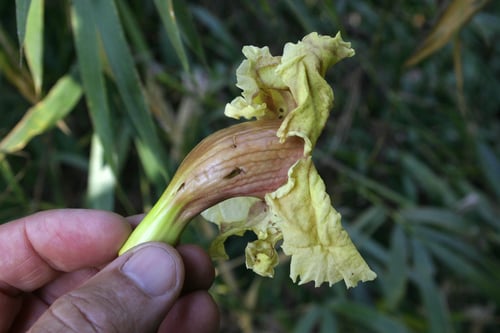
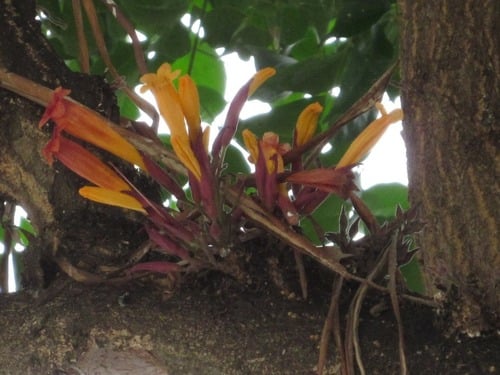
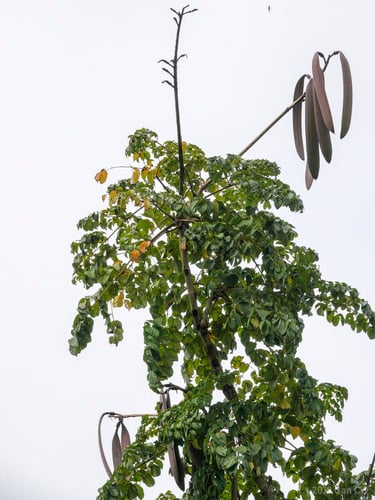
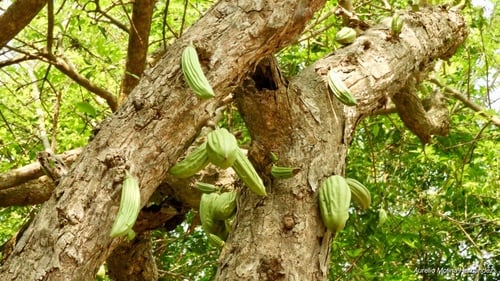
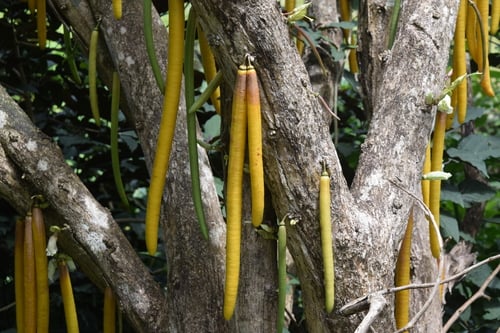
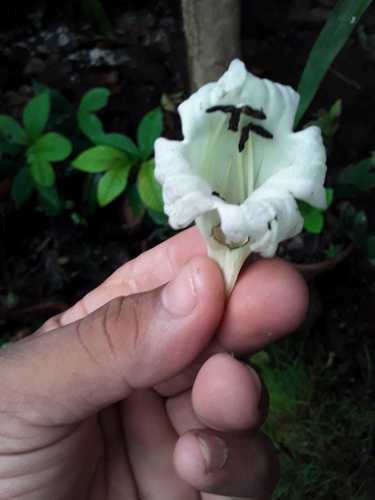
Millingtonia hortensis
L.f.
Tree jasmine, Indian cork tree
iNaturalist· cc-by-nc
(c) Cheongweei Gan, some rights reserved (CC BY-NC), uploaded by Cheongweei Gan
iNaturalist· cc-by-sa
(c) J.M.Garg, some rights reserved (CC BY-SA)
Description
A tree. It grows 18-25 m tall. The leaves have leaflets along the stalk and one at the end. The leaves are 40-100 cm long. The leaflets are narrowly oval and 5-7 cm long by 2-4 cm wide. The base is rounded and they taper to the tip.
Edible Uses
The tree is considered ornamental and the pleasant fragrance of the flowers renders it ideal as a garden tree. The wood is also used as timber and the bark is used as an inferior substitute for cork. The leaves are also used as a cheap substitute for tobacco in cigarettes.
Distribution
It is a tropical plant. It grows on slopes at low altitudes between 500-1,200 m above sea level. In XTBG Yunnan.
Where It Grows
Africa, Andamans, Asia, Cambodia, China, East Timor, Ghana, India, Indochina, Indonesia, Laos, Malaysia, Maldives, Myanmar, SE Asia, Thailand, Timor-Leste, Vietnam, West Africa,
Cultivation
Plants can be grown from cuttings.
Notes
The leaves are used as a tobacco substitute. It has medicinal uses. There is only one Millingtonia species.
Synonyms
Also Known As
Angkea bos, Egayit, Fonimaa, Mai-long-ka-hkam, Pohon melati, Sum-tung-hpraw
References (6)
- Anderson, E. F., 1993, Plants and people of the Golden Triangle. Dioscorides Press. p 215
- Benvenuti, S. & Mazzoncini, M., 2021, The Biodiversity of Edible Flowers: Discovering New Tastes and New Health Benefits. Frontiers in Plant Science Article 569499.
- Kachenchart, B., et al, 2008, Phenology of Edible Plants at Sakaerat Forest. In Proceedings of the FORTROP II: Tropical Forestry Change in a Changing World. Bangkok, Thailand.
- Kaewjampa, N., et al, 2014, Investigation Species of Edible Tree and Medicinal Plants in Faculty of Agriculture, Khon Kaen University. International Journal of Environmental and Rural Development (2014) 5-1
- Khumgratok, S., Edible Plants in Cultural Forests of Northeastern Thailand. Mahasarakham University Thailand.
Show all 6 references Hide references
- Sujanapal, P., & Sankaran, K. V., 2016, Common Plants of Maldives. FAO & Kerala FRI, p 174